Timothy K. Kuhner – författare
Visar alla böcker från författaren Timothy K. Kuhner. Handla med fri frakt och snabb leverans.
5 produkter
5 produkter
1 365 kr
Skickas inom 7-10 vardagar
As of the latest national elections, it costs approximately $1 billion to become president, $10 million to become a Senator, and $1 million to become a Member of the House. High-priced campaigns, an elite class of donors and spenders, superPACs, and increasing corporate political power have become the new normal in American politics. In Capitalism v. Democracy, Timothy Kuhner explains how these conditions have corrupted American democracy, turning it into a system of rule that favors the wealthy and marginalizes ordinary citizens. Kuhner maintains that these conditions have corrupted capitalism as well, routing economic competition through political channels and allowing politically powerful companies to evade market forces. The Supreme Court has brought about both forms of corruption by striking down campaign finance reforms that limited the role of money in politics. Exposing the extreme economic worldview that pollutes constitutional interpretation, Kuhner shows how the Court became the architect of American plutocracy. Capitalism v. Democracy offers the key to understanding why corporations are now citizens, money is political speech, limits on corporate spending are a form of censorship, democracy is a free market, and political equality and democratic integrity are unconstitutional constraints on money in politics. Supreme Court opinions have dictated these conditions in the name of the Constitution, as though the Constitution itself required the privatization of democracy. Kuhner explores the reasons behind these opinions, reveals that they form a blueprint for free market democracy, and demonstrates that this design corrupts both politics and markets. He argues that nothing short of a constitutional amendment can set the necessary boundaries between capitalism and democracy.
339 kr
Skickas inom 10-15 vardagar
As of the latest national elections, it costs approximately $1 billion to become president, $10 million to become a Senator, and $1 million to become a Member of the House. High-priced campaigns, an elite class of donors and spenders, superPACs, and increasing corporate political power have become the new normal in American politics. In Capitalism v. Democracy, Timothy Kuhner explains how these conditions have corrupted American democracy, turning it into a system of rule that favors the wealthy and marginalizes ordinary citizens. Kuhner maintains that these conditions have corrupted capitalism as well, routing economic competition through political channels and allowing politically powerful companies to evade market forces. The Supreme Court has brought about both forms of corruption by striking down campaign finance reforms that limited the role of money in politics. Exposing the extreme economic worldview that pollutes constitutional interpretation, Kuhner shows how the Court became the architect of American plutocracy. Capitalism v. Democracy offers the key to understanding why corporations are now citizens, money is political speech, limits on corporate spending are a form of censorship, democracy is a free market, and political equality and democratic integrity are unconstitutional constraints on money in politics. Supreme Court opinions have dictated these conditions in the name of the Constitution, as though the Constitution itself required the privatization of democracy. Kuhner explores the reasons behind these opinions, reveals that they form a blueprint for free market democracy, and demonstrates that this design corrupts both politics and markets. He argues that nothing short of a constitutional amendment can set the necessary boundaries between capitalism and democracy.
1 085 kr
Skickas inom 7-10 vardagar
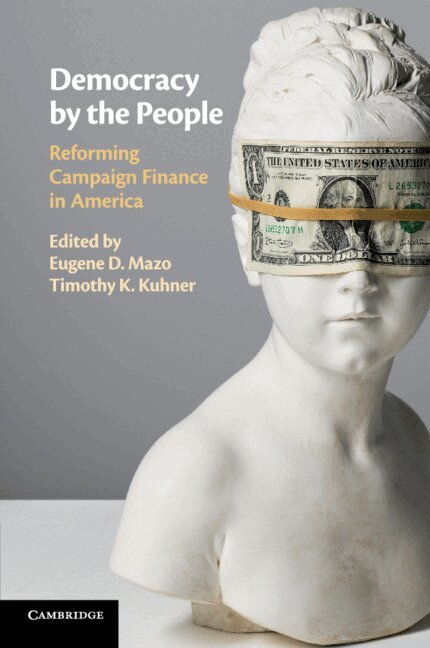
Thanks to a series of recent US Supreme Court decisions, corporations can now spend unlimited sums to influence elections, Super PACs and dark money groups are flourishing, and wealthy individuals and special interests increasingly dominate American politics. Despite the overwhelming support of Americans to fix this broken system, serious efforts at reform have languished. Campaign finance is a highly intricate and complex area of the law, and the current system favors the incumbent politicians who oversee it. This illuminating book takes these hard realities as a starting point and offers realistic solutions to reform campaign finance. With contributions from more than a dozen leading scholars of election law, it should be read by anyone interested in reclaiming the promise of American democracy.
515 kr
Skickas inom 7-10 vardagar
Thanks to a series of recent US Supreme Court decisions, corporations can now spend unlimited sums to influence elections, Super PACs and dark money groups are flourishing, and wealthy individuals and special interests increasingly dominate American politics. Despite the overwhelming support of Americans to fix this broken system, serious efforts at reform have languished. Campaign finance is a highly intricate and complex area of the law, and the current system favors the incumbent politicians who oversee it. This illuminating book takes these hard realities as a starting point and offers realistic solutions to reform campaign finance. With contributions from more than a dozen leading scholars of election law, it should be read by anyone interested in reclaiming the promise of American democracy.
140 kr
Skickas inom 7-10 vardagar
Democracy is being destroyed by an ancient evil, and modernity is in denial. In the Tyranny of Greed, Timothy K. Kuhner reveals the United States to be a government by and for the wealthy, with Trump—the spirit of infinite greed—at its helm. Taking readers on a tour through evolutionary biology, psychology, and biblical sources, Kuhner explores how democracy emerged from religious and revolutionary awakenings. He argues that to overcome Trump's regime and establish real democracy, we must reconnect with that radical heritage. Our political tradition demands a revolution against corruption.