Tommy Bengtsson - Böcker
Visar alla böcker från författaren Tommy Bengtsson. Handla med fri frakt och snabb leverans.
11 produkter
11 produkter
1 539 kr
Skickas inom 3-6 vardagar
Malthus's Essay on the Principle of Population has for the past two centuries been a constant source of inspiration and debate for scholars working on relationships between population and economy in historical perspective. This book of collected essays–an outcome of an A-session held at the 12th International Congress of Economic History in Madrid, 1998–sets a new standard in this active and influential field of research. The contributors go beyond the conventional European and North American geographical boundaries, bringing out new empirical findings and developing new arguments. The volume is divided into three parts. The first section takes up classical issues, the 'positive' and the 'preventive' checks and their determinants, raised by Malthus himself, and examines the issues against fresh evidence from Europe, America, and Asia. These issues are also themes of the second part, devoted to short-term fluctuations in mortality and fertility in relation to prices, wages, and other economic indicators. The final set of chapters is a coherent collection of technically sophisticated articles from an on-going international joint project concerned with how households respond to economic stress in different economic, social and cultural settings, in traditional China, Japan, Sweden, Belgium and Italy. With a brief but well organized introduction, this collection of scholarly essays offers both demographers and economic historians a wealth of exciting findings and stimulating insights.
Living Standards in the Past
New Perspectives on Well-Being in Asia and Europe
Inbunden, Engelska, 2005
3 325 kr
Skickas inom 5-8 vardagar
Why did Europe experience industrialisation and modern economic growth before China, India or Japan? This is one of the most fundamental questions in Economic History and one that has provoked intense debate. The main concern of this book is to determine when the gap in living standards between the East and the West emerged. The established view, dating back to Adam Smith, is that the gap emerged long before the Industrial Revolution, perhaps thousands of years ago. While this view has been called into question - and many of the explanations for it greatly undermined - the issue demands much more empirical research than has yet been undertaken. How did the standard of living in Europe and Asia compare in the seventeenth and eighteenth centuries? The present book proposes an answer by considering evidence of three sorts. The first is economic, focusing on income, food production, wages, and prices. The second is demographic, comparing heights, life expectancy and other demographic indicators. The third combines the economic and demographic by investigating the demographic vulnerability to short-term economic stress.The contributions show the highly complex and diverse pattern of the standard of living in the pre-industrial period. The general picture emerging is not one of a great divergence between East and West, but instead one of considerable similarities. These similarities not only pertain to economic aspects of standard of living but also to demography and the sensitivity to economic fluctuations. In addition to these similarities, there were also pronounced regional differences within the East and within the West - regional differences that in many cases were larger than the average differences between Europe and Asia. This clearly highlights the importance of analysing several dimensions of the standard of living, as well as the danger of neglecting regional, social, and household specific differences when assessing the level of well-being in the past.
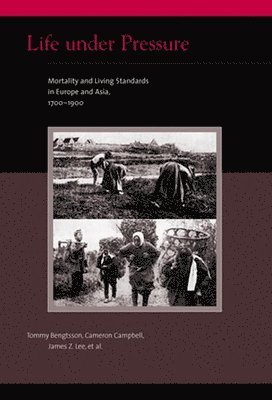
Life under Pressure
Mortality and Living Standards in Europe and Asia, 1700-1900
Häftad, Engelska, 2009
384 kr
Skickas inom 5-8 vardagar
651 kr
Skickas inom 5-8 vardagar
705 kr
Skickas inom 5-8 vardagar
1 095 kr
Skickas inom 10-15 vardagar
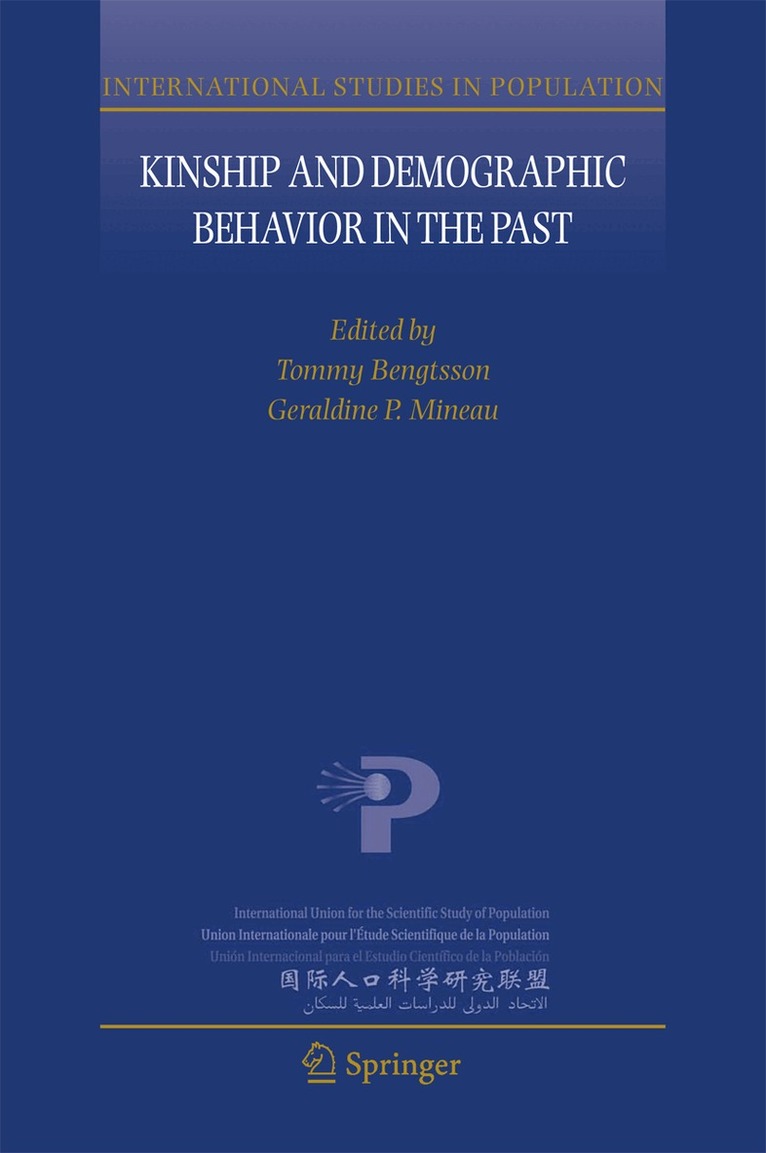
The International Union for the Scientific Study of Population’s Panel on Historical Demography applies a historical perspective, such as the importance of kinship networks for demographic outcomes later in life, to promote work of contemporary relevance. Connections over time, whether across generations or different segments of the life course, are an area of convergent interest among multiple disciplines. Specific topics of common interest are the influence of con- tions earlier in life on outcomes later in life, intergenerational associations in social, economic, and demographic outcomes, socioeconomic differences in health status and demographic outcomes, and the influence of industrialization and modernization on such patterns and relationships. Historical population da- bases, currently under expansion in a variety of locations around the world, provide longitudinal data on individuals across multiple generations and are especially amenable to the examination of such issues. Through a series of workshops sci- tists at the forefront of research on these issues were brought together in order to instigate a new wave of comparative work. Kinship and Demographic Behavior in the Past is intended to extend the disc- sions that occurred at two seminars, cosponsored by the International Union for the Scientific Study of Population, to a broader community of population scientists. Experts from many disciplines have come together in this volume to highlight the convergence of research by demographers, economic historians, historians, anth- pologists, sociologists, and geneticists.
535 kr
Skickas inom 10-15 vardagar
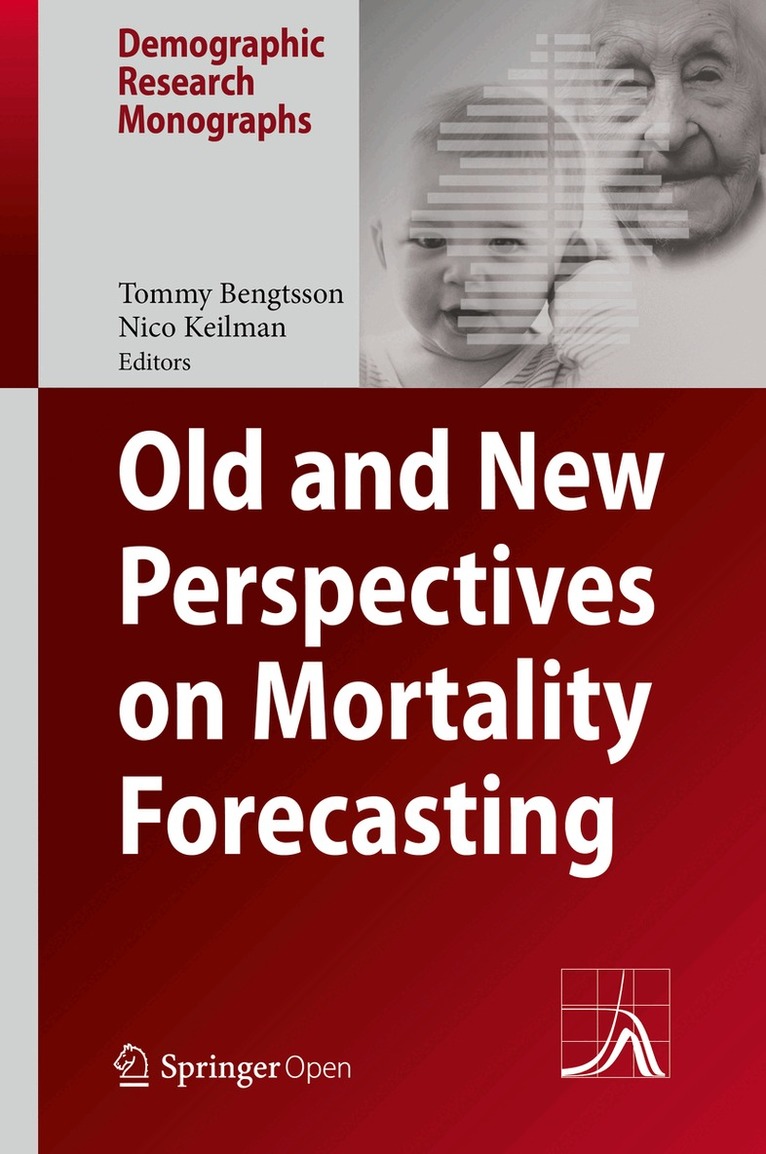
This open access book describes methods of mortality forecasting and discusses possible improvements. The different parts of the book provide discussions of current practice, probabilistic forecasting, the linearity in the increase of life expectancy, causes of death, and the role of cohort factors.
1 064 kr
Skickas inom 10-15 vardagar
Tommy Bengtsson Population ageing, the shift in age distribution towards older ages, is of immense global concern. It is taking place to a varying degree all over the world, more in Europe and some Asian countries, less on the African continent. The worldwide share of people aged 65 years and above is predicted to increase from 7. 5% in 2005 to 16. 1% in 2050 (UN 2007, p. 11). The corresponding ?gures for developed countries are 15. 5 and 26. 2% and for developing countries 5. 5 and 14. 6%. While population ageing has been going on for some time in the developed world, and will continue to do so, most of the change is yet to come for the developing world. The change in developing countries, however, is going to be much faster than it has been in the developed world. For example, while it took more than 100 years in France and more than 80 years in Sweden for the population group aged 65 and above to increase from 7 to 14% of the population, the same change in Japan took place over a 25-year period (UN 2007, p. 13). The scenario for the future is very similar for most developing countries, including highly populated countries like China, India and Brazil. While the start and the speed differ, the shift in age structure towards older ages is a worldwide phenomenon, stressing the signi?cance of the concept global ageing.
1 064 kr
Skickas inom 10-15 vardagar
Tommy Bengtsson Population ageing, the shift in age distribution towards older ages, is of immense global concern. It is taking place to a varying degree all over the world, more in Europe and some Asian countries, less on the African continent. The worldwide share of people aged 65 years and above is predicted to increase from 7. 5% in 2005 to 16. 1% in 2050 (UN 2007, p. 11). The corresponding ?gures for developed countries are 15. 5 and 26. 2% and for developing countries 5. 5 and 14. 6%. While population ageing has been going on for some time in the developed world, and will continue to do so, most of the change is yet to come for the developing world. The change in developing countries, however, is going to be much faster than it has been in the developed world. For example, while it took more than 100 years in France and more than 80 years in Sweden for the population group aged 65 and above to increase from 7 to 14% of the population, the same change in Japan took place over a 25-year period (UN 2007, p. 13). The scenario for the future is very similar for most developing countries, including highly populated countries like China, India and Brazil. While the start and the speed differ, the shift in age structure towards older ages is a worldwide phenomenon, stressing the signi?cance of the concept global ageing.
1 064 kr
Skickas inom 10-15 vardagar
Tommy Bengtsson The Swedish welfare model of the 1960s and 1970s excited great interest among many other countries. Today it still is an ideal image for some but a warning for many others. The reason why opinion about the Swedish welfare model has changed is primarily Sweden's financial problems, which are associated with a badly financed and excessively large public sector. It is argued that the size of the budget deficit is a great problem in itself, but also, and perhaps more importantly, that the large public sector has negative effects on the entire economy since it lead to inefficient allocation of resources. A first step in order to solve these problems is to examine how they arose. The questions then are to what extent the large public sector which Sweden has today results from social entitlements which have come into existence since the 1960s, from the maturing of welfare systems decided upon earlier, from unfavourable demographic developments, or from economic stagnation, and how these factors are interlinked. What is quite clear is that Sweden has had very low economic growth during the 1970s and 1980s compared with the preceding period. But so have many other industrial countries, without their having in consequence found themselves in diffi culties as great as Sweden's. Therefore economic stagnation alone cannot explain Sweden's situation.
1 064 kr
Skickas inom 10-15 vardagar
The International Union for the Scientific Study of Population’s Panel on Historical Demography applies a historical perspective, such as the importance of kinship networks for demographic outcomes later in life, to promote work of contemporary relevance. Connections over time, whether across generations or different segments of the life course, are an area of convergent interest among multiple disciplines. Specific topics of common interest are the influence of con- tions earlier in life on outcomes later in life, intergenerational associations in social, economic, and demographic outcomes, socioeconomic differences in health status and demographic outcomes, and the influence of industrialization and modernization on such patterns and relationships. Historical population da- bases, currently under expansion in a variety of locations around the world, provide longitudinal data on individuals across multiple generations and are especially amenable to the examination of such issues. Through a series of workshops sci- tists at the forefront of research on these issues were brought together in order to instigate a new wave of comparative work. Kinship and Demographic Behavior in the Past is intended to extend the disc- sions that occurred at two seminars, cosponsored by the International Union for the Scientific Study of Population, to a broader community of population scientists. Experts from many disciplines have come together in this volume to highlight the convergence of research by demographers, economic historians, historians, anth- pologists, sociologists, and geneticists.