Tony Greenfield – författare
731 kr
Skickas inom 10-15 vardagar
Statistical Practice in Business and Industry
1 322 kr
Skickas
692 kr
Skickas inom 5-8 vardagar
1 550 kr
Läs direkt efter köp
615 kr
Skickas inom 5-8 vardagar
712 kr
Läs direkt efter köp
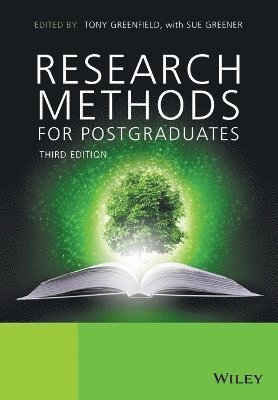
Methods for Postgraduates brings together guidance for postgraduate students on how to organise, plan and do research from an interdisciplinary perspective. In this new edition, the already wide-ranging coverage is enhanced by the addition of new chapters on social media, evaluating the research process, Kansei engineering and medical research reporting. The extensive updates also provide the latest guidance on issues relevant to postgraduates in all subject areas, from writing a proposal and securing research funds, to data analysis and the presentation of research, through to intellectual property protection and career opportunities.
This thoroughly revised new edition provides:
Clear and concise advice from distinguished international researchers on how to plan, organise and conduct research. New chapters explore social media in research, evaluate the research process, Kansei engineering and discuss the reporting of medical research. Check lists and diagrams throughout.Praise for the second edition:
“... the most useful book any new postgraduate could ever buy.” (New Scientist)“The book certainly merits its acceptance as essential reading for postgraduates and will be valuable to anyone associated in any way with research or with presentation of technical or scientific information of any kind.”(Robotica)
Like its predecessors, the third edition of Research Methods for Postgraduates is accessible and comprehensive, and is a must-read for any postgraduate student.
687 kr
Läs direkt efter köp
Methods for Postgraduates brings together guidance for postgraduate students on how to organise, plan and do research from an interdisciplinary perspective. In this new edition, the already wide-ranging coverage is enhanced by the addition of new chapters on social media, evaluating the research process, Kansei engineering and medical research reporting. The extensive updates also provide the latest guidance on issues relevant to postgraduates in all subject areas, from writing a proposal and securing research funds, to data analysis and the presentation of research, through to intellectual property protection and career opportunities.
This thoroughly revised new edition provides:
Clear and concise advice from distinguished international researchers on how to plan, organise and conduct research. New chapters explore social media in research, evaluate the research process, Kansei engineering and discuss the reporting of medical research. Check lists and diagrams throughout.Praise for the second edition:
“... the most useful book any new postgraduate could ever buy.” (New Scientist)“The book certainly merits its acceptance as essential reading for postgraduates and will be valuable to anyone associated in any way with research or with presentation of technical or scientific information of any kind.”(Robotica)
Like its predecessors, the third edition of Research Methods for Postgraduates is accessible and comprehensive, and is a must-read for any postgraduate student.
844 kr
Läs direkt efter köp
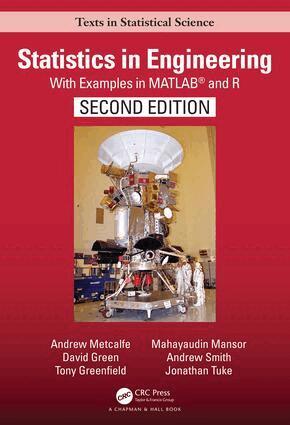
Engineers are expected to design structures and machines that can operate in challenging and volatile environments, while allowing for variation in materials and noise in measurements and signals. Statistics in Engineering, Second Edition: With Examples in MATLAB and R covers the fundamentals of probability and statistics and explains how to use these basic techniques to estimate and model random variation in the context of engineering analysis and design in all types of environments.
The first eight chapters cover probability and probability distributions, graphical displays of data and descriptive statistics, combinations of random variables and propagation of error, statistical inference, bivariate distributions and correlation, linear regression on a single predictor variable, and the measurement error model. This leads to chapters including multiple regression; comparisons of several means and split-plot designs together with analysis of variance; probability models; and sampling strategies. Distinctive features include:
All examples based on work in industry, consulting to industry, and research for industry. Examples and case studies include all engineering disciplines. Emphasis on probabilistic modeling including decision trees, Markov chains and processes, and structure functions. Intuitive explanations are followed by succinct mathematical justifications. Emphasis on random number generation that is used for stochastic simulations of engineering systems, demonstration of key concepts, and implementation of bootstrap methods for inference. Use of MATLAB and the open source software R, both of which have an extensive range of statistical functions for standard analyses and also enable programing of specific applications. Use of multiple regression for times series models and analysis of factorial and central composite designs. Inclusion of topics such as Weibull analysis of failure times and split-plot designs that are commonly used in industry but are not usually included in introductory textbooks. Experiments designed to show fundamental concepts that have been tested with large classes working in small groups. Website with additional materials that is regularly updated.1 477 kr
Skickas inom 10-15 vardagar
874 kr
Läs direkt efter köp
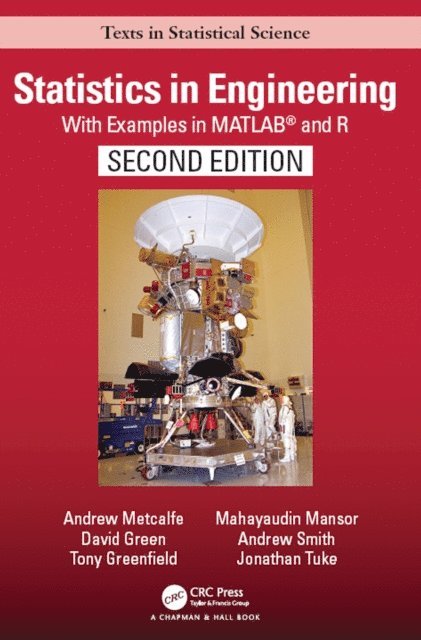
Engineers are expected to design structures and machines that can operate in challenging and volatile environments, while allowing for variation in materials and noise in measurements and signals. Statistics in Engineering, Second Edition: With Examples in MATLAB and R covers the fundamentals of probability and statistics and explains how to use these basic techniques to estimate and model random variation in the context of engineering analysis and design in all types of environments.
The first eight chapters cover probability and probability distributions, graphical displays of data and descriptive statistics, combinations of random variables and propagation of error, statistical inference, bivariate distributions and correlation, linear regression on a single predictor variable, and the measurement error model. This leads to chapters including multiple regression; comparisons of several means and split-plot designs together with analysis of variance; probability models; and sampling strategies. Distinctive features include:
All examples based on work in industry, consulting to industry, and research for industry. Examples and case studies include all engineering disciplines. Emphasis on probabilistic modeling including decision trees, Markov chains and processes, and structure functions. Intuitive explanations are followed by succinct mathematical justifications. Emphasis on random number generation that is used for stochastic simulations of engineering systems, demonstration of key concepts, and implementation of bootstrap methods for inference. Use of MATLAB and the open source software R, both of which have an extensive range of statistical functions for standard analyses and also enable programing of specific applications. Use of multiple regression for times series models and analysis of factorial and central composite designs. Inclusion of topics such as Weibull analysis of failure times and split-plot designs that are commonly used in industry but are not usually included in introductory textbooks. Experiments designed to show fundamental concepts that have been tested with large classes working in small groups. Website with additional materials that is regularly updated.