Tony Hey - Böcker
Visar alla böcker från författaren Tony Hey. Handla med fri frakt och snabb leverans.
6 produkter
6 produkter
422 kr
Skickas inom 7-10 vardagar
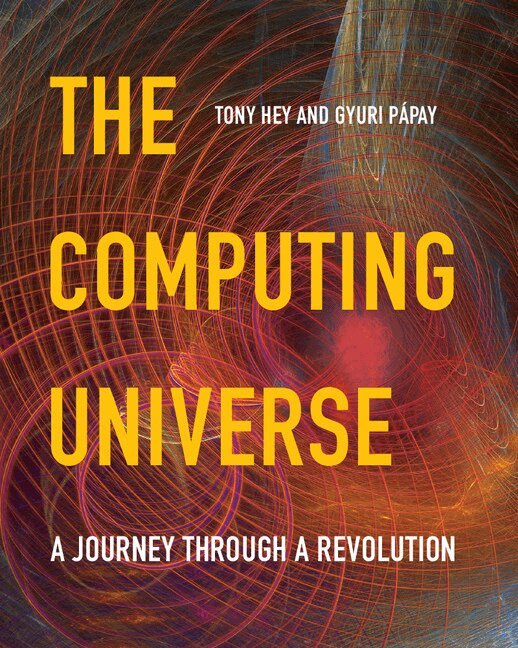
Computers now impact almost every aspect of our lives, from our social interactions to the safety and performance of our cars. How did this happen in such a short time? And this is just the beginning. In this book, Tony Hey and Gyuri Pápay lead us on a journey from the early days of computers in the 1930s to the cutting-edge research of the present day that will shape computing in the coming decades. Along the way, they explain the ideas behind hardware, software, algorithms, Moore's Law, the birth of the personal computer, the Internet and the Web, the Turing Test, Jeopardy's Watson, World of Warcraft, spyware, Google, Facebook and quantum computing. This book also introduces the fascinating cast of dreamers and inventors who brought these great technological developments into every corner of the modern world. This exciting and accessible introduction will open up the universe of computing to anyone who has ever wondered where his or her smartphone came from.
787 kr
Skickas inom 7-10 vardagar
Einstein's Mirror is a book on relativity with a difference. Following the successful format of their earlier book, The Quantum Universe, the authors blend a simple, non-mathematical account of the underlying theory of special relativity and gravitation with a description of the way these theories have been triumphantly supported by experiment. Applications of relativity in atomic and nuclear physics are wide-ranging, from satellite navigation systems, particle accelerators and nuclear power to quantum chemistry, anti-matter and black holes. The text is enlivened by a superb collection of photographs and by amusing anecdotes about the early pioneers. The closing chapter examines the influence of Einstein's relativity on the development of science fiction. Final year students at school, general readers with an interest in science, and undergraduates in science subjects will all enjoy and benefit from this fascinating and accessible introduction to one of the most profound scientific discoveries of the twentieth century.
485 kr
Skickas inom 7-10 vardagar
Following the success of The Quantum Universe, first published in 1987, a host of exciting new discoveries have been made in the field of quantum mechanics. The New Quantum Universe provides an up-to-date and accessible introduction to the essential ideas of quantum physics, and demonstrates how it affects our everyday life. Quantum mechanics gives an understanding of not only atoms and nuclei, but also all the elements and even the stars. The book explains quantum paradoxes and the eventful life of Schroedinger's Cat, along with the Einstein-Podolsky-Rosen paradox and Bell's Inequality. It then looks ahead to the nanotechnology revolution, describing quantum cryptography, quantum computing and quantum teleportation, and ends with an account of quantum mechanics and science fiction. Using simple non-mathematical language, this book is suitable for final-year school students, science undergraduates, and anyone wishing to appreciate how physics allows the new technologies that are changing our lives.
979 kr
Tillfälligt slut
Computers now impact almost every aspect of our lives, from our social interactions to the safety and performance of our cars. How did this happen in such a short time? And this is just the beginning. In this book, Tony Hey and Gyuri Pápay lead us on a journey from the early days of computers in the 1930s to the cutting-edge research of the present day that will shape computing in the coming decades. Along the way, they explain the ideas behind hardware, software, algorithms, Moore's Law, the birth of the personal computer, the Internet and the Web, the Turing Test, Jeopardy's Watson, World of Warcraft, spyware, Google, Facebook and quantum computing. This book also introduces the fascinating cast of dreamers and inventors who brought these great technological developments into every corner of the modern world. This exciting and accessible introduction will open up the universe of computing to anyone who has ever wondered where his or her smartphone came from.
2 012 kr
Skickas inom 10-15 vardagar
The last lecture course that Nobel Prize winner Richard P. Feynman gaveto students at Caltech from 1983 to 1986 was not on physics but on computerscience. The first edition of the Feynman Lectures on Computation, publishedin 1996, provided an overview of standard and not-so-standard topics incomputer science given in Feynman’s inimitable style. Although nowover 20 years old, most of the material is still relevant and interesting, andFeynman’s unique philosophy of learning and discovery shines through.For this new edition, Tony Hey has updated the lectures with an invitedchapter from Professor John Preskill on “Quantum Computing 40 YearsLater”. This contribution captures the progress made toward building aquantum computer since Feynman’s original suggestions in 1981. The last25 years have also seen the “Moore’s law” roadmap for the IT industrycoming to an end. To reflect this transition, John Shalf, Senior Scientistat Lawrence Berkeley National Laboratory, has contributed a chapteron “The Future of Computing beyond Moore’s Law”. The final updatefor this edition is an attempt to capture Feynman’s interest in artificialintelligence and artificial neural networks. Eric Mjolsness, now a Professorof Computer Science at the University of California Irvine, was a TeachingAssistant for Feynman’s original lecture course and his research interestsare now the application of artificial intelligence and machine learningfor multi-scale science. He has contributed a chapter called “Feynmanon Artificial Intelligence and Machine Learning” that captures the earlydiscussions with Feynman and also looks toward future developments.This exciting and important work provides key reading for students andscholars in the fields of computer science and computational physics.
2 169 kr
Skickas inom 5-8 vardagar
This unique collection introduces AI, Machine Learning (ML), and deep neural network technologies leading to scientific discovery from the datasets generated both by supercomputer simulation and by modern experimental facilities.Huge quantities of experimental data come from many sources — telescopes, satellites, gene sequencers, accelerators, and electron microscopes, including international facilities such as the Large Hadron Collider (LHC) at CERN in Geneva and the ITER Tokamak in France. These sources generate many petabytes moving to exabytes of data per year. Extracting scientific insights from these data is a major challenge for scientists, for whom the latest AI developments will be essential.The timely handbook benefits professionals, researchers, academics, and students in all fields of science and engineering as well as AI, ML, and neural networks. Further, the vision evident in this book inspires all those who influence or are influenced by scientific progress.