
Tore Wessel-Berg – författare
Visar alla böcker från författaren Tore Wessel-Berg. Handla med fri frakt och snabb leverans.
2 produkter
2 produkter
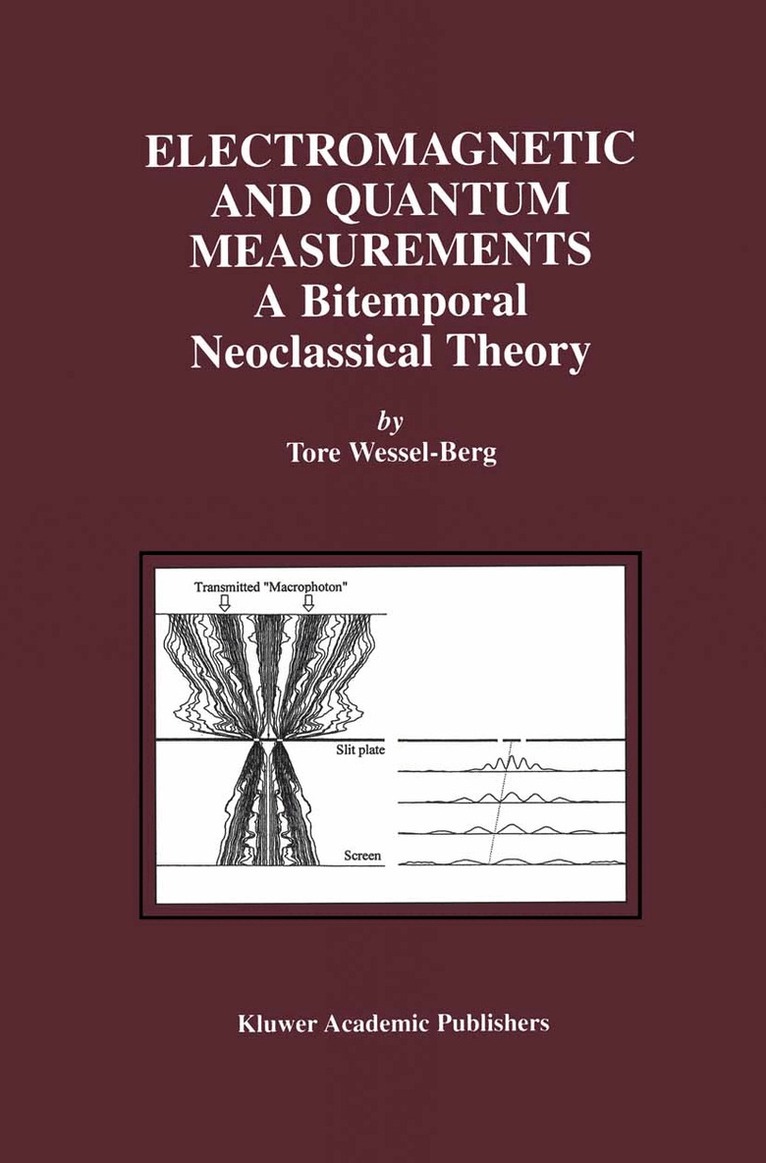
Inbunden, Engelska, 2000
1 602 kr
Skickas inom 10-15 vardagar
This text presents a generalization of electromagnetism into the bitemporal microcosm, where by hypothesis, regular causal relationships do not apply and time is allowed to flow in both directions. Labelled the "Neo-classical Electromagnetic Theory", the proposition is put on a sound formal footing by noting that Maxwell's field equations are valid for positive as well as negative time. The book explores the ramifications of the extra degree of freedom arising from incorporation of negative time elements, which introduce additional boundary conditions modifying orthodox quantum interpretations in a non-trivial way. The theory provides a merger of electromagnetism and quantum theory of photons, applicable to macroscopic as well as microscopic phenomena. Avoiding the hand-waving arguments so often encountered in quantum texts, the book presents detailed analyses of a number of well-known and famous quantum experiments riddled with interpretational dilemmas, such as the double-slit experiments for photons and electrons, the Einstein-Podolsky-Rosen (EPR) paradox, and many more.The investigations turned out to be a fascinating journey into largely unexplored territory, with rewards in the way of resolutions of bizarre puzzles and paradoxes in the quantum family, together with consistent agreements with existing experimental facts. In examples from the macroscopic domain, the book proposes a photonic origin of the enigmatic 1/f noise occuring in all active electronic components and devices, a proposition supported by detailed analysis consistent with existing empirical data.
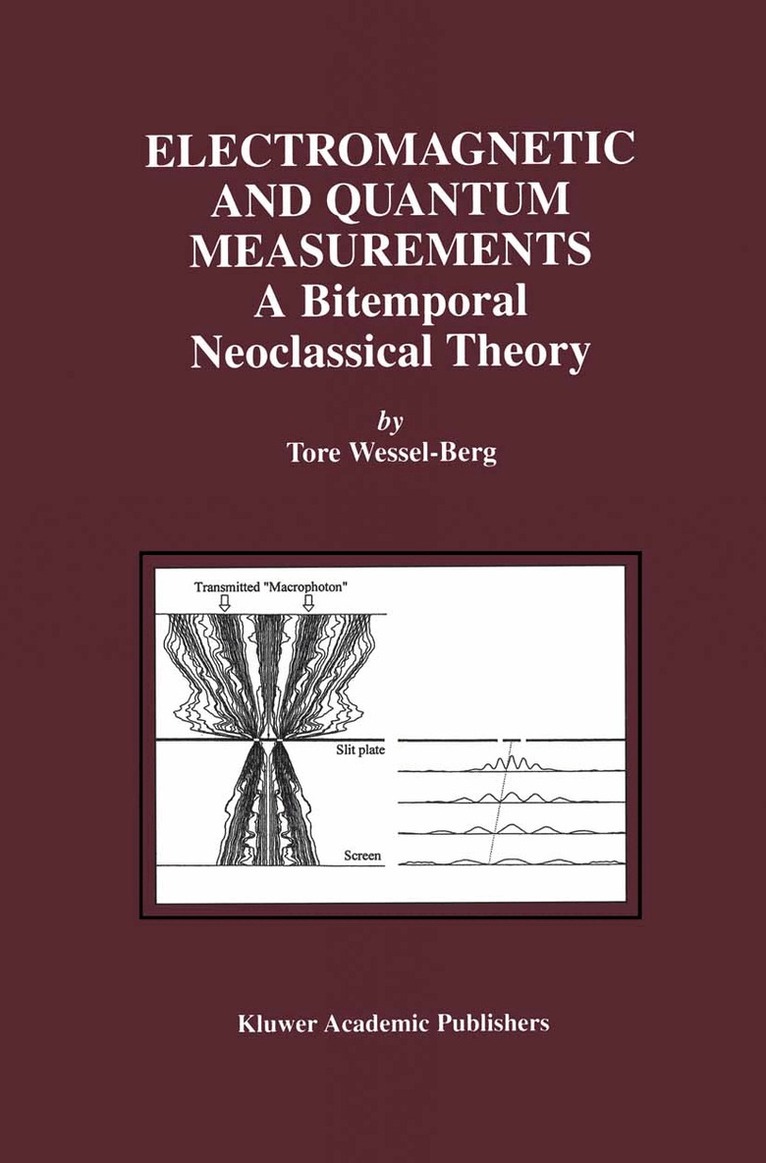
Häftad, Engelska, 2014
1 603 kr
Skickas inom 10-15 vardagar
It is a pleasure to write a foreword for Professor Tore Wessel-Berg's book, "Electromagnetic and Quantum Measurements: A Bitemporal Neoclassical Theory." This book appeals to me for several reasons. The most important is that, in this book, Wessel-Berg breaks from the pack. The distinguished astrophysicist Thomas Gold has written about the pressures on scientists to move in tight formation, to avoid having their legs nipped by the sheepdogs of science. This book demonstrates that Wessel-Berg is willing to take that risk. I confess that I do not sufficiently understand this book to be able to either agree or disagree with its thesis. Nevertheless, Wessel-Berg makes very cogent arguments for setting out on his journey. The basic equations of physics are indeed time-reversible. Our experience, that leads us to the concept of an "arrow of time," is derived from macro scopic phenomena, not from fundamental microscopic phenomena. For this reason, it makes very good sense to explore the consequences of treating microscopic phenomena on the assumption that forward time and backward time are equal.