Toru Ishida – författare
Visar alla böcker från författaren Toru Ishida. Handla med fri frakt och snabb leverans.
33 produkter
Real-Time Search for Learning Autonomous Agents
Av Toru Ishida
E-bok, 2007
2174 kr
Lägg i varukorg
Autonomous agents or multiagent systems are computational systems in which several computational agents interact or work together to perform some set of tasks. These systems may involve computational agents having common goals or distinct goals. Real-Time Search for Learning Autonomous Agents …
Real-Time Search for Learning Autonomous Agents
Av Toru Ishida
Inbunden, 1997
1693 kr
Lägg i varukorg
Autonomous agents or multiagent systems are computational systems in which several computational agents interact or work together to perform some set of tasks. These systems may involve computational agents having common goals or distinct goals. Real-Time Search for Learning Autonomous Agents …
Real-Time Search for Learning Autonomous Agents
Av Toru Ishida
Häftad, 2013
1687 kr
Lägg i varukorg
Autonomous agents or multiagent systems are computational systems in which several computational agents interact or work together to perform some set of tasks. These systems may involve computational agents having common goals or distinct goals. Real-Time Search for Learning Autonomous Agents …
Massively Multi-Agent Systems II
International Workshop, MMAS 2018, Stockholm, Sweden, July 14, 2018, Revised Selected Papers
Av Donghui Lin, Toru Ishida m. fl.
Häftad, 2019
567 kr
Lägg i varukorg
This book contains revised selected and invited papers presented at the International Workshop on Massively Multi-Agent Systems, MMAS 2018, held in Stockholm, Sweden, in July 2018.The 7 revised full papers presented were carefully reviewed and selected for inclusion in this volume. Also included …
Massively Multi-Agent Systems II
International Workshop, MMAS 2018, Stockholm, Sweden, July 14, 2018, Revised Selected Papers
Av Itsuki Noda, Franco Zambonelli m. fl.
E-bok, 2019
739 kr
Lägg i varukorg
This book contains revised selected and invited papers presented at the International Workshop on Massively Multi-Agent Systems, MMAS 2018, held in Stockholm, Sweden, in July 2018. The 7 revised full papers presented were carefully reviewed and selected for inclusion in this volume. Also included …
Massively Multi-Agent Systems I
First International Workshop, MMAS 2004, Kyoto, Japan, December 10-11, 2004, Revised Selected and Invited Papers
Av Toru Ishida, Les Gasser m. fl.
Häftad, 2005
567 kr
Lägg i varukorg
In the era of ubiquitous computing and networking, millions of electronic devices with computing facilities in the public space are connected with each other in ad hoc ways, but are required to behave coherently. Massively multi-agent systems, MMAS can be a major design paradigm or an …
Massively Multi-Agent Systems I
First International Workshop, MMAS 2004, Kyoto, Japan, December 10-11, 2004, Revised Selected and Invited Papers
Av Hideyuki Nakashima, Les Gasser m. fl.
E-bok, 2005
739 kr
Lägg i varukorg
In the era of ubiquitous computing and networking, millions of electronic devices with computing facilities in the public space are connected with each other in ad hoc ways, but are required to behave coherently. Massively multi-agent systems, MMAS can be a major design paradigm or an …
Active Media Technology
6th International Computer Science Conference, AMT 2001, Hong Kong, China, December 18-20, 2001. Proceedings
Av Jiming Liu, Pong C. Yuen m. fl.
Häftad, 2002
567 kr
Lägg i varukorg
The past few years have witnessed rapid scienti?c and technological devel- ments in human-centered, seamless computing environments, interfaces, de- ces, and systems with applications ranging from business and communication to entertainment and learning. These developments are collectively best …
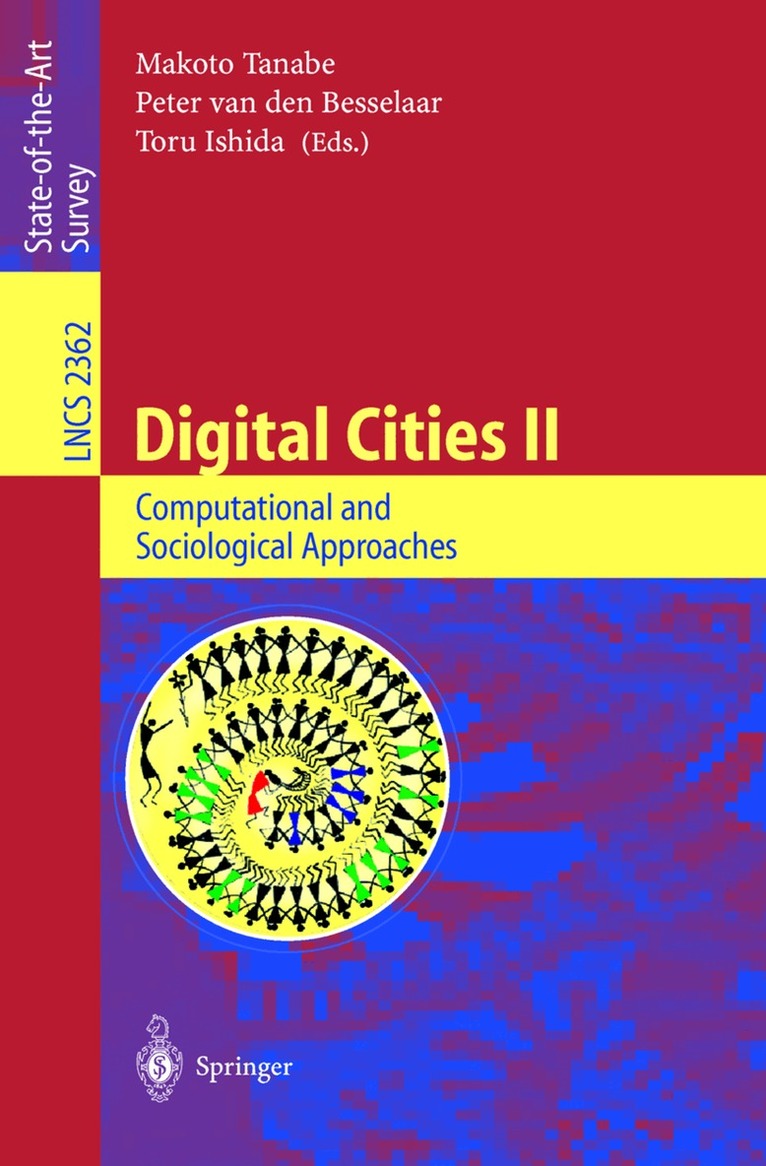
Digital Cities II: Computational and Sociological Approaches
Second Kyoto Workshop on Digital Cities, Kyoto, Japan, October 18-20, 2001. Revised Papers
Av Makoto Tanabe, Peter van den Besselaar m. fl.
Häftad, 2002
567 kr
Lägg i varukorg
This book contains the papers presented at the second KyotoWorkshop on Digital Cities that took place in October 2001. This was the third in a series of three related confer- ces. The previous conferences were the KyotoWorkshop on Communityware and Social Interaction in 1998, and the ?rst …
Active Media Technology
6th International Computer Science Conference, AMT 2001, Hong Kong, China, December 18-20, 2001. Proceedings
Av Toru Ishida, Joseph Ng m. fl.
E-bok, 2003
755 kr
Lägg i varukorg
The past few years have witnessed rapid scienti?c and technological devel- ments in human-centered, seamless computing environments, interfaces, de- ces, and systems with applications ranging from business and communication to entertainment and learning. These developments are collectively best …
Digital Cities II: Computational and Sociological Approaches
Second Kyoto Workshop on Digital Cities, Kyoto, Japan, October 18-20, 2001. Revised Papers
Av Toru Ishida, Peter van den Besselaar m. fl.
E-bok, 2003
755 kr
Lägg i varukorg
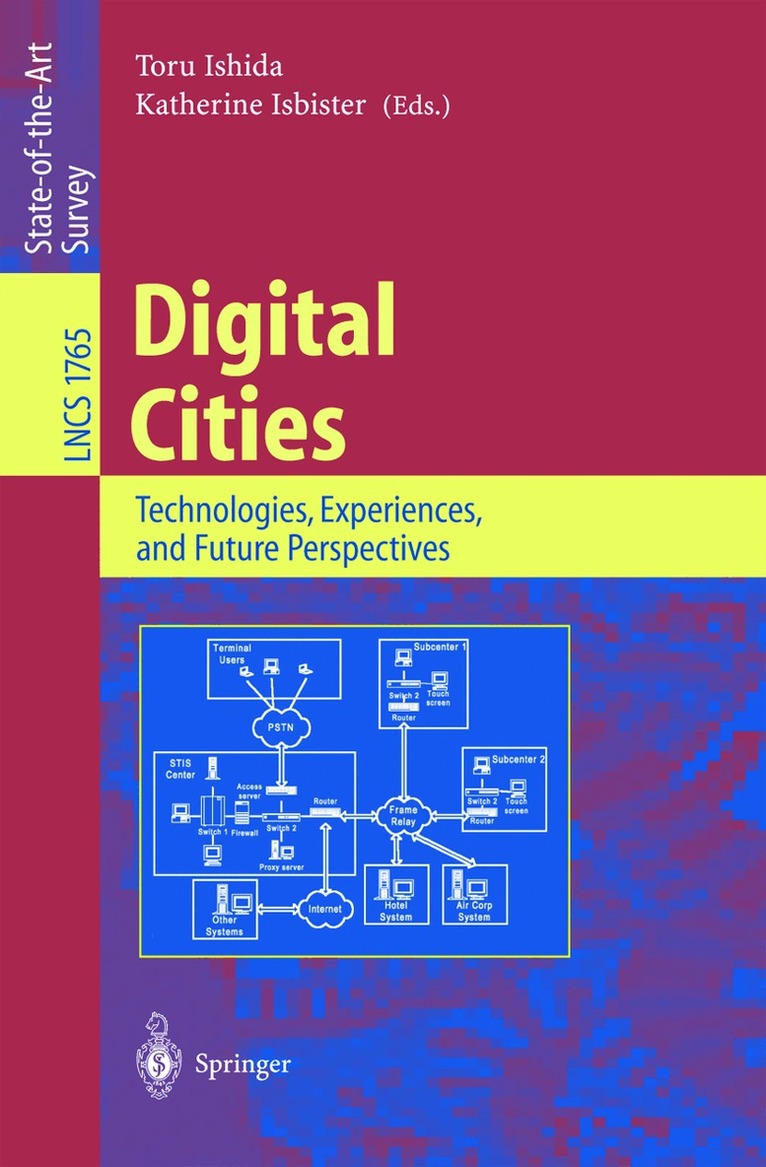
Digital Cities
Technologies, Experiences, and Future Perspectives
Av Katherine Isbister, Toru Ishida
E-bok, 2003
755 kr
Lägg i varukorg
On the way towards the Information Society, global networks such as the Internet, together with mobile computing, have made wide-area computing over virtual communities a reality. Digital city projects, with the goal of building platforms to support community networking, are going on worldwide. …
Multiagent Platforms
First Pacific Rim International Workshop on Multi-Agents, PRIMA''98, Singapore, November 23, 1998, Selected Papers
Av Toru Ishida
E-bok, 2007
739 kr
Lägg i varukorg
Community Computing and Support Systems
Social Interaction in Networked Communities
Av Toru Ishida
E-bok, 2003
755 kr
Lägg i varukorg
Parallel, Distributed and Multiagent Production Systems
Av Toru Ishida
Häftad, 1994
388 kr
Lägg i varukorg
This monograph coherently presents a series of research results on concurrent production systems recently contributed by the author and several co-authors.Before going into the details of concurrent production systems the performance of a single system is discussed. Based on these considerations it …
Community Computing and Support Systems
Social Interaction in Networked Communities
Av Toru Ishida
Häftad, 1998
551 kr
Lägg i varukorg
This article discusses the community metaphor as the next stage of network computing. The first meeting in Kyoto was blessed with lovely weather. Though we did not organize a formal committee for this meeting, a number of social and computer scientists joined. Since the meeting was semi closed, …
Multiagent Platforms
First Pacific Rim International Workshop on Multi-Agents, PRIMA'98, Singapore, November 23, 1998, Selected Papers
Av Toru Ishida
Häftad, 1999
567 kr
Lägg i varukorg
Autonomousagents andmultiagentsystems are computationalsystems inwhich several (semi-)autonomous agents interact each other or work together to p- form some set of tasks or satisfy some set of goals. These systems may involve computationalagents that are homogeneous or heterogeneous, they may …
Digital Cities
Technologies, Experiences, and Future Perspectives
Av Toru Ishida, Katherine Isbister
Häftad, 2000
567 kr
Lägg i varukorg
On the way towards the Information Society, global networks such as the Internet, together with mobile computing, have made wide-area computing over virtual communities a reality. Digital city projects, with the goal of building platforms to support community networking, are going on worldwide.This …
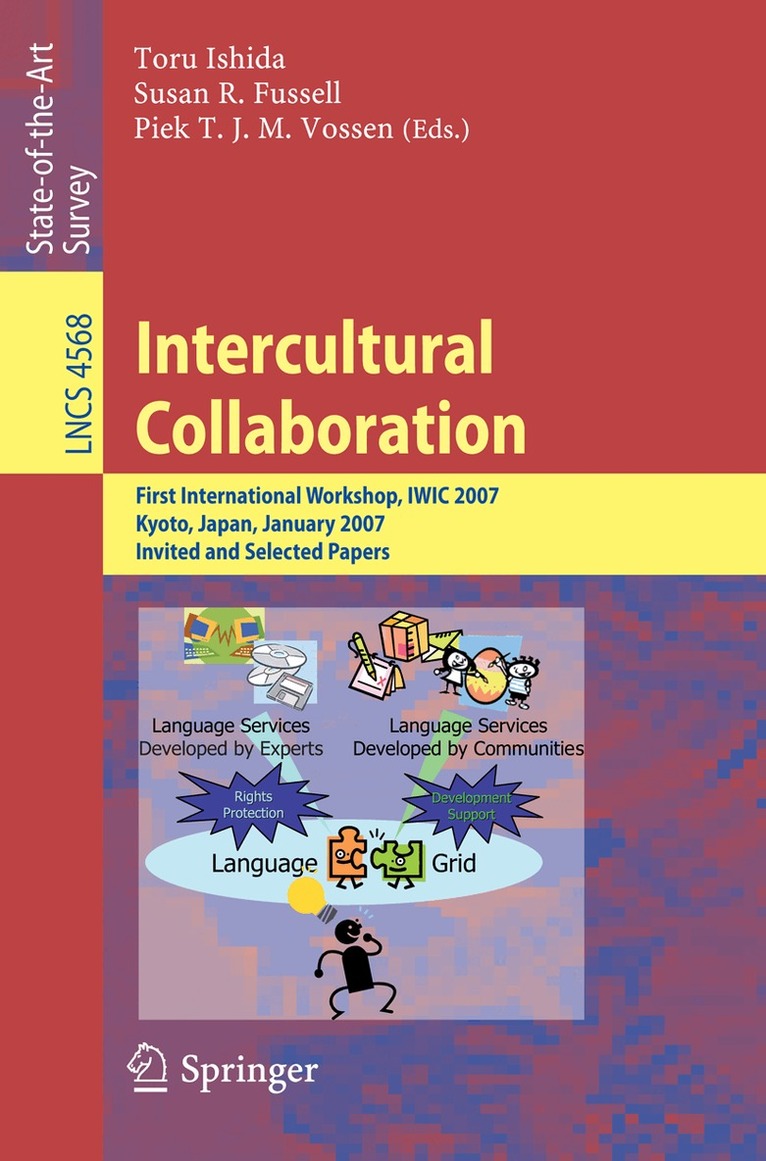
Intercultural Collaboration
First International Workshop, IWIC 2007 Kyoto, Japan, January 25-26, 2007 Invited and Selected Papers
Av Toru Ishida, Susan R. Fussell m. fl.
Häftad, 2007
551 kr
Lägg i varukorg
This book presents 29 revised invited and selected lectures given by top-researchers at the First International Workshop on Intercultural Collaboration, IWIC 2007, held in Kyoto, Japan. This state-of-the-art survey increases mutual understanding in our multicultural world by featuring collaboration …
Intercultural Collaboration
First International Workshop, IWIC 2007 Kyoto, Japan, January 25-26, 2007 Invited and Selected Papers
Av Piek T. J. M. Vossen, Susan R. Fussell m. fl.
E-bok, 2007
755 kr
Lägg i varukorg
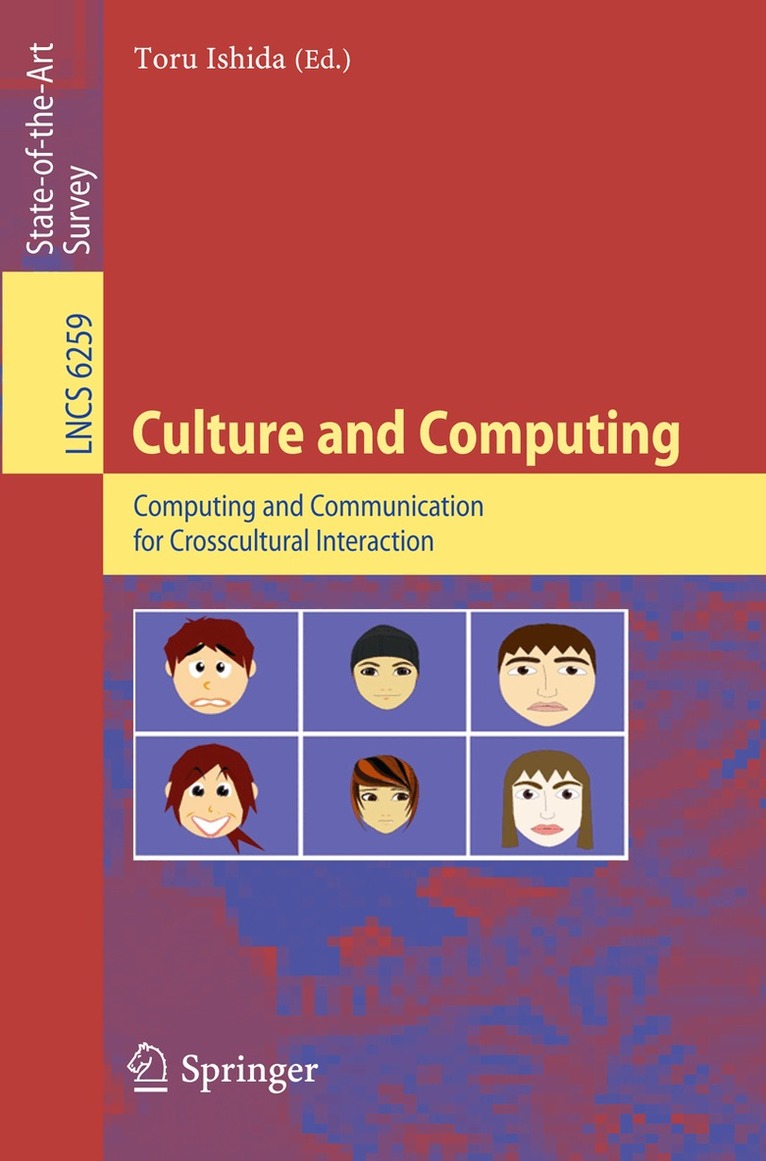
Culture and Computing
Computing and Communication for Crosscultural Interaction
Av Toru Ishida
Häftad, 2010
567 kr
Lägg i varukorg
In the light of upcoming global issues, concerning population, energy, the environment, and food, information and communication technologies are required to overcome difficulties in communication among cultures. In this context, the First International Conference on Culture and Computing, which was …
Culture and Computing
Computing and Communication for Crosscultural Interaction
Av Toru Ishida
E-bok, 2010
739 kr
Lägg i varukorg
In the light of upcoming global issues, concerning population, energy, the environment, and food, information and communication technologies are required to overcome difficulties in communication among cultures. In this context, the First International Conference on Culture and Computing, which was …
Language Grid
Service-Oriented Collective Intelligence for Language Resource Interoperability
Av Toru Ishida
Inbunden, 2011
569 kr
Lägg i varukorg
There is increasing interaction among communities with multiple languages, thus we need services that can effectively support multilingual communication. The Language Grid is an initiative to build an infrastructure that allows end users to create composite language services for intercultural …
Language Grid
Service-Oriented Collective Intelligence for Language Resource Interoperability
Av Toru Ishida
E-bok, 2011
739 kr
Lägg i varukorg
There is increasing interaction among communities with multiple languages, thus we need services that can effectively support multilingual communication. The Language Grid is an initiative to build an infrastructure that allows end users to create composite language services for intercultural …
Language Grid
Service-Oriented Collective Intelligence for Language Resource Interoperability
Av Toru Ishida
Häftad, 2013
569 kr
Lägg i varukorg
There is increasing interaction among communities with multiple languages, thus we need services that can effectively support multilingual communication. The Language Grid is an initiative to build an infrastructure that allows end users to create composite language services for intercultural …
Field Informatics
Kyoto University Field Informatics Research Group
Av Toru Ishida
Inbunden, 2012
552 kr
Lägg i varukorg
Here we use the term "field" to refer to a sphere of practical operation, and correspondingly the term "field informatics" describes informatics tools and methodologies that arise in the field. The components of field informatics are description, prediction, design and transfer, and the methods for …
Field Informatics
Kyoto University Field Informatics Research Group
Av Toru Ishida
E-bok, 2012
734 kr
Lägg i varukorg
Here we use the term "field" to refer to a sphere of practical operation, and correspondingly the term "field informatics" describes informatics tools and methodologies that arise in the field. The components of field informatics are description, prediction, design and transfer, and the methods for …
Advances on Practical Applications of Agents and Multi-Agent Systems
11th International Conference, PAAMS 2013, Salamanca, Spain, May 22-24, 2013. Proceedings
Av Yves Demazeau, Toru Ishida m. fl.
Häftad, 2013
552 kr
Lägg i varukorg
This book constitutes the refereed proceedings of the 11th International Conference on Practical Applications of Agents and Multi-Agent Systems, PAAMS 2013, held in Salamanca, Spain, in May 2013. The 14 revised full papers and 9 short papers presented together with 16 demonstrations were carefully …
Advances on Practical Applications of Agents and Multi-Agent Systems
11th International Conference, PAAMS 2013, Salamanca, Spain, May 22-24, 2013. Proceedings
Av Javier Bajo Perez, Juan Manuel Corchado Rodriguez m. fl.
E-bok, 2013
698 kr
Lägg i varukorg
This book constitutes the refereed proceedings of the 11th International Conference on Practical Applications of Agents and Multi-Agent Systems, PAAMS 2013, held in Salamanca, Spain, in May 2013. The 14 revised full papers and 9 short papers presented together with 16 demonstrations were carefully …
Field Informatics
Kyoto University Field Informatics Research Group
Av Toru Ishida
Häftad, 2014
552 kr
Lägg i varukorg
Here we use the term "field" to refer to a sphere of practical operation, and correspondingly the term "field informatics" describes informatics tools and methodologies that arise in the field. The components of field informatics are description, prediction, design and transfer, and the methods for …