Trevor Stone - Böcker
Visar alla böcker från författaren Trevor Stone. Handla med fri frakt och snabb leverans.
2 produkter
2 produkter
384 kr
Skickas inom 7-10 vardagar
About half of all the medicines prescribed by doctors are not taken by their patients. One of the reasons most commonly given by patients for not taking drugs is that they feel unhappy about taking medicines which they do not understand and of which they are afraid. This book attempts to rectify this problem by showing in clear, non-technical language how medicines and other drugs work in the body to reduce the effects of disease. Most chapters include fascinating background information on how some of our most important drugs were discovered, along with intriguing and often amusing anecdotes about the drugs and the people behind their discovery. Each chapter also includes a summary of the key points together with illustrations, photographs or diagrams to summarise the main groups and how they work in the body. The book covers all the major groups of drugs, with complete listings of all the drugs available in the UK and the USA, so that the reader can locate his or her specific drug and read about the actions of the drugs in that group. The various chapters cover drugs used to treat high blood pressure, heart disease, diabetes, nausea, vomiting, diarrhoea, constipation, ulcers, cancers, infections, impotence, incontinence, arthritis, osteoporosis, as well as hormone replacement therapy, oral contraceptives and drugs used in disorders of the brain such as schizophrenia, depression, Parkinson's disease, Alzheimer's disease and epilepsy. There is also a chapter on drugs which are abused such as cannabis, alcohol, nicotine and ecstasy, and a chapter covering some of the poisons we encounter, such as carbon monoxide, arsenic, sheep dip, and the venoms of snakes, spiders, scorpions and marine organisms. Here, then, a fascinating survey of how chemicals have their effects in the body. It shows how drugs work and explains why it is that taking some medicines for many years is far safer than suffering the long-term effects of disease. Pills, Potions and Poisons is an entertaining read that should also help to improve your health and quality of life.
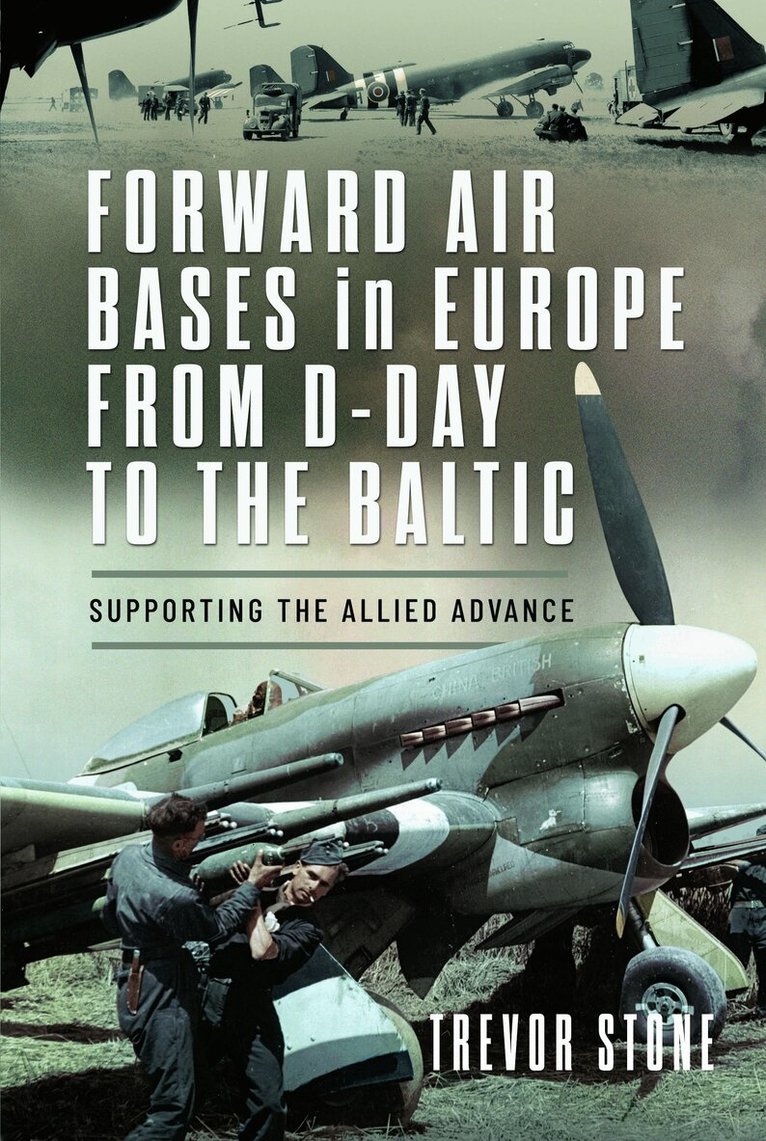
Forward Air Bases in Europe from D-Day to the Baltic
Supporting the Allied Advance
Inbunden, Engelska, 2023
266 kr
Skickas
The largely sea-borne invasion of Northern France in June 1944, Operation Overlord, is acknowledged as one of the key actions which hastened the end of the Second World War. The RAF played a vital part in the landings. It then supported the subsequent advance of Montgomery’s 21st Army, and the Allies as a whole, through France, Belgium, Holland and into Germany.Following the breakout from the Normandy bridgehead in early August 1944, the RAF’s Second Tactical Air Force moved forward in support of the troops, occupying a number of temporary airfields as it went. The ground support for this operation was complex, a situation that was exacerbated by the fact that much of it had to be highly mobile. The advance, however, was rapid and soon ran into problems as the supply lines grew longer by the day.The planners had envisaged that capturing the Belgian port of Antwerp would eventually enable them to bring in vitally needed supplies much further north on the Continent. Although the city and its port were liberated in September 1944, the port’s route to the sea along the River Scheldt was still controlled by German forces. It took nearly three months until this was resolved, and the port opened for business. Until then, in the RAF’s equivalent of the US Army’s famed ‘Red Ball Express’, it was some 300 miles by road from Normandy with the Second Tactical Air Force largely reliant on the Army for transporting its needs. For an air force needing large volumes of fuel and ammunition, demand soon began to outpace supply.A number of emergency measures were put in place to keep the aircraft operational, which saw the RAF resorting to the use of its heavy bombers to fly in supplies. Even when Antwerp was up and running, supplying the Second Tactical Air Force remained a hand-to-mouth affair right through until the enemy’s surrender in May 1945.In Forward Air Bases in Europe from D-Day to the Baltic the author explores the challenges of supporting a mobile air force in those uncertain days as Hitler’s forces were retreating to their homeland. As the Allies found, things can go badly wrong when thinking loses touch with the art of the possible – logistics. In the end, miraculously, it worked, but it was a close-run thing.