Tulay Adali – författare
995 kr
Kommande
Adaptive Signal Processing
Next Generation Solutions
1 830 kr
Skickas inom 5-8 vardagar
2 104 kr
Läs direkt efter köp
Recent developments in signal processing have made it clear that significant performance gains can be achieved beyond those achievable using standard adaptive filtering approaches. Adaptive Signal Processing presents the next generation of algorithms that will produce these desired results, with an emphasis on important applications and theoretical advancements. This highly unique resource brings together leading authorities in the field writing on the key topics of significance, each at the cutting edge of its own area of specialty. It begins by addressing the problem of optimization in the complex domain, fully developing a framework that enables taking full advantage of the power of complex-valued processing. Then, the challenges of multichannel processing of complex-valued signals are explored. This comprehensive volume goes on to cover Turbo processing, tracking in the subspace domain, nonlinear sequential state estimation, and speech-bandwidth extension.
Examines the seven most important topics in adaptive filtering that will define the next-generation adaptive filtering solutions
Introduces the powerful adaptive signal processing methods developed within the last ten years to account for the characteristics of real-life data: non-Gaussianity, non-circularity, non-stationarity, and non-linearity
Features self-contained chapters, numerous examples to clarify concepts, and end-of-chapter problems to reinforce understanding of the material
Contains contributions from acknowledged leaders in the field
Adaptive Signal Processing is an invaluable tool for graduate students, researchers, and practitioners working in the areas of signal processing, communications, controls, radar, sonar, and biomedical engineering.
2 199 kr
Läs direkt efter köp
Contents
1. Mathematical Preliminaries. 2. Estimation by Joint Diagonalization. 3. Maximum Likelihood ICA.
About the Authors
Eric Moreau is Professor of Electrical Engineering at the University of Toulon, France. His research interests concern statistical signal processing, high order statistics and matrix/tensor decompositions with applications to data analysis, telecommunications and radar. Tülay Adali is Professor of Electrical Engineering and Director of the Machine Learning for Signal Processing Laboratory at the University of Maryland, Baltimore County, USA. Her research interests concern statistical and adaptive signal processing, with an emphasis on nonlinear and complex-valued signal processing, and applications in biomedical data analysis and communications.
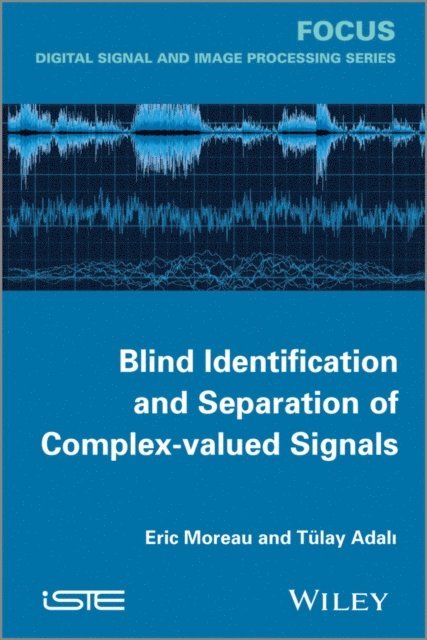
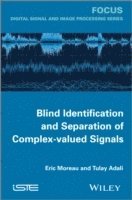
Blind identification consists of estimating a multidimensional system through the use of only its output. Source separation is concerned with the blind estimation of the inverse of the system. The estimation is generally performed by using different statistics of the outputs. The authors consider the blind estimation of a multiple input/multiple output (MIMO) system that mixes a number of underlying signals of interest called sources. They also consider the case of direct estimation of the inverse system for the purpose of source separation. They then describe the estimation theory associated with the identifiability conditions and dedicated algebraic algorithms. The algorithms depend critically on (statistical and/or time frequency) properties of complex sources that will be precisely described.2 199 kr
Läs direkt efter köp
Contents
1. Mathematical Preliminaries. 2. Estimation by Joint Diagonalization. 3. Maximum Likelihood ICA.
About the Authors
Eric Moreau is Professor of Electrical Engineering at the University of Toulon, France. His research interests concern statistical signal processing, high order statistics and matrix/tensor decompositions with applications to data analysis, telecommunications and radar. Tülay Adali is Professor of Electrical Engineering and Director of the Machine Learning for Signal Processing Laboratory at the University of Maryland, Baltimore County, USA. Her research interests concern statistical and adaptive signal processing, with an emphasis on nonlinear and complex-valued signal processing, and applications in biomedical data analysis and communications.
Blind identification consists of estimating a multidimensional system through the use of only its output. Source separation is concerned with the blind estimation of the inverse of the system. The estimation is generally performed by using different statistics of the outputs. The authors consider the blind estimation of a multiple input/multiple output (MIMO) system that mixes a number of underlying signals of interest called sources. They also consider the case of direct estimation of the inverse system for the purpose of source separation. They then describe the estimation theory associated with the identifiability conditions and dedicated algebraic algorithms. The algorithms depend critically on (statistical and/or time frequency) properties of complex sources that will be precisely described.1 116 kr
Skickas inom 10-15 vardagar
1 408 kr
Läs direkt efter köp
548 kr
Tillfälligt slut