Christian Jutten – författare
1 583 kr
Läs direkt efter köp
1 427 kr
Skickas inom 10-15 vardagar
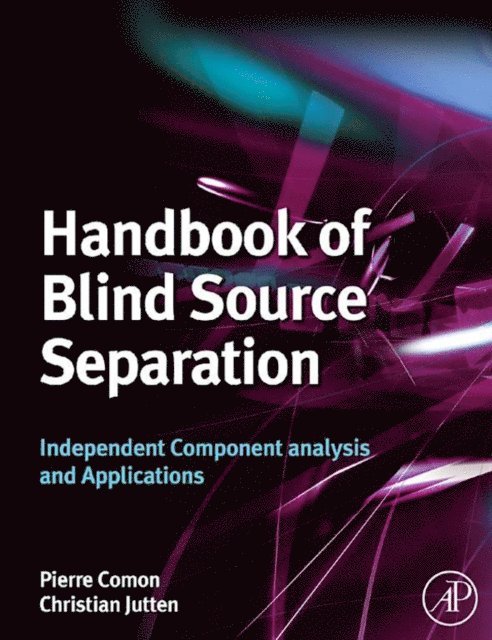
Edited by the people who were forerunners in creating the field, together with contributions from 34 leading international experts, this handbook provides the definitive reference on Blind Source Separation, giving a broad and comprehensive description of all the core principles and methods, numerical algorithms and major applications in the fields of telecommunications, biomedical engineering and audio, acoustic and speech processing. Going beyond a machine learning perspective, the book reflects recent results in signal processing and numerical analysis, and includes topics such as optimization criteria, mathematical tools, the design of numerical algorithms, convolutive mixtures, and time frequency approaches. This Handbook is an ideal reference for university researchers, R&D engineers and graduates wishing to learn the core principles, methods, algorithms, and applications of Blind Source Separation.
Covers the principles and major techniques and methods in one book Edited by the pioneers in the field with contributions from 34 of the world's experts Describes the main existing numerical algorithms and gives practical advice on their design Covers the latest cutting edge topics: second order methods; algebraic identification of under-determined mixtures, time-frequency methods, Bayesian approaches, blind identification under non negativity approaches, semi-blind methods for communications Shows the applications of the methods to key application areas such as telecommunications, biomedical engineering, speech, acoustic, audio and music processing, while also giving a general method for developing applications995 kr
Kommande
1 468 kr
Skickas inom 5-8 vardagar
1 708 kr
Läs direkt efter köp
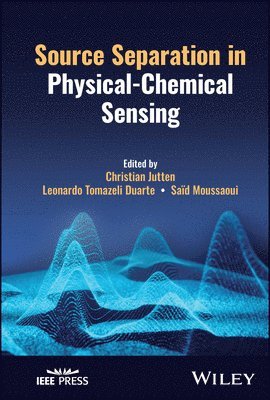
Master advanced signal processing for enhanced physical and chemical sensors with this essential guide
In many domains (medicine, satellite imaging and remote sensing, food industry, materials science), data is obtained from large sets of physical/chemical sensors or sensor arrays. Such sophisticated measurement techniques require advanced and smart processing for extracting useful information from raw sensing data. Usually, sensors are not very selective and record a mixture of the useful latent variables. An innovative technique called Blind Source Separation (BSS) can isolate and retrieve the individual latent variables from a mixed-source data array, allowing for refined analysis that fully exploits these cutting-edged imaging and signal-sensing technologies.
Source Separation in Physical-Chemical Sensing, supplies a thorough introduction to the principles of BSS, main methods and algorithms and its potential applications in various domains where data are obtained through physical or chemical sensors. Designed to bridge the gap between chemical/physical analysis and signal processing, it promises to be invaluable in many fields. Its alertness to the latest technologies and the full range of potential BSS applications make it an indispensable introduction to this cutting-edge method.
Source Separation in Physical-Chemical Sensing readers will also find:
BSS examples on chemical and physical sensors and devices to enhance processing and analysis. Detailed treatment of source separation in potentiometric sensors, ion-sensitive sensors, hyperspectral imaging, Raman and fluorescence spectroscopy, chromatography, and others. Thorough discussion of Bayesian source separation, nonnegative matrix factorization, tensorial methods, geometrical methods, constrained optimization, and more.Source Separation in Physical-Chemical Sensing is a must-have for researchers and engineers working in signal processing and statistical analysis, as well as for chemists, physicists or engineers looking to apply source separation in various application domains.
1 708 kr
Läs direkt efter köp
Master advanced signal processing for enhanced physical and chemical sensors with this essential guide
In many domains (medicine, satellite imaging and remote sensing, food industry, materials science), data is obtained from large sets of physical/chemical sensors or sensor arrays. Such sophisticated measurement techniques require advanced and smart processing for extracting useful information from raw sensing data. Usually, sensors are not very selective and record a mixture of the useful latent variables. An innovative technique called Blind Source Separation (BSS) can isolate and retrieve the individual latent variables from a mixed-source data array, allowing for refined analysis that fully exploits these cutting-edged imaging and signal-sensing technologies.
Source Separation in Physical-Chemical Sensing, supplies a thorough introduction to the principles of BSS, main methods and algorithms and its potential applications in various domains where data are obtained through physical or chemical sensors. Designed to bridge the gap between chemical/physical analysis and signal processing, it promises to be invaluable in many fields. Its alertness to the latest technologies and the full range of potential BSS applications make it an indispensable introduction to this cutting-edge method.
Source Separation in Physical-Chemical Sensing readers will also find:
BSS examples on chemical and physical sensors and devices to enhance processing and analysis. Detailed treatment of source separation in potentiometric sensors, ion-sensitive sensors, hyperspectral imaging, Raman and fluorescence spectroscopy, chromatography, and others. Thorough discussion of Bayesian source separation, nonnegative matrix factorization, tensorial methods, geometrical methods, constrained optimization, and more.Source Separation in Physical-Chemical Sensing is a must-have for researchers and engineers working in signal processing and statistical analysis, as well as for chemists, physicists or engineers looking to apply source separation in various application domains.
1 116 kr
Skickas inom 10-15 vardagar
1 408 kr
Läs direkt efter köp