Tuomas Heikkilä - Böcker
Visar alla böcker från författaren Tuomas Heikkilä. Handla med fri frakt och snabb leverans.
3 produkter
3 produkter
Nordic Latin Manuscript Fragments
The Destruction and Reconstruction of Medieval Books
Häftad, Engelska, 2019
648 kr
Skickas inom 10-15 vardagar
Much of what is known about the past often rests upon the chance survival of objects and texts. Nowhere is this better illustrated than in the fragments of medieval manuscripts re-used as bookbindings in the sixteenth and seventeenth centuries. Such fragments provide a tantalizing, yet often problematic glimpse into the manuscript culture of the Middle Ages. Exploring the opportunities and difficulties such documents provide, this volume concentrates on the c. 50,000 fragments of medieval Latin manuscripts stored in archives across the five Nordic countries of Denmark, Finland, Iceland, Norway and Sweden. This large collection of fragments (mostly from liturgical works) provides rich evidence about European Latin book culture, both in general and in specific relation to the far north of Europe, one of the last areas of Europe to be converted to Christianity. As the essays in this volume reveal, individual and groups of fragments can play a key role in increasing and advancing knowledge about the acquisition and production of medieval books, and in helping to distinguish locally made books from imported ones. Taking an imaginative approach to the source material, the volume goes beyond a strictly medieval context to integrate early modern perspectives that help illuminate the pattern of survival and loss of Latin manuscripts through post-Reformation practices concerning reuse of parchment. In so doing it demonstrates how the use of what might at first appear to be unpromising source material can offer unexpected and rewarding insights into diverse areas of European history and the history of the medieval book.
Nordic Latin Manuscript Fragments
The Destruction and Reconstruction of Medieval Books
Inbunden, Engelska, 2017
2 414 kr
Skickas inom 10-15 vardagar
Much of what is known about the past often rests upon the chance survival of objects and texts. Nowhere is this better illustrated than in the fragments of medieval manuscripts re-used as bookbindings in the sixteenth and seventeenth centuries. Such fragments provide a tantalizing, yet often problematic glimpse into the manuscript culture of the Middle Ages. Exploring the opportunities and difficulties such documents provide, this volume concentrates on the c. 50,000 fragments of medieval Latin manuscripts stored in archives across the five Nordic countries of Denmark, Finland, Iceland, Norway and Sweden. This large collection of fragments (mostly from liturgical works) provides rich evidence about European Latin book culture, both in general and in specific relation to the far north of Europe, one of the last areas of Europe to be converted to Christianity. As the essays in this volume reveal, individual and groups of fragments can play a key role in increasing and advancing knowledge about the acquisition and production of medieval books, and in helping to distinguish locally made books from imported ones. Taking an imaginative approach to the source material, the volume goes beyond a strictly medieval context to integrate early modern perspectives that help illuminate the pattern of survival and loss of Latin manuscripts through post-Reformation practices concerning reuse of parchment. In so doing it demonstrates how the use of what might at first appear to be unpromising source material can offer unexpected and rewarding insights into diverse areas of European history and the history of the medieval book.
Del 22 - Later Medieval Europe
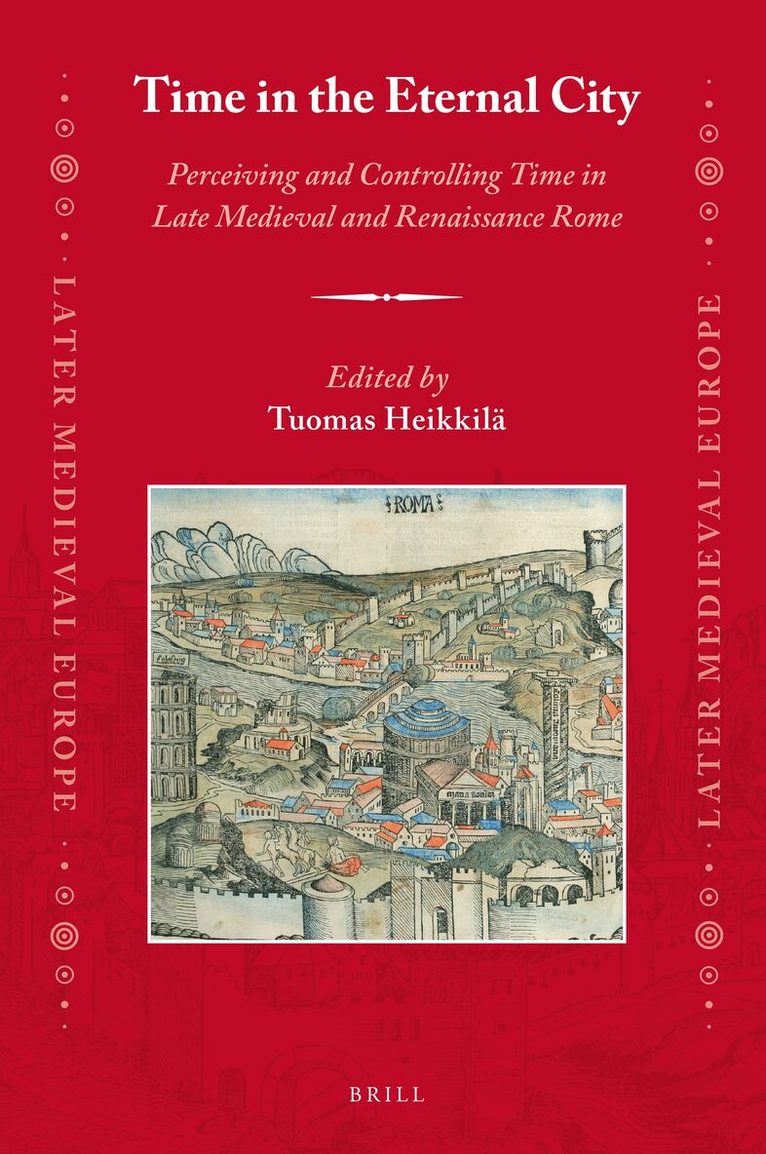
Time in the Eternal City
Perceiving and Controlling Time in Late Medieval and Renaissance Rome
Inbunden, Engelska, 2020
2 122 kr
Skickas inom 5-8 vardagar
Time in the Eternal City: Perceiving and Controlling Time in Late Medieval and Renaissance Rome is a major contribution to the study of time and its numerous aspects in late medieval and Renaissance Rome. The authors offer a versatile view on the variety of ways time could be perceived. Individual chapters concentrate on the grass-root levels of everyday life, on various uses of the past in the present, as well as on the control of time by the ecclesiastical authorities. These studies reveal a wealth of new information that demonstrates the almost endlessly fluid manner in which time could be perceived, as well as the innovative ways in which time could be used by individuals and authorities alike. Contributors are members of Tuomas Heikkilä’s research group at the Finnish Institute in Rome: Holger Kaasik, Urpo Kantola, Marko Halonen, Jasmin Lukkari and Saku Pihko.