V. Wiktor Marek - Böcker
Visar alla böcker från författaren V. Wiktor Marek. Handla med fri frakt och snabb leverans.
3 produkter
3 produkter
1 584 kr
Skickas inom 10-15 vardagar
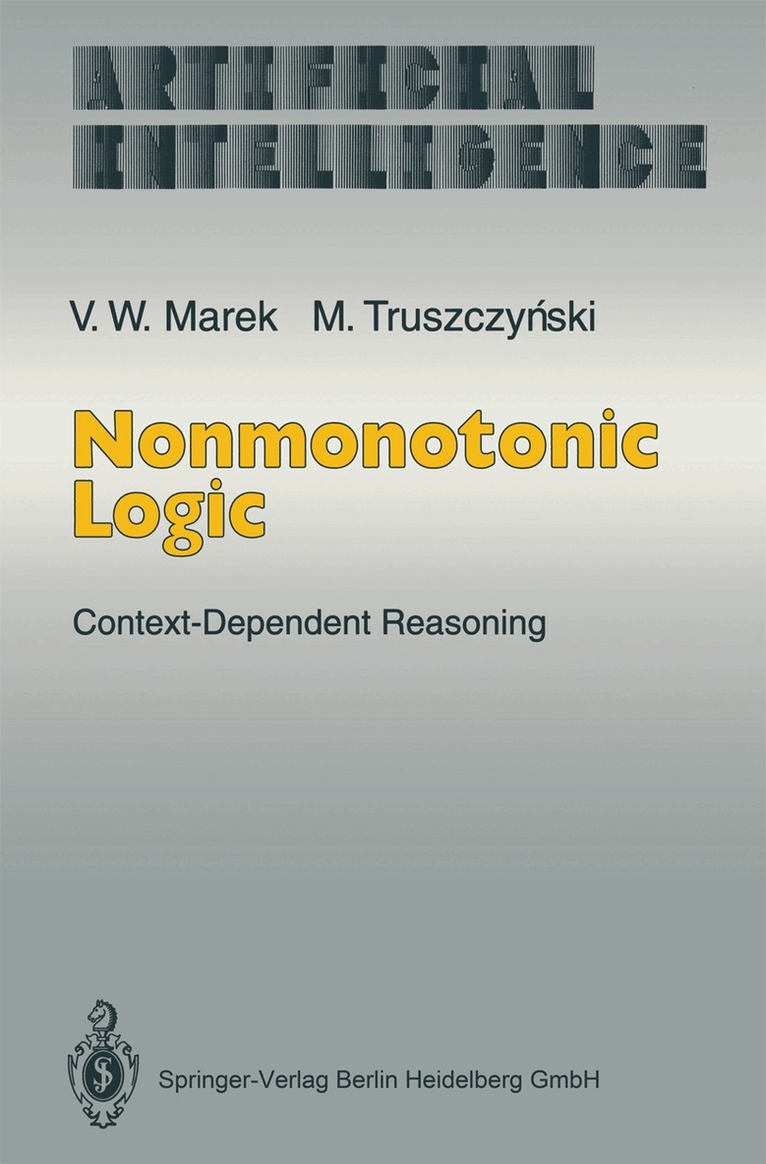
This monograph provides a thorough analysis of two importantformalisms for nonmonotonic reasoning: default logic andmodal nonmonotonic logics. It is also shown how they arerelated to each other and how they provide the formalfoundations for logic programming. The discussion isrigorous, and all main results are formally proved. Many ofthe results are deep and surprising, some of them previouslyunpublished. The book has three parts, on default logic, modalnonmonotonic logics, and connections and complexity issues,respectively. The study of general default logic is followedby a discussion of normal default logic and its connectionsto the closed world assumption, and also a presentation ofrelated aspects of logic programming. The general theory ofthe family of modal nonmonotonic logics introduced byMcDermott and Doyle is followed by studies of autoepistemiclogic, the logic of reflexive knowledge, and the logic ofpure necessitation, and also a short discussion ofalgorithms for computing knowledge and belief sets. Thethird part explores connections between default logic andmodal nonmonotonic logics and contains results on thecomplexity of nonmonotonic reasoning.The ideas are presented with an elegance and unity ofperspective that set a new standard of scholarship for booksin this area, and the work indicates that the field hasreached a very high level of maturity and sophistication. The book is intended as a reference on default logic,nonmonotonic logics, and related computational issues, andis addressed to researchers, programmers, and graduatestudents in the Artificial Intelligence community.
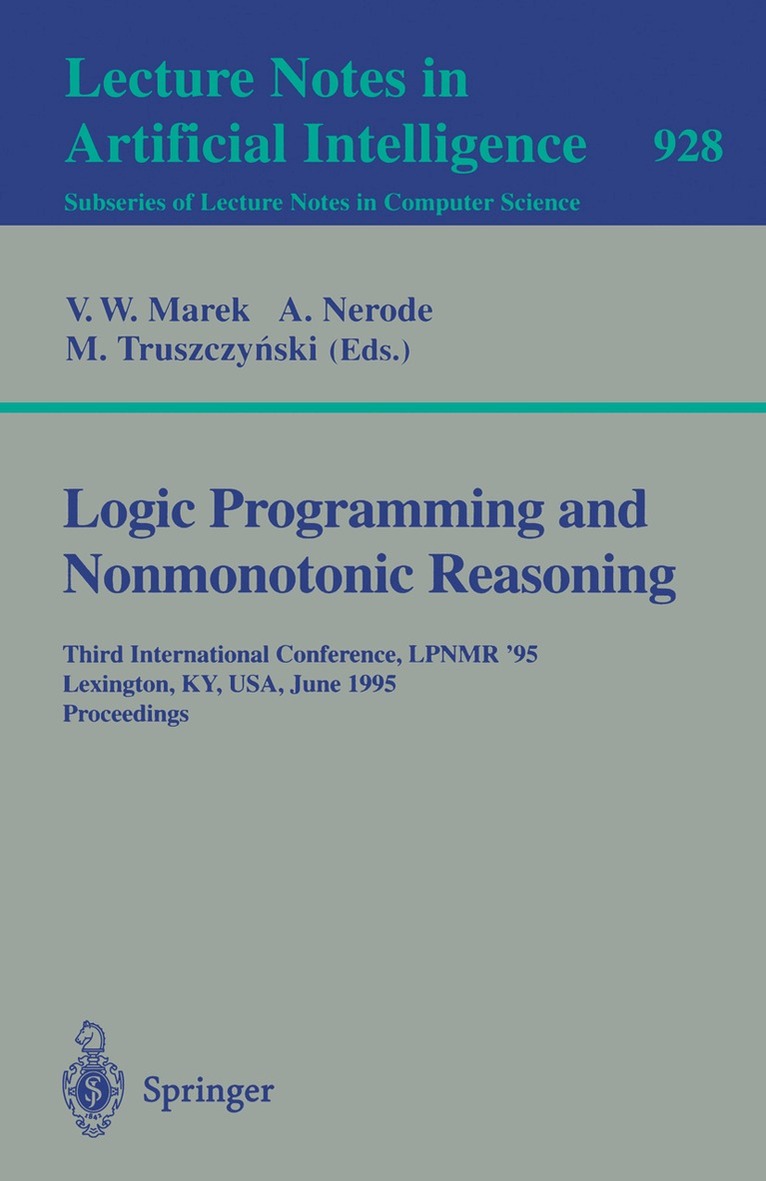
Logic Programming and Nonmonotonic Reasoning
Third International Conference, LPNMR '95, Lexington, KY, USA, June 26 - 28, 1995. Proceedings
Häftad, Engelska, 1995
554 kr
Skickas inom 10-15 vardagar
This volume contains the revised refereed papers accepted for presentation at the Third International Conference on Logic Programming and Nonmonotonic Reasoning, LPNMR '95, held in Lexington, KY, USA in June 1995 under the sponsorship of the Association for Logic Programming.The LPNMR conferences bring together researchers from logic programming and the logical foundations of artificial intelligence in order to facilitate cooperation and cross-fertilization of ideas. The 28 full papers presented define the state of the art in this interdisciplinary area of research, which has recently attracted much interest.
1 690 kr
Skickas inom 10-15 vardagar
When I first participated in exploring theories of nonmonotonic reasoning in the late 1970s, I had no idea of the wealth of conceptual and mathematical results that would emerge from those halting first steps. This book by Wiktor Marek and Miroslaw Truszczynski is an elegant treatment of a large body of these results. It provides the first comprehensive treatment of two influen tial nonmonotonic logics - autoepistemic and default logic - and describes a number of surprising and deep unifying relationships between them. It also relates them to various modal logics studied in the philosophical logic litera ture, and provides a thorough treatment of their applications as foundations for logic programming semantics and for truth maintenance systems. It is particularly appropriate that Marek and Truszczynski should have authored this book, since so much of the research that went into these results is due to them. Both authors were trained in the Polish school of logic and they bring to their research and writing the logical insights and sophisticated mathematics that one would expect from such a background. I believe that this book is a splendid example of the intellectual maturity of the field of artificial intelligence, and that it will provide a model of scholarship for us all for many years to come. Ray Reiter Department of Computer Science University of Toronto Toronto, Canada M5S 1A4 and The Canadian Institute for Advanced Research Table of Contents 1 1 Introduction .........