Vassilis Pontikis - Böcker
Visar alla böcker från författaren Vassilis Pontikis. Handla med fri frakt och snabb leverans.
8 produkter
8 produkter
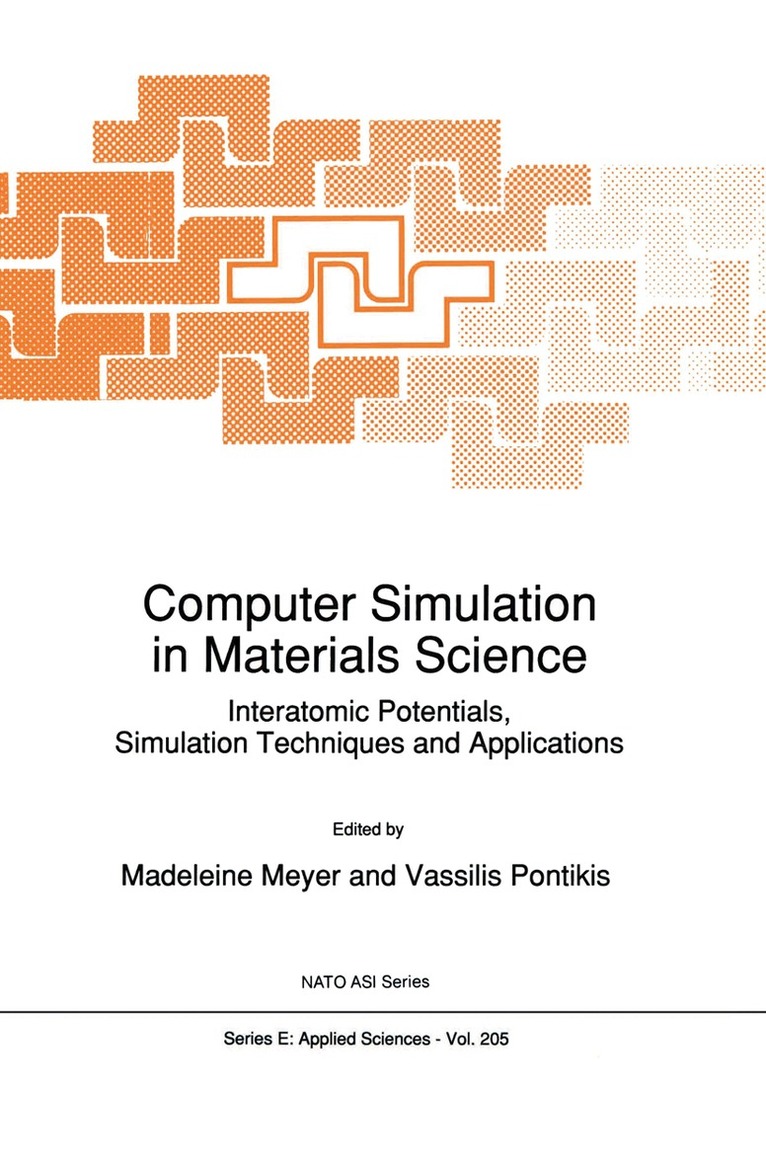
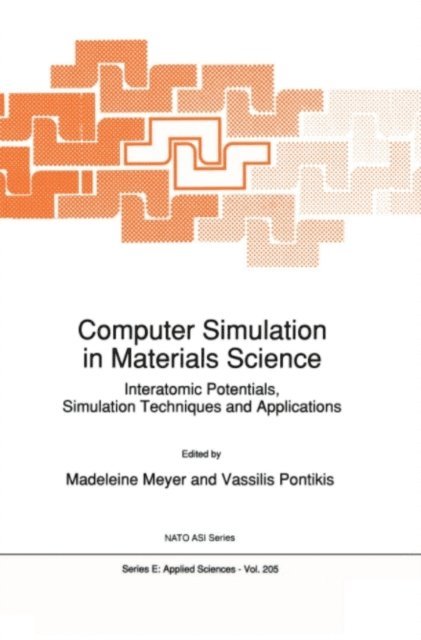
Computer Simulation in Materials Science
Interatomic Potentials, Simulation Techniques and Applications
Inbunden, Engelska, 1991
2 117 kr
Skickas inom 10-15 vardagar
This volume collects the contributions! to the NATO Advanced Study Institute (ASI) held in Aussois (France) by March 25 - April 5, 1991. This NATO ASI was intended to present and illustrate recent advances in computer simulation techniques applied to the study of materials science problems. Introductory lectures have been devoted to classical simulations with special reference to recent technical improvements, in view of their application to complex systems (glasses, molecular systems . . . ). Several other lectures and seminars focused on the methods of elaboration of interatomic potentials and to a critical presentation of quantum simulation techniques. On the other hand, seminars and poster sessions offered the opportunity to discuss the results of a great variety of simulation studies dealing with materials and complex systems. We hope that these proceedings will be of some help for those interested in simulations of material properties. The scientific committee advises have been of crucial importance in determining the conference program. The directors of the ASI express their gratitude to the colleagues who have participated to the committee: Y. Adda, A. Bellemans, G. BIeris, J. Castaing, C. R. A. Catlow, G. Ciccotti, J. Friedel, M. Gillan, J. P. Hansen, M. L. Klein, G. Martin, S. Nose, L. Rull-Fernandez, J. Valleau, J. Villain. The main financial support has been provided by the NATO Scientific Affairs Division and the Commission of European Communities (plan Science).
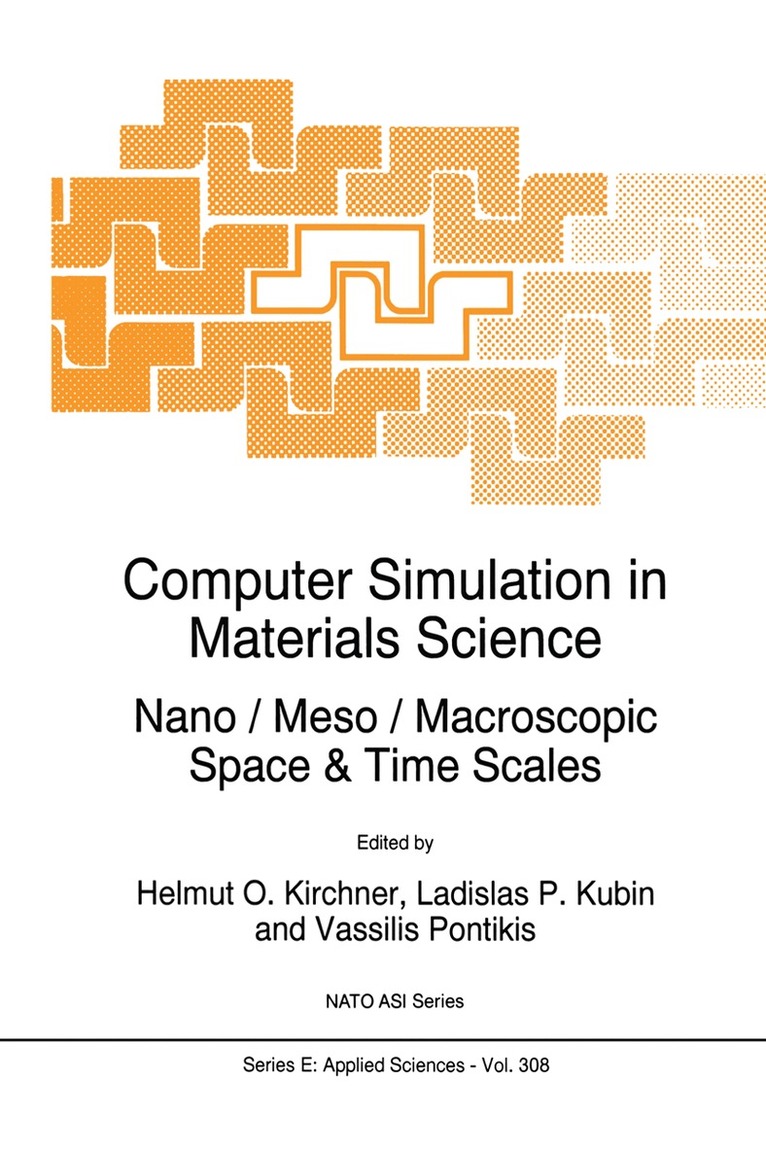
Computer Simulation in Materials Science
Nano / Meso / Macroscopic Space & Time Scales
Inbunden, Engelska, 1996
3 172 kr
Skickas inom 10-15 vardagar
For decades to come, the limits to computing power will not allow atomistic simulations of macroscopic specimens. Simulations can only be performed on various scales (nano, meso, micro and macro) using the input provided by simulations (or data) on the next smaller scale. The resulting hierarchy has been the focus of many seminars and lectures. Necessarily, special emphasis has been placed on mesoscopic simulations, bridging the gaps between nano (atomic) and micro space and time scales. The contributors to this work consider both fundamental problems and applications. Papers on the evolution of morphological patterns in phase transformations and plastic deformation, irradiation effects, mass transport and mechanical properties of materials in general highlight what has already been achieved. It is concluded that computer simulations must be based on realistic and efficient models: the fundamental equations controlling the dynamical evolution of microstructures, stochastic field kinetic models, being a case in point. The mesoscopic approach has proved particularly effective in plastic deformation and work hardening.On the mesoscopic scale, the contributions made to the deformation of polycrystals and localized plastic flow show the importance of computing power in ongoing and future research.
Del 367 - NATO Science Series E:
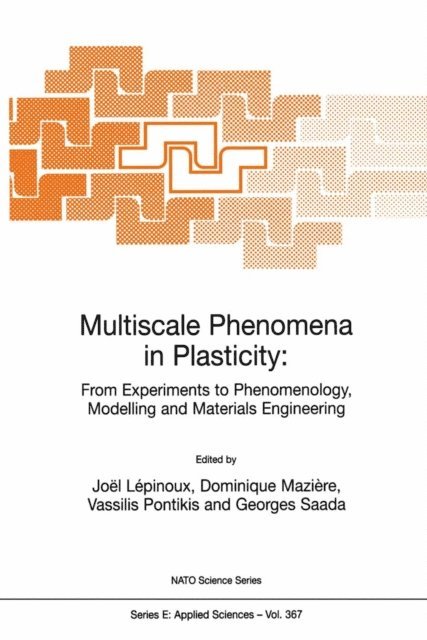
Multiscale Phenomena in Plasticity: From Experiments to Phenomenology, Modelling and Materials Engineering
Inbunden, Engelska, 2000
2 117 kr
Skickas inom 10-15 vardagar
The various scales of the physical phenomena occurring during plastic flow are reviewed from the atomic level to the constitutive laws, from both theoretical and experimental sides. The fundamentals of plastic flow are revisited, revealing the impact of recent experimental breakthroughs on the theoretical formulation. New developments (constrained plasticity, indentation) are also addressed. The importance of atomic scale phenomena on macroscopic mechanical behaviour are demonstrated in the case of cross-slip and its influence on fatigue properties, and in the effect of hydrogen on ductility. These developments emphasize the importance of the numerical methods used to connect the various scales and show that much remains to be done in this area. Classical fundamental problems, such as the brittle to ductile transition, are described by both experimentalists and theoreticians, as are constrained and heterogeneous deformation.
Multiscale Phenomena in Plasticity: From Experiments to Phenomenology, Modelling and Materials Engineering
Häftad, Engelska, 2000
2 117 kr
Skickas inom 10-15 vardagar
The various scales of the physical phenomena occurring during plastic flow are reviewed from the atomic level to the constitutive laws, from both theoretical and experimental sides. The fundamentals of plastic flow are revisited, revealing the impact of recent experimental breakthroughs on the theoretical formulation. New developments (constrained plasticity, indentation) are also addressed. The importance of atomic scale phenomena on macroscopic mechanical behaviour are demonstrated in the case of cross-slip and its influence on fatigue properties, and in the effect of hydrogen on ductility. These developments emphasize the importance of the numerical methods used to connect the various scales and show that much remains to be done in this area. Classical fundamental problems, such as the brittle to ductile transition, are described by both experimentalists and theoreticians, as are constrained and heterogeneous deformation.
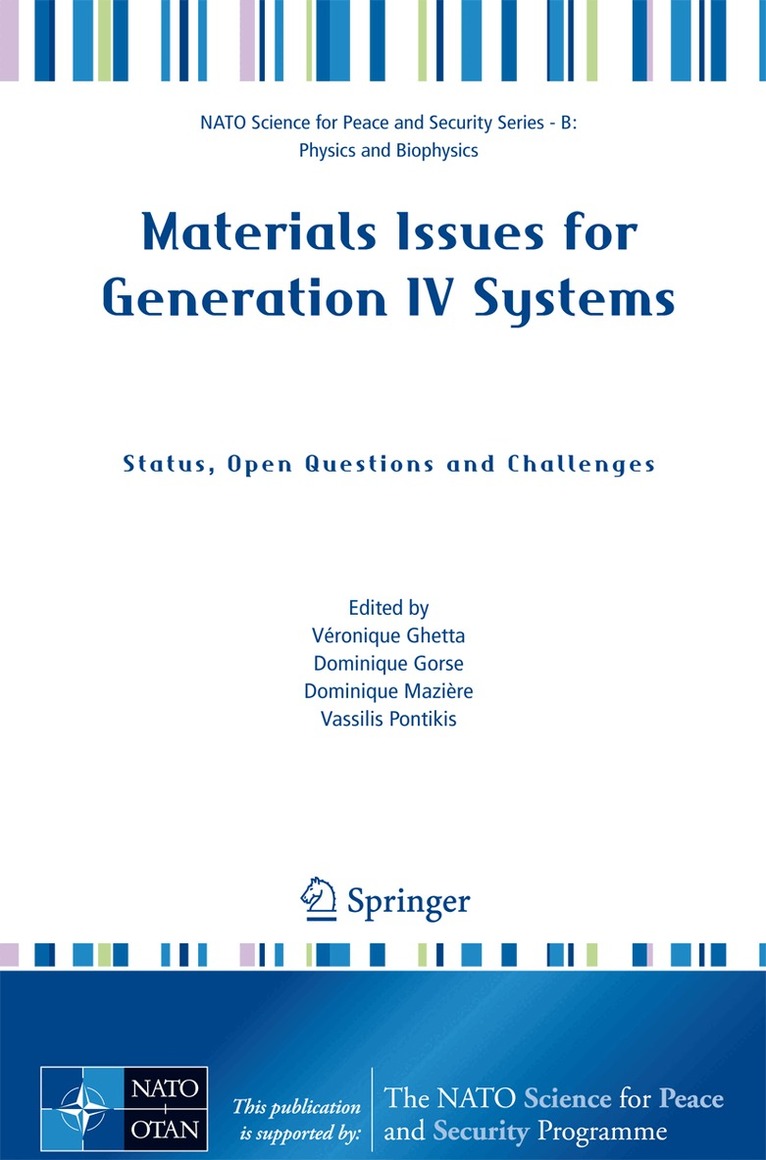
Materials Issues for Generation IV Systems
Status, Open Questions and Challenges
Inbunden, Engelska, 2008
3 172 kr
Skickas inom 10-15 vardagar
Global warming, shortage of low-cost oil resources and the increasing demand for energy are currently controlling the world's economic expansion while often opposing desires for sustainable and peaceful development. In this context, atomic energy satisfactorily fulfills the criteria of low carbon gas production and high overall yield. However, in the absence of industrial fast-breeders the use of nuclear fuel is not optimal, and the production of high activity waste materials is at a maximum. These are the principal reasons for the development of a new, fourth generation of nuclear reactors, minimizing the undesirable side-effects of current nuclear energy production technology while increasing yields by increasing operation temperatures and opening the way for the industrial production of hydrogen through the decomposition of water.The construction and use of such reactors is hindered by several factors, including performance limitations of known structural materials, particularly if the life of the projected systems had to extend over the periods necessary to achieve low costs (at least 60 years).This book collects lectures and seminars presented at the homonymous NATO ASI held in autumn 2007 at the Institut d’Etudes Scientifiques in Cargèse, France. The adopted approach aims at improving and coordinating basic knowledge in materials science and engineering with specific areas of condensed matter physics, the physics of particle/matter interaction and of radiation damage. It is our belief that this methodology is crucially conditioning the development and the industrial production of new structural materials capable of coping with the requirements of these future reactors.
Materials Issues for Generation IV Systems
Status, Open Questions and Challenges
Häftad, Engelska, 2008
3 172 kr
Skickas inom 10-15 vardagar
Global warming, shortage of low-cost oil resources and the increasing demand for energy are currently controlling the world's economic expansion while often opposing desires for sustainable and peaceful development. In this context, atomic energy satisfactorily fulfills the criteria of low carbon gas production and high overall yield. However, in the absence of industrial fast-breeders the use of nuclear fuel is not optimal, and the production of high activity waste materials is at a maximum. These are the principal reasons for the development of a new, fourth generation of nuclear reactors, minimizing the undesirable side-effects of current nuclear energy production technology while increasing yields by increasing operation temperatures and opening the way for the industrial production of hydrogen through the decomposition of water.The construction and use of such reactors is hindered by several factors, including performance limitations of known structural materials, particularly if the life of the projected systems had to extend over the periods necessary to achieve low costs (at least 60 years).This book collects lectures and seminars presented at the homonymous NATO ASI held in autumn 2007 at the Institut d’Etudes Scientifiques in Cargèse, France. The adopted approach aims at improving and coordinating basic knowledge in materials science and engineering with specific areas of condensed matter physics, the physics of particle/matter interaction and of radiation damage. It is our belief that this methodology is crucially conditioning the development and the industrial production of new structural materials capable of coping with the requirements of these future reactors.
Computer Simulation in Materials Science
Interatomic Potentials, Simulation Techniques and Applications
Häftad, Engelska, 2012
2 117 kr
Skickas inom 10-15 vardagar
This volume collects the contributions! to the NATO Advanced Study Institute (ASI) held in Aussois (France) by March 25 - April 5, 1991. This NATO ASI was intended to present and illustrate recent advances in computer simulation techniques applied to the study of materials science problems. Introductory lectures have been devoted to classical simulations with special reference to recent technical improvements, in view of their application to complex systems (glasses, molecular systems . . . ). Several other lectures and seminars focused on the methods of elaboration of interatomic potentials and to a critical presentation of quantum simulation techniques. On the other hand, seminars and poster sessions offered the opportunity to discuss the results of a great variety of simulation studies dealing with materials and complex systems. We hope that these proceedings will be of some help for those interested in simulations of material properties. The scientific committee advises have been of crucial importance in determining the conference program. The directors of the ASI express their gratitude to the colleagues who have participated to the committee: Y. Adda, A. Bellemans, G. BIeris, J. Castaing, C. R. A. Catlow, G. Ciccotti, J. Friedel, M. Gillan, J. P. Hansen, M. L. Klein, G. Martin, S. Nose, L. Rull-Fernandez, J. Valleau, J. Villain. The main financial support has been provided by the NATO Scientific Affairs Division and the Commission of European Communities (plan Science).
Computer Simulation in Materials Science
Nano / Meso / Macroscopic Space & Time Scales
Häftad, Engelska, 2011
3 172 kr
Skickas inom 10-15 vardagar
This volume collects the contributions to the NATO Advanced Study Institute (ASI); "Computer Simulation in Materials Science -NanolMesolMacroscopic Space and Time Scales", held on lIe d'OIeron (France) June 6-16, 1995.1his event was intended to present the state of the art in simulation techniques in Materials Science. For decades to come the limits of computing power will not allow for atomistic simulations of macroscopic specimens. Simulations can only be performed on various scales (nano, meso, micro, macro) with the constitutive input provided by simulations (or data) on the next smaller scale. The resulting hierarchy has been the main topic of many of lectures and seminars. Necessarily, special emphasis was placed on mesoscopic simulations bridging the gaps between nano (atomic) and micro space and time scales. During the ASI, lecturers and participants did not only consider fundamental problems, but also applications. Papers on the evolution of morphological patterns in phase transformations and plastic deformation, irradiation effects, mass transport and mechanical properties of materials in general, highlighted what has already been achieved. It was concluded that computer simulations must be based on realistic and efficient models, the fundamental equations controlling the dynamical evolution of microstructures, stochastic field kinetic models being a case in point.