Victor R. Fuchs – författare
Visar alla böcker från författaren Victor R. Fuchs. Handla med fri frakt och snabb leverans.
11 produkter
11 produkter
Individual and Social Responsibility
Child Care, Education, Medical Care, and Long-Term Care in America
Inbunden, Engelska, 1996
1 343 kr
Skickas
Does the US government spend too little or too much on child care? How can education dollars be spent more efficiently? Should the government's role in medical care increase or decrease? In this volume, social scientists, lawyers and a physician explore the political, social and economic forces that shape policies affecting human services. Four studies of human-service sectors - child care, education, medical care and long-term care for the elderly - are followed by six cross-sector studies that stimulate new ways of thinking about human services through the application of economic theory, institutional analysis and the history of social policy. Seeking to shed light on the tension between individual and social responsibility, this book should appeal to economists and other social scientists and policy-makers concerned with social policy issues. The contributors include Kenneth J. Arrow, Martin Feldstein, Victor Fuchs, Alan M. Garber, Eric A. Hanushek, Christopher Jencks, Seymour Martin Lipset, Glenn Loury, Roger G. Noll, Paul M. Romer, Amartya Sen and Theda Skocpol.
418 kr
Skickas inom 10-15 vardagar
Americans are understandably concerned about the runaway costs of medical care and the fact that one citizen out of seven is without health insurance coverage. Solving these problems is a top priority for the Clinton administration, but as Victor Fuchs shows, the task is enormously complex. In this book Fuchs, America's foremost health economist, provides the reader with the necessary concepts, facts, and analyses to comprehend the complicated issues of health policy. He shows why health care reform that benefits society as a whole will unavoidably burden certain individuals and groups.Fuchs addresses such central questions as cost containment, managed competition, technology assessment, poverty and health, children's health, and national health insurance. The future of U.S. health policy, he argues, is tightly linked to three basic questions; First, how can we disengage health insurance from employment? Second, how can we tame technological change in health care? And finally how can we cope with the runaway medical costs of an aging society?
363 kr
Skickas inom 10-15 vardagar
Victor Fuchs, author of Who Shall Live?, cuts through the hand wringing and the “pop” panaceas for America's current social crises in a brilliant analysis of the way we live. The facts are familiar. A doubled rate of divorce. A birth rate cut nearly in half while the percentage of illegitimate births nearly tripled. The young face dismal job prospects, and many of the old are totally dependent on the federal government.Fuchs's economic approach shows us that the societal upheaval of American life is not created by fiat but rather emerges as millions of men and women make seemingly small choices that are constrained by their circumstances: “Should I go back to school?” “How many children should we have?” “When should I retire?” In a masterly synthesis, he shows the interrelatedness of our choices regarding family, work, health, and education throughout the life cycle. He uses the latest facts of American life to explore three major themes—the fading family, the impact of simple demographics on individual destiny, and the effect of weighing present and future costs and benefits on individual choice.Fuchs concludes by offering innovative solutions to many contemporary problems: social security, health insurance, child care, youth unemployment, and illegitimate births. Moving beyond the outworn orthodoxies of liberalism and conservatism, he offers a clearer view of our circumstances so that readers from all walks of life can make better private choices, and contribute to more effective public policies.
341 kr
Skickas inom 10-15 vardagar
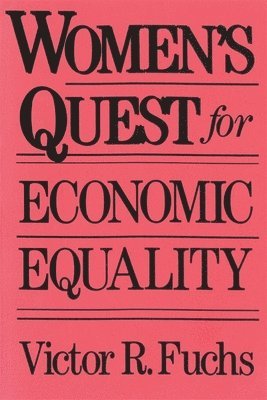
It may seem to the casual observer that women have made striking gains in their quest for equality with men since the early 1960s. But have they really improved their lot? Are they really better off economically? In this clear, compact, and controversial book Victor Fuchs makes plain that except for women who are young, white, unmarried, and well educated, today’s women have not gained economically at all relative to men. He shows that although women are earning a lot more, they have much less leisure time than they used to while men have more; the decline of marriage has made women more dependent on their own income, and their share of financial responsibility for children has grown.Scrutinizing this relative lack of progress and the reasons for the persistence of occupational segregation, the infamous wage gap, and the unequal responsibility for housework and childcare, Fuchs shows that the standard explanations—discrimination and exploitation by employers—are not the most important causes. Women’s weaker economic position results primarily from conflicts between career and family, conflicts that are stronger for women than for men. Fuchs assembles many different kinds of evidence to suggest that, on average, women feel a stronger desire for children than men do, and have a greater concern for their welfare after they are born. This desire and concern create an economic disadvantage for women, even women who never marry and never have children.
Del 3 - Economic Ideas Leading To The 21st Century
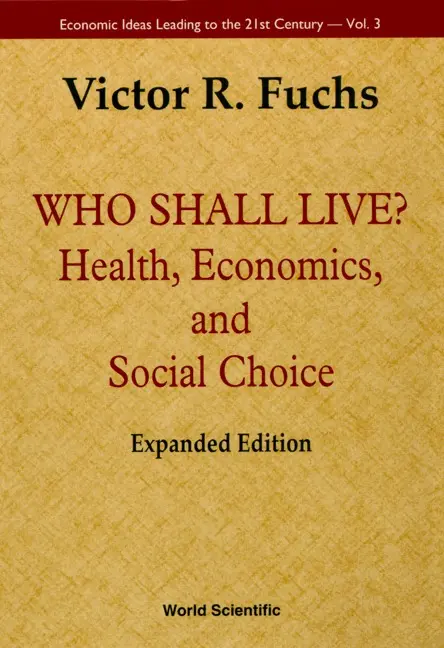
Who Shall Live? Health, Economics, And Social Choice (Expanded Edition)
Inbunden, Engelska, 1998
838 kr
Tillfälligt slut
In this classic book, Professor Victor Fuchs draws on his deep understanding of the strengths and limitations of economics and his intimate knowledge of health care institutions to help readers understand the problems every nation faces in trying to allocate health resources efficiently and equitably. Six complementary papers dealing with national health insurance, poverty and health, and other policy issues, including his 1996 presidential address to the American Economic Association, accompany the original 1974 text.Health professionals, policy makers, social scientists, students and concerned citizens will all benefit from this highly readable, authoritative, and nuanced discussion of the difficult choices that lie ahead.
Del 3 - Economic Ideas Leading To The 21st Century
Who Shall Live? Health, Economics, And Social Choice (Expanded Edition)
Häftad, Engelska, 1998
598 kr
Tillfälligt slut
In this classic book, Professor Victor Fuchs draws on his deep understanding of the strengths and limitations of economics and his intimate knowledge of health care institutions to help readers understand the problems every nation faces in trying to allocate health resources efficiently and equitably. Six complementary papers dealing with national health insurance, poverty and health, and other policy issues, including his 1996 presidential address to the American Economic Association, accompany the original 1974 text.Health professionals, policy makers, social scientists, students and concerned citizens will all benefit from this highly readable, authoritative, and nuanced discussion of the difficult choices that lie ahead.
1 132 kr
Skickas inom 5-8 vardagar
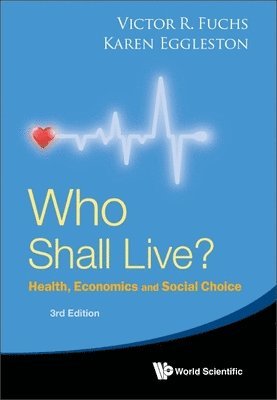
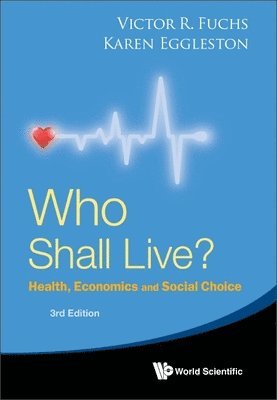
"Vic Fuchs' Who Shall Live? is the most important book ever on health economics. It has inspired us all these many years, and it is terrific to see a new edition, post-Obamacare and post-pandemic."Sir Angus S DeatonRecipient of the Nobel Prize in Economics 2015"In considering the great health challenges of our time Victor Fuchs' work remains more important than ever. In the third edition, Fuchs' seminal text has been expanded to reflect recent policy and politics. It remains essential reading to better understand the complex interaction between social determinants, health and health care costs."Victor J Dzau, MDPresident, National Academy of MedicineSince the first edition of Who Shall Live? (1974), over 100,000 students, teachers, physicians, and general readers from more than a dozen fields have found this book to be a reader-friendly, authoritative introduction to economic concepts applied to health and medical care.Health care is by far the largest industry in the United States. It is three times larger than education and five times as large as national defense. In 2001, Americans spent over $12,500 per person for hospitals, physicians, drugs and other health care services and goods. Other high-income democracies spend one third less, enjoy three more years of life expectancy, and have more equal access to medical care.In this book, each of the chapters of the original edition is followed by supplementary readings on such subjects as: "Social Determinants of Health: Caveats and Nuances", "The Structure of Medical Education — It's Time for a Change", and "How to Save $1 Trillion Out of Health Care".The ten years following publication of the 2nd expanded edition in 2011 were arguably more turbulent for US health and health care than any other ten-year period since World War II. They span the implementation of the Affordable Care Act, the deepening opioid epidemic, and the physical, psychological, and socio-economic traumas of the COVID-19 pandemic.An important new contribution to this book is to describe and analyze the changes in five sections: "The Affordable Care Act and the Uninsured", "Health Care Expenditures", "Health Outcomes", "The COVID-19 Pandemic", and "Health and Politics". This part includes 24 tables and figures.This book will be welcomed by students, professionals, and life-long learners to gain increased understanding of the relation between health, economics, and social choice.
652 kr
Skickas inom 3-6 vardagar
"Vic Fuchs' Who Shall Live? is the most important book ever on health economics. It has inspired us all these many years, and it is terrific to see a new edition, post-Obamacare and post-pandemic."Sir Angus S DeatonRecipient of the Nobel Prize in Economics 2015"In considering the great health challenges of our time Victor Fuchs' work remains more important than ever. In the third edition, Fuchs' seminal text has been expanded to reflect recent policy and politics. It remains essential reading to better understand the complex interaction between social determinants, health and health care costs."Victor J Dzau, MDPresident, National Academy of MedicineSince the first edition of Who Shall Live? (1974), over 100,000 students, teachers, physicians, and general readers from more than a dozen fields have found this book to be a reader-friendly, authoritative introduction to economic concepts applied to health and medical care.Health care is by far the largest industry in the United States. It is three times larger than education and five times as large as national defense. In 2001, Americans spent over $12,500 per person for hospitals, physicians, drugs and other health care services and goods. Other high-income democracies spend one third less, enjoy three more years of life expectancy, and have more equal access to medical care.In this book, each of the chapters of the original edition is followed by supplementary readings on such subjects as: "Social Determinants of Health: Caveats and Nuances", "The Structure of Medical Education — It's Time for a Change", and "How to Save $1 Trillion Out of Health Care".The ten years following publication of the 2nd expanded edition in 2011 were arguably more turbulent for US health and health care than any other ten-year period since World War II. They span the implementation of the Affordable Care Act, the deepening opioid epidemic, and the physical, psychological, and socio-economic traumas of the COVID-19 pandemic.An important new contribution to this book is to describe and analyze the changes in five sections: "The Affordable Care Act and the Uninsured", "Health Care Expenditures", "Health Outcomes", "The COVID-19 Pandemic", and "Health and Politics". This part includes 24 tables and figures.This book will be welcomed by students, professionals, and life-long learners to gain increased understanding of the relation between health, economics, and social choice.
3 078 kr
Skickas
"The collection represents an extraordinary intellectual achievement and ... a handbook for anyone thinking about health and health policy."Foreword by Sir Angus Deatonwinner of the Nobel Prize in Economics "Victor Fuchs ... is one of the world's most influential figures in health, medicine, and policy ... His writings could be considered the single most authoritative guidebook on health economics."Foreword by Victor J Dzau, MDPresident of the National Academy of Medicine Victor Fuchs offers a selection of his public lectures, articles, papers, and op-eds during the past 50 years. Also included are forewords by Sir Angus Deaton, Nobel Prize Laureate in Economics, and Victor Dzau, MD, president of the National Academy of Medicine. Organized in eight parts, it begins with an introduction to the field of health economics and ends with tributes to the founders and leaders of the field. In between, Fuchs discusses the determinants of health, the cost of medical care, international comparisons, health insurance, demography and aging, and health policy and health care reform. A special introduction precedes each Part. This book represents what Fuchs calls the economic perspective applied to health and medical care, a perspective of which Angus Deaton says, "Fuchs has long been the master."
1 045 kr
Skickas inom 5-8 vardagar
Since the first edition of Who Shall Live? (1974) over 100,000 students, teachers, physicians, and general readers from more than a dozen fields have found this book to be a reader-friendly, authoritative introduction to economic concepts applied to health and medical care. Fuchs provides clear explanations and memorable examples of the importance of the non-medical determinants of health, the dominant role of physicians in health care expenditures, the necessity of choices about health at the individual and societal levels, and many other compelling themes.Now, in a new introduction of some 8,000 words including new tables and figures, Fuchs, often called the “Dean of health economists”, concisely summarizes the major changes of the past 37 years in health, medical care, and health policy. He focuses primarily on the United States but includes remarks about health policy in other countries, and addresses the question of whether national health care systems are becoming more alike. In addition to reviewing changes, the introduction explains why health expenditures grow so rapidly, why health spending in the United States is so much greater than in other countries, and what physicians need in order to practice cost-effective medicine.This second expanded edition also includes recent papers by Fuchs on the economics of aging, the socio-economic correlates of health, the future of health economics, and his policy recommendations for the United States to secure universal coverage, control of costs, and improvement in the quality of care. As was true of the first expanded edition (1998), this book will be welcomed by current students and life-long learners in economics, other social and behavioral sciences, medicine, public health, law, business, public policy, and other fields who want to understand the relation between health, economics, and social choice.
479 kr
Tillfälligt slut
Since the first edition of Who Shall Live? (1974) over 100,000 students, teachers, physicians, and general readers from more than a dozen fields have found this book to be a reader-friendly, authoritative introduction to economic concepts applied to health and medical care. Fuchs provides clear explanations and memorable examples of the importance of the non-medical determinants of health, the dominant role of physicians in health care expenditures, the necessity of choices about health at the individual and societal levels, and many other compelling themes.Now, in a new introduction of some 8,000 words including new tables and figures, Fuchs, often called the “Dean of health economists”, concisely summarizes the major changes of the past 37 years in health, medical care, and health policy. He focuses primarily on the United States but includes remarks about health policy in other countries, and addresses the question of whether national health care systems are becoming more alike. In addition to reviewing changes, the introduction explains why health expenditures grow so rapidly, why health spending in the United States is so much greater than in other countries, and what physicians need in order to practice cost-effective medicine.This second expanded edition also includes recent papers by Fuchs on the economics of aging, the socio-economic correlates of health, the future of health economics, and his policy recommendations for the United States to secure universal coverage, control of costs, and improvement in the quality of care. As was true of the first expanded edition (1998), this book will be welcomed by current students and life-long learners in economics, other social and behavioral sciences, medicine, public health, law, business, public policy, and other fields who want to understand the relation between health, economics, and social choice.