Victoria Beatrix Maria Fendel - Böcker
Visar alla böcker från författaren Victoria Beatrix Maria Fendel. Handla med fri frakt och snabb leverans.
2 produkter
2 produkter
1 996 kr
Skickas inom 5-8 vardagar
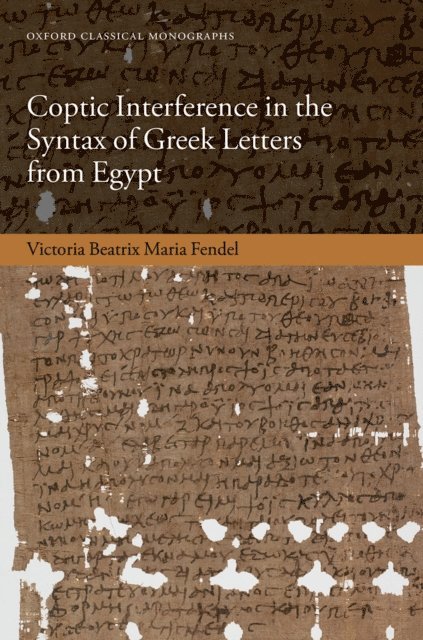
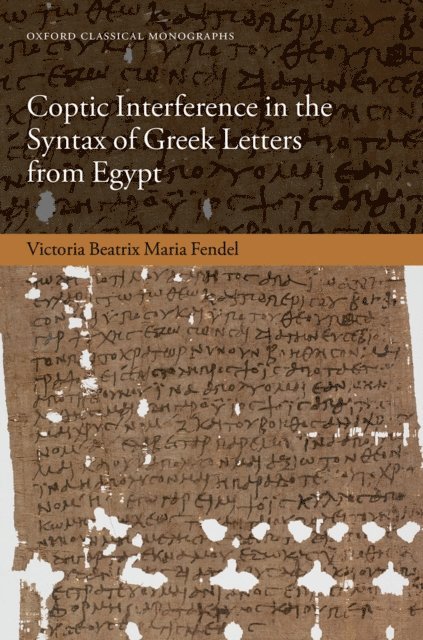
Egypt in the early Byzantine period was a bilingual country where Greek and Egyptian (Coptic) were used alongside each other. Historical studies along with linguistic studies of the phonology and lexicon of early Byzantine Greek in Egypt testify to this situation. In order to describe the linguistic traces that the language-contact situation left behind in individuals' linguistic output, Coptic Interference in the Syntax of Greek Letters from Egypt analyses the syntax of early Byzantine Greek texts from Egypt. The primary object of interest is bilingual interference in the syntax of verbs, adverbial phrases, clause linkage as well as in semi-formulaic expressions and formulaic frames. The study is based on a corpus of Greek and Coptic private letters on papyrus, which date from the fourth to mid-seventh centuries, originate from Egypt and belong to bilingual, Greek-Coptic, papyrus archives.
760 kr
Kommande
Sociopragmatic Translation in Latin teaches how to use the principles of sociopragmatics on canonical classical Latin texts in order to (re-)embed them in their settings and discourse(s).A common interview response to the question of why someone wants to learn an ancient language from scratch is that it is about connecting with the text and/or author more intimately. Usually, when prompting further, things get derailed. The biggest hurdle between us and the ancient author and/or text is often not so much the surface-level vocabulary, but how we approach the text as a whole, i.e. its genre, register, and style as well as its topic, focus, and relationship to the reader. This book addresses common misconceptions about the translation technique and result, and all of them come back to sociopragmatics and thus to an area of linguistics alien to many aspiring Classicists. This book revisits common grammatical and methodological troublemakers specifically from the perspective of sociopragmatics to help achieve the best translation (and commentary) result possible. It is a practical guide on how to implement theoretical concepts in order to achieve a more accurate translation and one that brings us closer to the ancient audience.Every translation is an interpretation. In the age of DeepL and co., transposing a source text into a target language may seem easier than ever. However, purposefully translating a text to reflect its social, cultural, material embedding into its original context and discourse in a way that resonates with the intended audience of the translation has never been more complicated. The book is unique: first, in its drawing linguistic research into everyday translation practice. Secondly, it offers a full range of pedagogical features that makes this more than a monograph but rather an interactive resource. It offers case studies with reflection questions/tasks, in-text bite-size translation tricks, a glossary of terminology, and an answer key for each exercise. Thirdly, the book aims to bring about a paradigm shift in the approach to translation across classical subjects, i.e. the co-text, context, and the social and material settings are drawn upon to arrive at a translation that reflects the reality the source text emerged from and that does it justice.