Victoria Wohl - Böcker
Visar alla böcker från författaren Victoria Wohl. Handla med fri frakt och snabb leverans.
8 produkter
8 produkter
385 kr
Skickas inom 7-10 vardagar
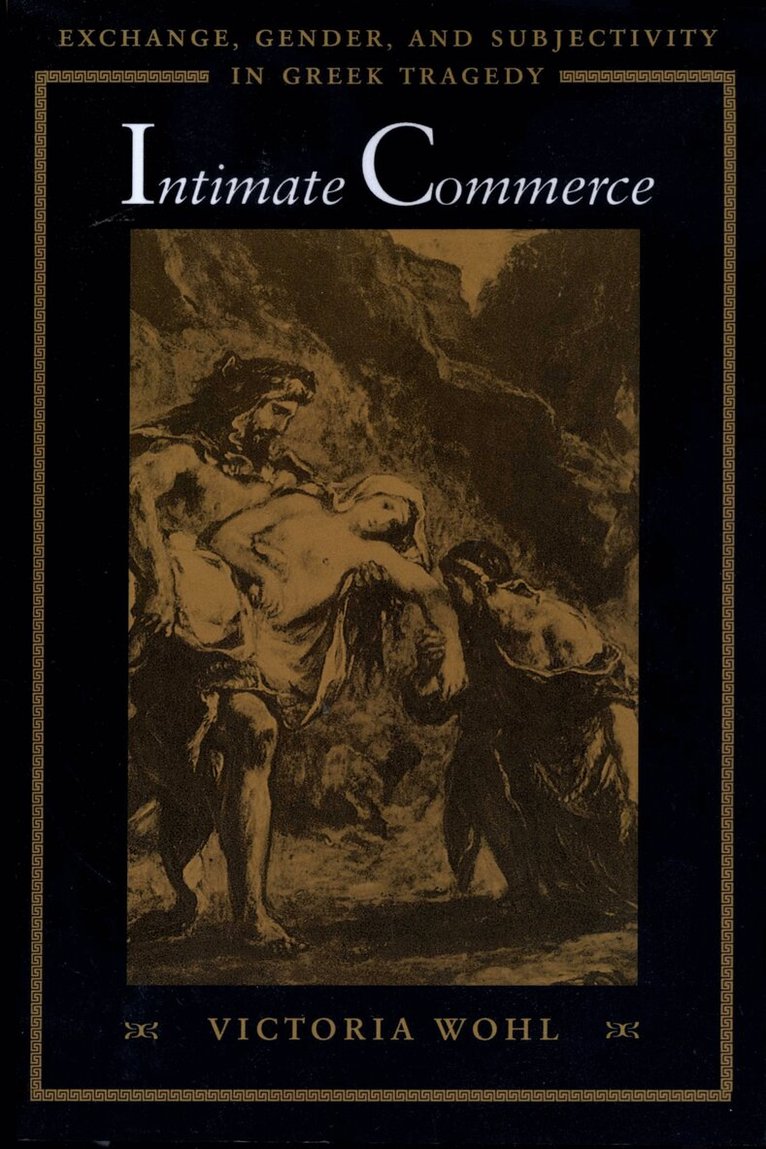
Exchanges of women between men occur regularly in Greek tragedy-and almost always with catastrophic results. Instead of cementing bonds between men, such exchanges rend them. They allow women, who should be silent objects, to become monstrous subjects, while men often end up as lifeless corpses. But why do the tragedies always represent the transferal of women as disastrous?Victoria Wohl offers an illuminating analysis of the exchange of women in Sophocles' Trachiniae, Aeschylus' Agamemnon, and Euripides' Alcestis. She shows how the attempts of women in these plays to become active subjects rather than passive objects of exchange inevitably fail. While these failures seem to validate male hegemony, the women's actions, however futile, blur the distinction between male subject and female object, calling into question the very nature of the tragic self. What the tragedies thus present, Wohl asserts, is not only an affirmation of Athens' reigning ideologies (including its gender hierarchy) but also the possibility of resistance to them and the imagination of alternatives.
Del 78 - Sather Classical Lectures
Poetry of Being and the Prose of the World in Early Greek Philosophy
Häftad, Engelska, 2025
324 kr
Skickas inom 7-10 vardagar
A free ebook version of this title is available through Luminos, University of California Press’s Open Access publishing program. Visit www.luminosoa.org to learn more.The Presocratic philosophers, writing in Greece in the sixth and fifth centuries BCE, invented new ways of thinking about human life, the natural world, and structures of reality. They also developed novel ways of using language to express their thought. In this book, Victoria Wohl examines these innovations and the productive relation between them in the work of five figures: Parmenides, Heraclitus, Empedocles, Anaxagoras, and Democritus. Bringing these thinkers into conversation with modern critical theorists on questions of shared concern, Wohl argues for the poetic sophistication of their work and the inextricable convergence of their aesthetic form and philosophical content. In addition to offering original readings of these fascinating figures and robust strategies for interpreting their fragmentary, rebarbative texts, this book invites readers to communicate across entrenched divisions between literature and philosophy and between antiquity and modernity.
Del 78 - Sather Classical Lectures
Poetry of Being and the Prose of the World in Early Greek Philosophy
Inbunden, Engelska, 2025
866 kr
Skickas inom 7-10 vardagar
A free ebook version of this title is available through Luminos, University of California Press’s Open Access publishing program. Visit www.luminosoa.org to learn more.The Presocratic philosophers, writing in Greece in the sixth and fifth centuries BCE, invented new ways of thinking about human life, the natural world, and structures of reality. They also developed novel ways of using language to express their thought. In this book, Victoria Wohl examines these innovations and the productive relation between them in the work of five figures: Parmenides, Heraclitus, Empedocles, Anaxagoras, and Democritus. Bringing these thinkers into conversation with modern critical theorists on questions of shared concern, Wohl argues for the poetic sophistication of their work and the inextricable convergence of their aesthetic form and philosophical content. In addition to offering original readings of these fascinating figures and robust strategies for interpreting their fragmentary, rebarbative texts, this book invites readers to communicate across entrenched divisions between literature and philosophy and between antiquity and modernity.
1 485 kr
Skickas inom 7-10 vardagar
Recent literary-critical work in legal studies reads law as a genre of literature, noting that Western law originated as a branch of rhetoric in classical Greece and lamenting the fact that the law has lost its connection to poetic language, narrative, and imagination. But modern legal scholarship has paid little attention to the actual juridical discourse of ancient Greece. This book rectifies that neglect through an analysis of the courtroom speeches from classical Athens, texts situated precisely at the intersection between law and literature. Reading these texts for their subtle literary qualities and their sophisticated legal philosophy, it proposes that in Athens' juridical discourse literary form and legal matter are inseparable. Through its distinctive focus on the literary form of Athenian forensic oratory, Law's Cosmos aims to shed new light on its juridical thought, and thus to change the way classicists read forensic oratory and legal historians view Athenian law.
897 kr
Skickas inom 7-10 vardagar
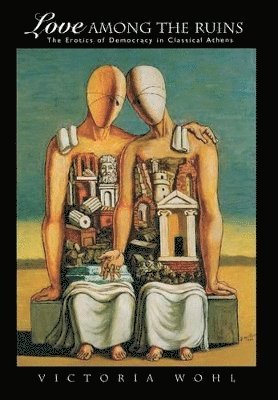
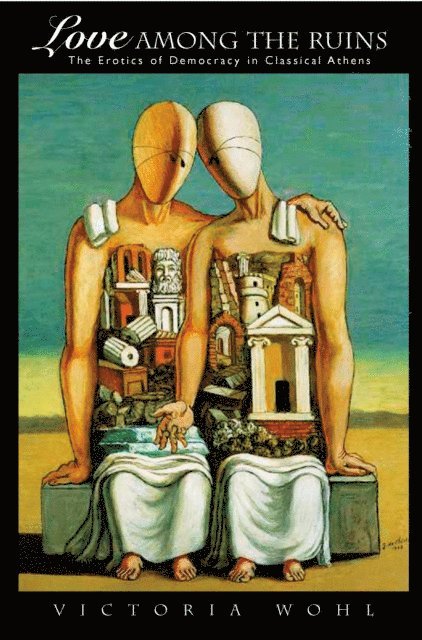
Classical Athenian literature often speaks of democratic politics in sexual terms. Citizens are urged to become lovers of the polis, and politicians claim to be lovers of the people. Victoria Wohl argues that this was no dead metaphor. Exploring the intersection between eros and politics in democratic Athens, Wohl traces the private desires aroused by public ideology and the political consequences of citizens' most intimate longings. Love among the Ruins analyzes the civic fantasies that lay beneath (but not necessarily parallel to) Athens's political ideology. It shows how desire can disrupt politics and provides a deeper--at times disturbing--insight into the democratic unconscious of ancient Athens. The Athenians imagined the perfect citizen as a noble and manly lover. But this icon conceals a multitude of other possible figures: sexy tyrants, potent pathics, and seductive perverts. Through critical re-readings of canonical texts, Wohl investigates these fantasies, which seem so antithetical to Athens's manifest ideals.She examines the interrelation of patriotism and narcissism, the trope of politics as prostitution, the elite suspicion of political pleasure, and the status of perversion within Athens's sexual and political norms. She also discusses the morbid drive that propelled Athenian imperialism, as well as democratic Athens's paradoxical fascination with the joys of tyranny. Drawing on contemporary critical theory in original ways, Wohl sketches the relationship between citizen psyche and political life to illuminate the complex, frequently contradictory passions that structure democracy, ancient and modern.
487 kr
Skickas inom 7-10 vardagar
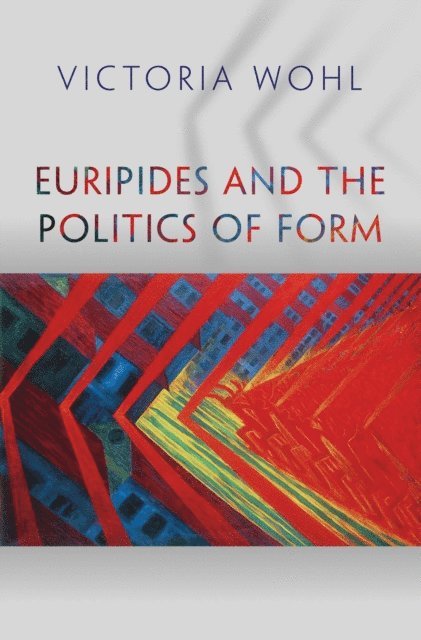
How can we make sense of the innovative structure of Euripidean drama? And what political role did tragedy play in the democracy of classical Athens? These questions are usually considered to be mutually exclusive, but this book shows that they can only be properly answered together. Providing a new approach to the aesthetics and politics of Greek tragedy, Victoria Wohl argues that the poetic form of Euripides' drama constitutes a mode of political thought. Through readings of select plays, she explores the politics of Euripides' radical aesthetics, showing how formal innovation generates political passions with real-world consequences. Euripides' plays have long perplexed readers. With their disjointed plots, comic touches, and frequent happy endings, they seem to stretch the boundaries of tragedy. But the plays' formal traits--from their exorbitantly beautiful lyrics to their arousal and resolution of suspense--shape the audience's political sensibilities and ideological attachments. Engendering civic passions, the plays enact as well as express political ideas.Wohl draws out the political implications of Euripidean aesthetics by exploring such topics as narrative and ideological desire, the politics of pathos, realism and its utopian possibilities, the logic of political allegory, and tragedy's relation to its historical moment. Breaking through the impasse between formalist and historicist interpretations of Greek tragedy, Euripides and the Politics of Form demonstrates that aesthetic structure and political meaning are mutually implicated--and that to read the plays poetically is necessarily to read them politically.
360 kr
Skickas inom 7-10 vardagar
How can we make sense of the innovative structure of Euripidean drama? And what political role did tragedy play in the democracy of classical Athens? These questions are usually considered to be mutually exclusive, but this book shows that they can only be properly answered together. Providing a new approach to the aesthetics and politics of Greek tragedy, Victoria Wohl argues that the poetic form of Euripides' drama constitutes a mode of political thought. Through readings of select plays, she explores the politics of Euripides' radical aesthetics, showing how formal innovation generates political passions with real-world consequences.Euripides' plays have long perplexed readers. With their disjointed plots, comic touches, and frequent happy endings, they seem to stretch the boundaries of tragedy. But the plays' formal traits—from their exorbitantly beautiful lyrics to their arousal and resolution of suspense—shape the audience's political sensibilities and ideological attachments. Engendering civic passions, the plays enact as well as express political ideas. Wohl draws out the political implications of Euripidean aesthetics by exploring such topics as narrative and ideological desire, the politics of pathos, realism and its utopian possibilities, the logic of political allegory, and tragedy's relation to its historical moment.Breaking through the impasse between formalist and historicist interpretations of Greek tragedy, Euripides and the Politics of Form demonstrates that aesthetic structure and political meaning are mutually implicated—and that to read the plays poetically is necessarily to read them politically.
1 245 kr
Skickas inom 7-10 vardagar
This volume explores the conceptual terrain defined by the Greek word eikos: the probable, likely, or reasonable. A term of art in Greek rhetoric, a defining feature of literary fiction, a seminal mode of historical, scientific, and philosophical inquiry, eikos was a way of thinking about the probable and improbable, the factual and counterfactual, the hypothetical and the real. These thirteen original and provocative essays examine the plausible arguments of courtroom speakers and the 'likely stories' of philosophers, verisimilitude in art and literature, the likelihood of resemblance in human reproduction, the limits of human knowledge and the possibilities of ethical and political agency. The first synthetic study of probabilistic thinking in ancient Greece, the volume illuminates a fascinating chapter in the history of Western thought.