Vidyan Ravinthiran - Böcker
Visar alla böcker från författaren Vidyan Ravinthiran. Handla med fri frakt och snabb leverans.
14 produkter
14 produkter
1 504 kr
Skickas inom 5-8 vardagar
This study analyzes post-Romantic prose whose authors--in terms of race, gender, class, nationality, and more--occupy a range of subject-positions. Unlike poetry, modern literary prose has no rhetorical repertoire or structure (beyond those of grammar) that one could tabulate. As a result, it becomes a zone of experimentation and spontaneous creativity, as well as a means to investigate the concept of spontaneity, understood as post-secular. Heeding separate histories and peculiar particularities, this volume reveals writers discovering their ideas as they go, in prose whose sound, rhythm, syntax, and imagery escapes the preordained. There are chapters on William Hazlitt, Ralph Waldo Emerson and Walt Whitman (and Hindu philosophy), Gerard Manley Hopkins, Herman Melville, D.H. Lawrence and Saul Bellow, Virginia Woolf and Marion Milner, Gwendolyn Brooks, Adil Jussawalla, and Chimamanda Ngozi Adichie. These writers are intelligently vexed by two transitions: first, the movement from impulse into form; and second, the overlap between literary forms and social forms. They explore the yearning for renovated societies which, expressive of our deepest selves, would also enable those selves--in times of panicked fragmentation, moral relativism, and communication imperiled--to interact as citizens.
1 090 kr
Skickas inom 7-10 vardagar
Writing about poetry follows models provided either by academic scholarship or literary journalism, each with its pitfalls. The former distances the reader from the poem and effaces the critic’s personality. In literary journalism, the critic is front and center, but the discussion is introductory and prioritizes value judgments. In either case, entrenched practices and patterns of privilege limit one’s perspective. The situation worsens when it comes to minoritized poets and poets from the Global South, where the focus is on restrictive notions of identity: the stylistic innovations of literary works get ousted by prefabricated historical narratives.In Worlds Woven Together, the critic, poet, and scholar Vidyan Ravinthiran searches for alternatives, pursuing close, imaginative readings of a variety of writers. His essays are open-ended, attentive, and curious, unabashedly passionate and subjective yet keenly analytical and investigative. Discussing neglected authors and those well-known in the West, Ravinthiran sees politics as inseparable from literary form and is fascinated by the relation of the creative consciousness to the violences of history. The book features essays on writers including Mir Taqi Mir, Ana Blandiana, A. K. Ramanujan, Marianne Moore, Eunice de Souza, Czeslaw Milosz, Ted Hughes, Rae Armantrout, Arvind Krishna Mehrotra, Galway Kinnell, Dawn Lundy Martin, and Vahni Capildeo. Revealing serendipitous connections—between poems and cultures, between lines of verse and the lives we lead—Worlds Woven Together is for all readers fascinated by the mechanics and politics of poetry.
278 kr
Skickas inom 7-10 vardagar
Writing about poetry follows models provided either by academic scholarship or literary journalism, each with its pitfalls. The former distances the reader from the poem and effaces the critic’s personality. In literary journalism, the critic is front and center, but the discussion is introductory and prioritizes value judgments. In either case, entrenched practices and patterns of privilege limit one’s perspective. The situation worsens when it comes to minoritized poets and poets from the Global South, where the focus is on restrictive notions of identity: the stylistic innovations of literary works get ousted by prefabricated historical narratives.In Worlds Woven Together, the critic, poet, and scholar Vidyan Ravinthiran searches for alternatives, pursuing close, imaginative readings of a variety of writers. His essays are open-ended, attentive, and curious, unabashedly passionate and subjective yet keenly analytical and investigative. Discussing neglected authors and those well-known in the West, Ravinthiran sees politics as inseparable from literary form and is fascinated by the relation of the creative consciousness to the violences of history. The book features essays on writers including Mir Taqi Mir, Ana Blandiana, A. K. Ramanujan, Marianne Moore, Eunice de Souza, Czeslaw Milosz, Ted Hughes, Rae Armantrout, Arvind Krishna Mehrotra, Galway Kinnell, Dawn Lundy Martin, and Vahni Capildeo. Revealing serendipitous connections—between poems and cultures, between lines of verse and the lives we lead—Worlds Woven Together is for all readers fascinated by the mechanics and politics of poetry.
865 kr
Skickas inom 7-10 vardagar
Identifying ourselves, others, writers, with their opinions-and taking the form of the opinion as the epitome of political engagement-we assert a picture of the self that ought to be scrutinized. Mass print generated, along with the railways, telegraph, information-relays national and global, as well as the development of specialized forms of technological, scientific, economic, and medical knowledge, a sea of discourse belying any vision of a cogent public sphere: disinformation is not a purely 21st century, internet phenomenon. Poetry helps us understand this situation. Appearing in verse, claims about reality have been characterized, or have self-characterized, as virtual. As such, Romantic and post-Romantic poetry makes perceptible other ways in which, in other precincts, utterance becomes virtualized. Sometimes, by the psychological turbulences of the citizen-as-creature, appropriating world events to the need to self-assert; sometimes, as a result of affective matrices that challenge the idea that we are the authors of our own opinions.
269 kr
Skickas inom 7-10 vardagar
Identifying ourselves, others, writers, with their opinions-and taking the form of the opinion as the epitome of political engagement-we assert a picture of the self that ought to be scrutinized. Mass print generated, along with the railways, telegraph, information-relays national and global, as well as the development of specialized forms of technological, scientific, economic, and medical knowledge, a sea of discourse belying any vision of a cogent public sphere: disinformation is not a purely 21st century, internet phenomenon. Poetry helps us understand this situation. Appearing in verse, claims about reality have been characterized, or have self-characterized, as virtual. As such, Romantic and post-Romantic poetry makes perceptible other ways in which, in other precincts, utterance becomes virtualized. Sometimes, by the psychological turbulences of the citizen-as-creature, appropriating world events to the need to self-assert; sometimes, as a result of affective matrices that challenge the idea that we are the authors of our own opinions.
168 kr
Skickas
Vidyan Ravinthiran was born in the north of England to Sri Lankan Tamils, and moved to the United States five years ago. Considering identity in both its political and psychological senses, he leaps adventurously between memoir and criticism, understanding his life through poetry, and vice versa. Ranging from Andrew Marvell to Divya Victor, Ravinthiran writes both about and through poems, discussing Sri Lanka; experiences of racism and resilience; intergenerational trauma; pandemic parenting in an autism family; relationships shaped by the internet; growing up with a speech impediment and being sent by one’s aspirational brown parents to elocution lessons; and the relative invisibility of South Asians in Western television and film. This electric, compelling hybrid memoir discovers a new way of writing about the self and also literature.
1 391 kr
Skickas inom 10-15 vardagar
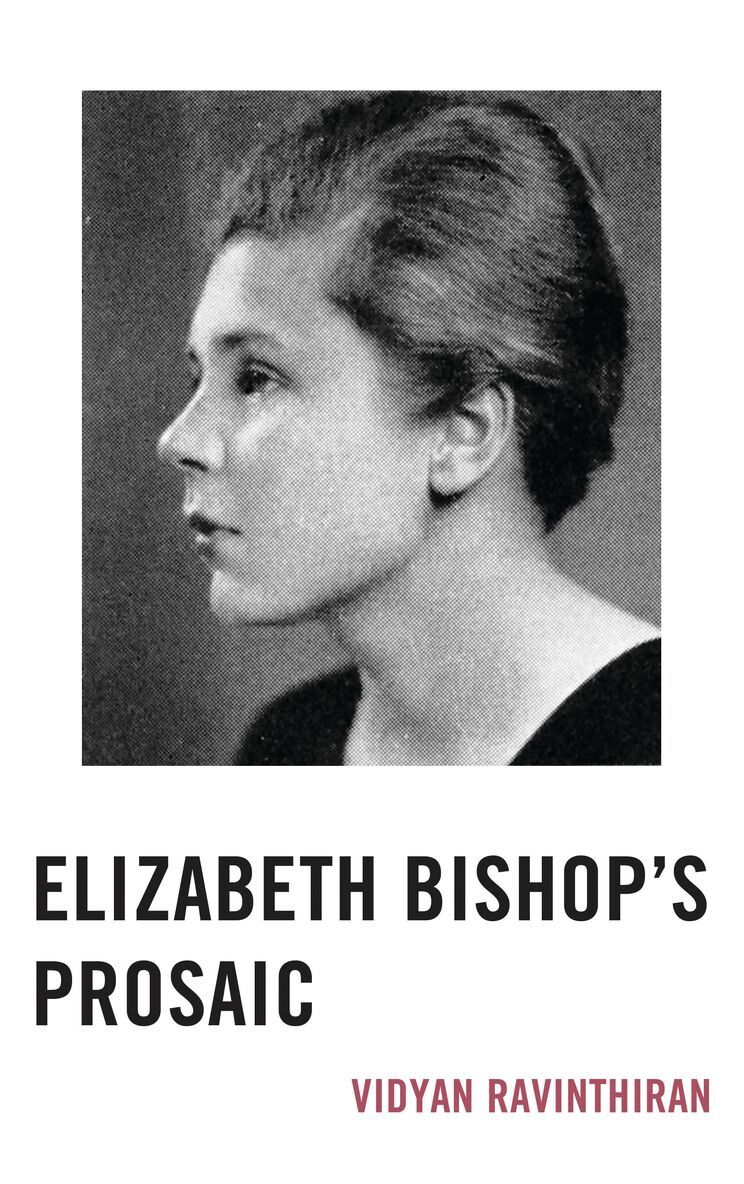
Elizabeth Bishop is now recognized as one of the greatest poets of the twentieth century—a uniquely cosmopolitan writer with connections to the US, Canada, Brazil, and also the UK, given her neglected borrowings from many English authors, and her strong influence on modern British verse. Yet the dominant biographical/psychoanalytical approach leaves her style relatively untouched—and it is vital that an increasing focus on archival material does not replace our attention to the writing itself. Bishop’s verse is often compared with prose (sometimes insultingly); writing fiction, she worried she was really writing poems. But what truly is the difference between poetry and prose—structurally, conceptually, historically speaking? Is prose simply formalized speech, or does it have rhythms of its own? Ravinthiran seeks an answer to this question through close analysis of Bishop’s prose-like verse, her literary prose, her prose poems, and her letter prose. This title is a provocation. It demands that we reconsider the pejorative quality of the word prosaic; playing on mosaic, Ravinthiran uses Bishop’s thinking about prose to approach—for the first time—her work in multiple genres as a stylistic whole.Elizabeth Bishop’s Prosaic is concerned not only with her inimitable style, but also larger questions to do with the Anglo-American shift from closed to open forms in the twentieth century. This study identifies not just borrowings from, but rich intertextual relationships with, writers as diverse as—among others—Gerard Manley Hopkins, W.H. Auden, Virginia Woolf, Flannery O’Connor, and Dorothy Richardson. (Though Bishop criticized Woolf, she in particular is treated as a central and thus far neglected precursor, crucial to our understanding of Bishop as a feminist poet.) Finally, the sustained discussion of how the history of prose frames effects of rhythm, syntax, and acoustic texture—in both Bishop’s prose proper and her prosaic verse—extends a body of research which seeks now to treat literature as a form of cognition. Technique and thought are finely wedded in Bishop’s work—her literary forms evince a historical intelligence attuned to questions of power, nationality, tradition (both literary and otherwise), race, and gender.
684 kr
Skickas inom 10-15 vardagar
Elizabeth Bishop is now recognized as one of the greatest poets of the twentieth century—a uniquely cosmopolitan writer with connections to the US, Canada, Brazil, and also the UK, given her neglected borrowings from many English authors, and her strong influence on modern British verse. Yet the dominant biographical/psychoanalytical approach leaves her style relatively untouched—and it is vital that an increasing focus on archival material does not replace our attention to the writing itself. Bishop’s verse is often compared with prose (sometimes insultingly); writing fiction, she worried she was really writing poems. But what truly is the difference between poetry and prose—structurally, conceptually, historically speaking? Is prose simply formalized speech, or does it have rhythms of its own? Ravinthiran seeks an answer to this question through close analysis of Bishop’s prose-like verse, her literary prose, her prose poems, and her letter prose. This title is a provocation. It demands that we reconsider the pejorative quality of the word prosaic; playing on mosaic, Ravinthiran uses Bishop’s thinking about prose to approach—for the first time—her work in multiple genres as a stylistic whole.Elizabeth Bishop’s Prosaic is concerned not only with her inimitable style, but also larger questions to do with the Anglo-American shift from closed to open forms in the twentieth century. This study identifies not just borrowings from, but rich intertextual relationships with, writers as diverse as—among others—Gerard Manley Hopkins, W.H. Auden, Virginia Woolf, Flannery O’Connor, and Dorothy Richardson. (Though Bishop criticized Woolf, she in particular is treated as a central and thus far neglected precursor, crucial to our understanding of Bishop as a feminist poet.) Finally, the sustained discussion of how the history of prose frames effects of rhythm, syntax, and acoustic texture—in both Bishop’s prose proper and her prosaic verse—extends a body of research which seeks now to treat literature as a form of cognition. Technique and thought are finely wedded in Bishop’s work—her literary forms evince a historical intelligence attuned to questions of power, nationality, tradition (both literary and otherwise), race, and gender.
141 kr
Skickas inom 7-10 vardagar
Vidyan Ravinthiran's much-anticipated first collection contains many poems about Sri Lanka which fuse politics, personal history and myth, yet his voice pitches itself not so much halfway between East and West as between emotional forthrightness and linguistic exuberance. Traditional forms - of culture, of verse - contend with brusquer impulses in an era of technological distortion; without taking himself too seriously, the poet asks if perhaps we don't take ourselves seriously enough. These are poems of impassioned intelligence, which refuse to separate thought and feeling and seek not only to delight and disturb but to work through difficult problems. The intricacies of the modern relationship - the smallest society, a haven of two - are reconnected with the historical world; translations, some from classical Tamil, ask how close two languages or two people can get. Indeed, Grun-tu-molani is concerned throughout with a range of human behaviours common to different societies - the need to assert oneself, save face, explain, and touch; the last of which would not be possible were it not for the distances between us.
169 kr
Skickas inom 7-10 vardagar
Vidyan Ravinthiran’s second collection is a book of sonnets for his wife. These are love poems that turn analytical, consider the world, and in which the pronoun 'we' aspires to stand for a larger community, including (if you like) readers themselves. Many describe life in the North East for a mixed-race couple, considering both the redemptive force of love and the cultural origins of our discontent. Brexit; racist and sexist abuse; class; our work-life balance, and our relationship with institutions (be it our employer, or the NHS); taboos surrounding mental health; civil war in Sri Lanka; media representation of minorities; immigrant anxieties: these poems look inward, but also outward. Worrying at the link between society and our private lives, they scorn a politics which would put us all in separate boxes. Love, and imagination, may not conquer all, but as recent shocks suggest, ‘we’ must at least try to understand people different to us. Shortlisted for the 2019 Forward Prize for Best Collection, the collection is a Poetry Book Society Recommendation.
Out of Sri Lanka
Tamil, Sinhala and English poetry from Sri Lanka and its diasporas
Häftad, Engelska, 2023
181 kr
Skickas
Sri Lanka has thrilled the foreign imagination as a land of infinite possibility. Portuguese, Dutch and British colonisers envisioned an island of gems and pearls, a stopping-point on the Silk Road; tourists today are sold a vision of golden beaches and swaying palm trees, delicious food and smiling locals. This favours the south of the island over the north rebuilt piecemeal after the end of the civil war in 2009, and erases a history of war crimes, illicit assassination of activists and journalists, subjugation of minorities, and a legacy of governmental corruption that has now led the country into economic and social crisis.This first ever anthology of Sri Lankan and diasporic poetry – many exiles refuse to identify as “Sri Lankan” – features over a hundred poets writing in English, or translated from Tamil and Sinhala. It brings to light a long-neglected national literature, and reshapes our understanding of migrational poetics and the poetics of atrocity. Poets long out of print appear beside exciting new talents; works written in the country converse with poetry from the UK, the US, Canada and Australia. Poems in traditional and in open forms, concrete poems, spoken word poems, and experimental post-lyric hybrids of poetry and prose, appear with an introduction explaining Sri Lanka’s history.There are poems here about love, art, nature – and others exploring critical events: the Marxist JVP insurrections of the 1970s and 80s, the 2004 tsunami and its aftermath, recent bombings linked with the demonisation of Muslim communities. The civil war between the government and the separatist Tamil Tigers is a haunting and continual presence. A poetry of witness challenges those who would erase, rather than enquire into, the country’s troubled past. This anthology affirms the imperative to remember, whether this relates to folk practices suppressed by colonisers, or more recent events erased from the record by Sinhalese nationalists.Poetry Book Society Special Commendation.
158 kr
Skickas
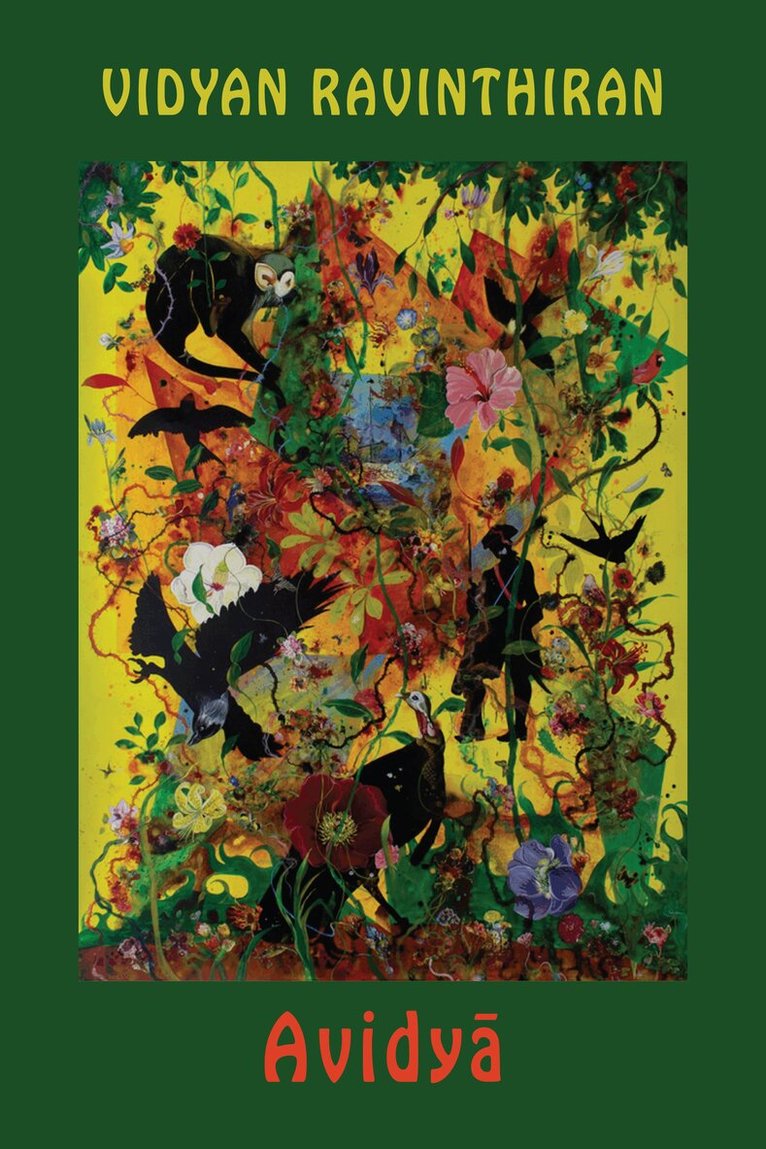
These poems emerged from journeys of great personal significance, and out of a migrant sensibility tied to three different countries. Sensuous, droll, yearning, they consider otherwise forgotten (ignored, repressed, erased) events.In 2017, Vidyan Ravinthiran travelled to the north of Sri Lanka where his parents grew up – it finally felt safe – visiting war-torn Tamil areas overwritten by a tourist focus on the sun-spoiled South. In 2020, he, his wife and their one-year-old moved from Britain to the United States, months before the pandemic hit and the travel ban separated them for almost two years from family overseas.Avidya is a political and a spiritual collection, whose multiple poetic forms, open and closed, are shaped by myth and philosophy, and by Sri Lankan as well as global crises. It is also a book about the forms of both strength and fear that parents pass on to their children.
225 kr
Tillfälligt slut
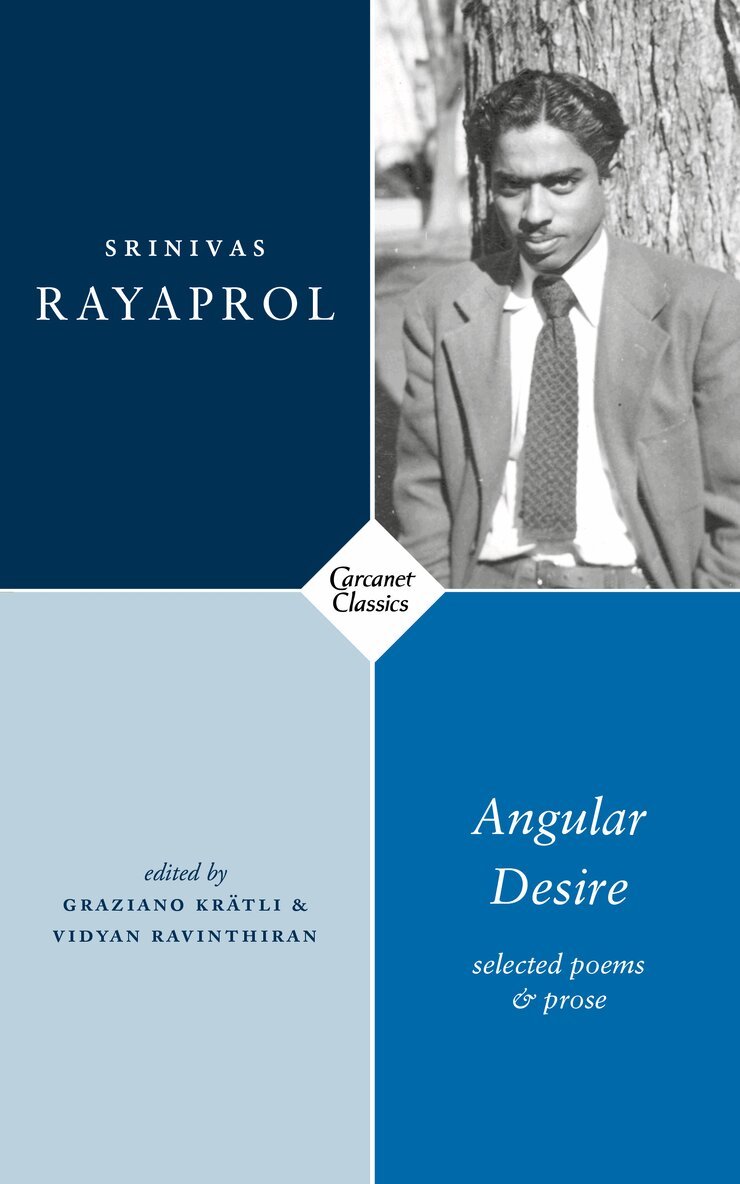
Poetry Book Society Spring 2020 Special Commendation. A handful of writers defines the canon of postcolonial anglophone poetry in India. Srinivas Rayaprol has generally been omitted from the list, but his recently published correspondence with William Carlos Williams and publisher James Laughlin reveals an accomplished, complex and enigmatic figure torn between opposing forces. His Brahmin Indian background and his profession as a civil engineer in a newly independent country were at odds with his Western education, literary vocation and demonic impulses. Such contradictions are expressed in his intense poetry, here restored to print, providing insights into Anglo-Indian and American writing, and a unique contribution to international literary modernism.
210 kr
Skickas
A perceptive exploration of poetry, race, and otherness from one of our most promising voices in criticism.Vidyan Ravinthiran was born in the north of England to Sri Lankan Tamils, and moved to the United States five years ago. Considering identity in both its political and psychological senses - as these concepts fuse, or fail to, at different times and in different places - he leaps adventurously between memoir and criticism, understanding his life through poetry, and vice versa. Ranging from Andrew Marvell to Divya Victor, he writes both about and through poems, discussing Sri Lanka; experiences of racism and resilience; intergenerational trauma; pandemic parenting in an autism family; relationships shaped by the internet; growing up with a speech impediment and being sent by one's aspirational brown parents to elocution lessons; and the relative invisibility of South Asians in Western television and film. This electric, compelling hybrid memoir discovers a new way of writing about the self and also literature.