Viviana Farina - Böcker
Visar alla böcker från författaren Viviana Farina. Handla med fri frakt och snabb leverans.
2 produkter
2 produkter
755 kr
Kommande
Brings to light the long-lost original version of Velázquez’s portrait of Cardinal Gaspar de Borja, which enhances our understanding of the artist’s work and legacyThis book delves into the study of the portrait of Cardenal Gaspar de Borja, painted by Diego Velázquez around 1645. It reveals the true and original version of this portrait, a masterpiece that had long been assumed to exist but was only known through versions by Velázquez’s followers. It focuses on the rich historical and technical aspects of the portrait, examining its attribution and the various versions of the work that have existed throughout history. The book provides a comprehensive analysis of the portrait's journey, its rediscovery, and the technical methods employed in Velázquez's execution of the piece.It presents a scholarly investigation that combines art history, technical analysis, and restoration studies, shedding new light on the portrait of Cardenal Gaspar de Borja and confirming its place as a true masterpiece by Velázquez. It represents a groundbreaking contribution to the history of art, as it brings to light the long-lost original version by Velázquez, a discovery that significantly enhances our understanding of his work and legacy.
456 kr
Kommande
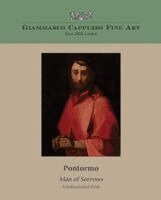
Presents a rediscovered a rediscovered panel painting depicting the Vir Dolorum (Man of Sorrows), attributed to Jacopo Carucci da PontormoThis volume presents the comprehensive scholarly study of a rediscovered panel painting depicting the Vir Dolorum (Man of Sorrows), attributed to Jacopo Carucci da Pontormo and datable to the years c. 1523–1525. Long known only through old photographic documentation and briefly discussed in the historiography following its publication by Roberto Longhi, the painting has now been fully re-examined through direct study, conservation, and scientific analysis, allowing its autograph status to be convincingly reassessed. The book brings together art-historical, iconographic, and technical research in order to situate the work securely within Pontormo’s oeuvre and within the broader cultural and spiritual context of early sixteenth-century Florence. Particular attention is devoted to clarifying the subject of the painting, which is demonstrated not to represent an Ecce Homo, as previously assumed, but rather the Vir Dolorum, a devotional image deeply rooted in late medieval and early modern religious practice. This clarification has important consequences for the interpretation, dating, and function of the work.