Vladimir A. Dobrushkin - Böcker
Visar alla böcker från författaren Vladimir A. Dobrushkin. Handla med fri frakt och snabb leverans.
3 produkter
3 produkter
1 168 kr
Skickas inom 10-15 vardagar
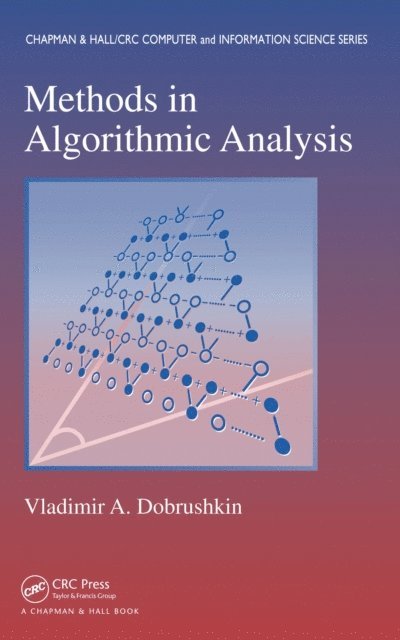
Explores the Impact of the Analysis of Algorithms on Many Areas within and beyond Computer ScienceA flexible, interactive teaching format enhanced by a large selection of examples and exercisesDeveloped from the author’s own graduate-level course, Methods in Algorithmic Analysis presents numerous theories, techniques, and methods used for analyzing algorithms. It exposes students to mathematical techniques and methods that are practical and relevant to theoretical aspects of computer science.After introducing basic mathematical and combinatorial methods, the text focuses on various aspects of probability, including finite sets, random variables, distributions, Bayes’ theorem, and Chebyshev inequality. It explores the role of recurrences in computer science, numerical analysis, engineering, and discrete mathematics applications. The author then describes the powerful tool of generating functions, which is demonstrated in enumeration problems, such as probabilistic algorithms, compositions and partitions of integers, and shuffling. He also discusses the symbolic method, the principle of inclusion and exclusion, and its applications. The book goes on to show how strings can be manipulated and counted, how the finite state machine and Markov chains can help solve probabilistic and combinatorial problems, how to derive asymptotic results, and how convergence and singularities play leading roles in deducing asymptotic information from generating functions. The final chapter presents the definitions and properties of the mathematical infrastructure needed to accommodate generating functions.Accompanied by more than 1,000 examples and exercises, this comprehensive, classroom-tested text develops students’ understanding of the mathematical methodology behind the analysis of algorithms. It emphasizes the important relation between continuous (classical) mathematics and discrete mathematics, which is the basis of computer science.
2 113 kr
Skickas inom 10-15 vardagar
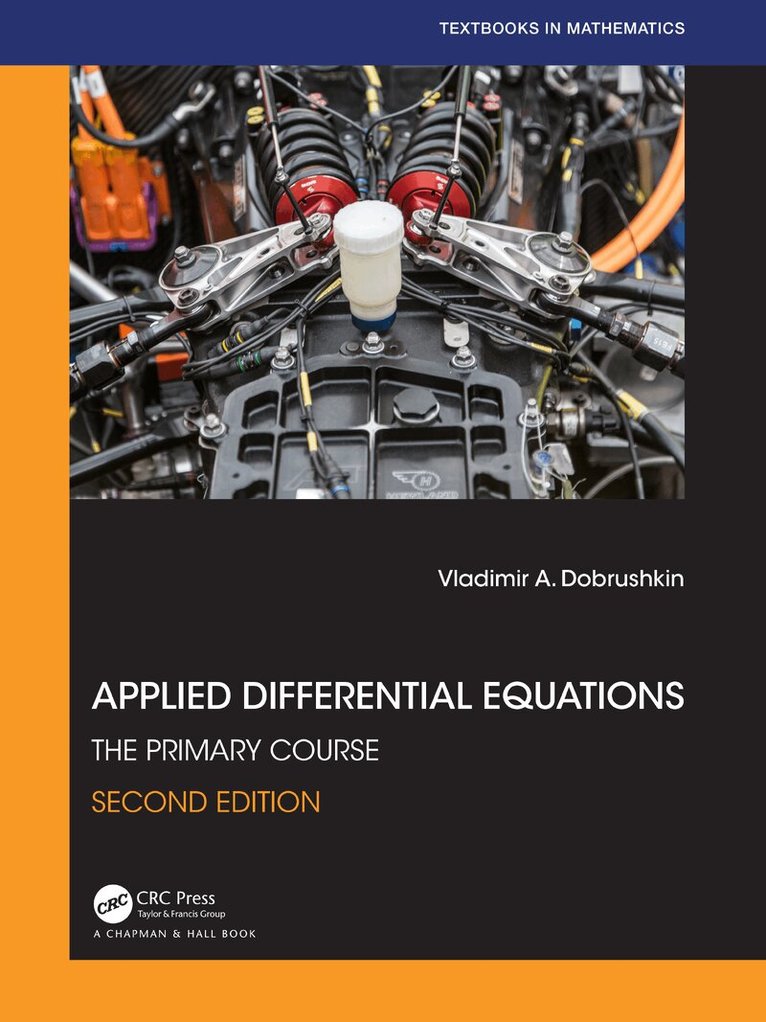
This book started as a collection of lecture notes for a course in differential equations taught by the Division of Applied Mathematics at Brown University. To some extent, it is a result of collective insights given by almost every instructor who taught such a course over the last 15 years. Therefore, the material and its presentation covered in this book were practically tested for many years. This text is designed for a two-semester sophomore or junior level course in differential equations. It offers novel approaches in presentation and utilization of computer capabilities. This text intends to provide a solid background in differential equations for students majoring in a breadth of fields. Differential equations are described in the context of applications. The author stresses differential equations constitute an essential part of modeling by showing their applications, including numerical algorithms and syntax of the four most popular software packages. Students learn how to formulate a mathematical model, how to solve differential equations (analytically or numerically), how to analyze them qualitatively, and how to interpret the results.In writing this textbook, the author aims to assist instructors and students through:Showing a course in differential equations is essential for modeling real-life phenomenaStressing the mastery of traditional solution techniques and presenting effective methods, including reliable numerical approximationsProviding qualitative analysis of ordinary differential equations. The reader should get an idea of how all solutions to the given problem behave, what are their validity intervals, whether there are oscillations, vertical or horizontal asymptotes, and what is their long-term behaviorThe reader will learn various methods of solving, analysis, visualization, and approximation, exploiting the capabilities of computersIntroduces and employs Maple™, Mathematica®, MatLab®, and MaximaThis textbook facilitates the development of the student’s skills to model real-world problemsOrdinary and partial differential equations is a classical subject that has been studied for about 300 years. The beauty and utility of differential equations and their application in mathematics, biology, chemistry, computer science, economics, engineering, geology, neuroscience, physics, the life sciences, and other fields reaffirm their inclusion in myriad curricula.A great number of examples and exercises make this text well suited for self-study or for traditional use by a lecturer in class. Therefore, this textbook addresses the needs of two levels of audience, the beginning and the advanced.
2 932 kr
Skickas inom 7-10 vardagar
Explores the Impact of the Analysis of Algorithms on Many Areas within and beyond Computer ScienceA flexible, interactive teaching format enhanced by a large selection of examples and exercisesDeveloped from the author’s own graduate-level course, Methods in Algorithmic Analysis presents numerous theories, techniques, and methods used for analyzing algorithms. It exposes students to mathematical techniques and methods that are practical and relevant to theoretical aspects of computer science.After introducing basic mathematical and combinatorial methods, the text focuses on various aspects of probability, including finite sets, random variables, distributions, Bayes’ theorem, and Chebyshev inequality. It explores the role of recurrences in computer science, numerical analysis, engineering, and discrete mathematics applications. The author then describes the powerful tool of generating functions, which is demonstrated in enumeration problems, such as probabilistic algorithms, compositions and partitions of integers, and shuffling. He also discusses the symbolic method, the principle of inclusion and exclusion, and its applications. The book goes on to show how strings can be manipulated and counted, how the finite state machine and Markov chains can help solve probabilistic and combinatorial problems, how to derive asymptotic results, and how convergence and singularities play leading roles in deducing asymptotic information from generating functions. The final chapter presents the definitions and properties of the mathematical infrastructure needed to accommodate generating functions.Accompanied by more than 1,000 examples and exercises, this comprehensive, classroom-tested text develops students’ understanding of the mathematical methodology behind the analysis of algorithms. It emphasizes the important relation between continuous (classical) mathematics and discrete mathematics, which is the basis of computer science.