Vladimir Dedijer – författare
Visar alla böcker från författaren Vladimir Dedijer. Handla med fri frakt och snabb leverans.
5 produkter
5 produkter
War Diaries of Vladimir Dedijer
Volume 1: From April 6, 1941, to November 27, 1942
Häftad, Engelska, 1990
723 kr
Skickas inom 7-10 vardagar
After fleeing from occupied Beograd to the liberated territory in the Sumadija, Vladimir Dedijer began his life as a Yugoslavian Partisan. Commissioned at the request of then Commander Tito, Vladimir Dedijer began writing his diaries in April of 1941 to record the daily lives, battles, and casualties of the Yugoslavian Partisan Army. The War Diaries of Vladimir Dedijer represents a wealth of primary information about the lives and struggles of the Partisan brigades. There can be no complete understanding of Tito's Yugoslavia without knowing the Diaries' account of the extent of the Second World War's impact on Yugoslavia's people. Tito, who was a frequent reader of the Diaries as the Partisan Army fought across Yugoslavia, called this work "Our Great Obituary." To maintain a diary under the hardships of war was difficult. Among the hazards were river crossings, rain, self-censorship should the Germans find the diaries, and in many instances a shortage of ink. In fact, ink was in such demand that German supplies were targeted by Partisans during raids. Despite these difficulties, Dedijer continually recorded day-to-day life throughout the war. These three volumes contain his writings up to the liberation of Prague in November of 1944. The Diaries were originally published in Yugoslavia more than forty years ago, and have since gone through four editions. The original publication in 1945 caused great debate because of Dedijer's fierce commitment to speaking his views and his uncompromising dedication to recording what he lived. Many felt that Dedijer should not make public the names of Partisan heroes who supported Stalin during the bitter Stalin-Tito split, but in keeping with his values, Dedijer refused, with Tito supporting his decision.
War Diaries of Vladimir Dedijer
Volume 3: From September 11, 1943, to November 7, 1944
Häftad, Engelska, 1990
664 kr
Skickas inom 7-10 vardagar
After fleeing from occupied Beograd to the liberated territory in the Sumadija, Vladimir Dedijer began his life as a Yugoslavian Partisan. Commissioned at the request of then Commander Tito, Vladimir Dedijer began writing his diaries in April of 1941 to record the daily lives, battles, and casualties of the Yugoslavian Partisan Army. The War Diaries of Vladimir Dedijer represents a wealth of primary information about the lives and struggles of the Partisan brigades. There can be no complete understanding of Tito's Yugoslavia without knowing the Diaries' account of the extent of the Second World War's impact on Yugoslavia's people. Tito, who was a frequent reader of the Diaries as the Partisan Army fought across Yugoslavia, called this work "Our Great Obituary." To maintain a diary under the hardships of war was difficult. Among the hazards were river crossings, rain, self-censorship should the Germans find the diaries, and in many instances a shortage of ink. In fact, ink was in such demand that German supplies were targeted by Partisans during raids. Despite these difficulties, Dedijer continually recorded day-to-day life throughout the war. These three volumes contain his writings up to the liberation of Prague in November of 1944. The Diaries were originally published in Yugoslavia more than forty years ago, and have since gone through four editions. The original publication in 1945 caused great debate because of Dedijer's fierce commitment to speaking his views and his uncompromising dedication to recording what he lived. Many felt that Dedijer should not make public the names of Partisan heroes who supported Stalin during the bitter Stalin-Tito split, but in keeping with his values, Dedijer refused, with Tito supporting his decision.
War Diaries of Vladimir Dedijer
Volume 2: From November 28, 1942, to September 10, 1943
Häftad, Engelska, 1990
606 kr
Skickas inom 7-10 vardagar
After fleeing from occupied Beograd to the liberated territory in the Sumadija, Vladimir Dedijer began his life as a Yugoslavian Partisan. Commissioned at the request of then Commander Tito, Vladimir Dedijer began writing his diaries in April of 1941 to record the daily lives, battles, and casualties of the Yugoslavian Partisan Army. The War Diaries of Vladimir Dedijer represents a wealth of primary information about the lives and struggles of the Partisan brigades. There can be no complete understanding of Tito's Yugoslavia without knowing the Diaries' account of the extent of the Second World War's impact on Yugoslavia's people. Tito, who was a frequent reader of the Diaries as the Partisan Army fought across Yugoslavia, called this work "Our Great Obituary." To maintain a diary under the hardships of war was difficult. Among the hazards were river crossings, rain, self-censorship should the Germans find the diaries, and in many instances a shortage of ink. In fact, ink was in such demand that German supplies were targeted by Partisans during raids. Despite these difficulties, Dedijer continually recorded day-to-day life throughout the war. These three volumes contain his writings up to the liberation of Prague in November of 1944. The Diaries were originally published in Yugoslavia more than forty years ago, and have since gone through four editions. The original publication in 1945 caused great debate because of Dedijer's fierce commitment to speaking his views and his uncompromising dedication to recording what he lived. Many felt that Dedijer should not make public the names of Partisan heroes who supported Stalin during the bitter Stalin-Tito split, but in keeping with his values, Dedijer refused, with Tito supporting his decision.
622 kr
Skickas inom 3-6 vardagar
First-hand testimony of survivors and eyewitnesses is compiled in this shocking and graphic account of the crimes committed during World War II at the largest death camp in Yugoslavia. At the small Croatian town of Jasenovac, the fascist "Independent State of Croatia" (a satellite state of the Nazi Third Reich) constructed a concentration camp where more than 200,000 people, mostly Orthodox Serbs, were systematically murdered. Among the participants in this genocide were members of the Roman Catholic Clergy, from the Franciscan monk who became the camp commandant to the infamous Archbishop Stepinac, the spiritual advisor to the fascist state appointed by Pope Pius XII.Vladimir Dedijer, a close associate of Marshall Tito, has collected irrefutable documentary and photographic evidence, attesting to thousands of atrocities and the complicity of the Catholic Church in these crimes. The events described in this important volume provide a historical context to the recent conflict in Yugoslavia and shed light on the motivations behind the apparently senseless ethnic and religious strife which tore Yugoslavia apart. The massacre at Jasenovac was the terrible culmination of centuries-old animosities between Orthodox Serbs and Catholic Croats, and a dark episode in the history of the Church, one that the Church has attempted to hush up for fifty years.
Del 1 - Unerwünschte Bücher zum Faschismus
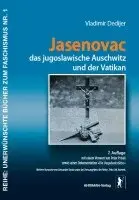
Jasenovac, das jugoslawische Auschwitz und der Vatikan
Häftad, Tyska
238 kr
Skickas inom 3-6 vardagar