Vladimir Shpilrain – författare
Visar alla böcker från författaren Vladimir Shpilrain. Handla med fri frakt och snabb leverans.
13 produkter
Combinatorial Methods
Free Groups, Polynomials, and Free Algebras
Av Jie-tai Yu, Alexander Mikhalev m. fl.
E-bok, 2012
712 kr
Lägg i varukorg
This book is about three seemingly independent areas of mathematics: combinatorial group theory, the theory of Lie algebras and affine algebraic geometry. Indeed, for many years these areas were being developed fairly independently. Combinatorial group theory, the oldest of the three, was born in …
Combinatorial Methods
Free Groups, Polynomials, and Free Algebras
Av Vladimir Shpilrain, Alexander Mikhalev m. fl.
Inbunden, 2003
550 kr
Lägg i varukorg
This book is about three seemingly independent areas of mathematics: combinatorial group theory, the theory of Lie algebras and affine algebraic geometry. Indeed, for many years these areas were being developed fairly independently. Combinatorial group theory, the oldest of the three, was born in …
Non-commutative Cryptography and Complexity of Group-theoretic Problems
Av Alexei Myasnikov, Vladimir Shpilrain m. fl.
Inbunden, 2011
1549 kr
Lägg i varukorg
This book is about relations between three different areas of mathematics and theoretical computer science: combinatorial group theory, cryptography, and complexity theory. It explores how non-commutative (infinite) groups, which are typically studied in combinatorial group theory, can be used in …
Combinatorial Methods
Free Groups, Polynomials, and Free Algebras
Av Vladimir Shpilrain, Alexander Mikhalev m. fl.
Häftad, 2011
551 kr
Lägg i varukorg
This book is about three seemingly independent areas of mathematics: combinatorial group theory, the theory of Lie algebras and affine algebraic geometry. Indeed, for many years these areas were being developed fairly independently. Combinatorial group theory, the oldest of the three, was born in …
Elementary Theory of Groups and Group Rings, and Related Topics
Proceedings of the Conference held at Fairfield University and at the Graduate Center, CUNY, November 1-2, 2018
Av Paul Baginski, Benjamin Fine m. fl.
Inbunden, 2020
1912 kr
Lägg i varukorg
This proceedings volume documents the contributions presented at the conference held at Fairfield University and at the Graduate Center, CUNY in 2018 celebrating the New York Group Theory Seminar, in memoriam Gilbert Baumslag, and to honor Benjamin Fine and Anthony Gaglione. It includes several …
Elementary Theory of Groups and Group Rings, and Related Topics
Proceedings of the Conference held at Fairfield University and at the Graduate Center, CUNY, November 1-2, 2018
Av Vladimir Shpilrain, Gerhard Rosenberger m. fl.
E-bok, 2020
1975 kr
Lägg i varukorg
This proceedings volume documents the contributions presented at the conference held at Fairfield University and at the Graduate Center, CUNY in 2018 celebrating the New York Group Theory Seminar, in memoriam Gilbert Baumslag, and to honor Benjamin Fine and Anthony Gaglione. It includes several …
Elementary Theory of Groups and Group Rings, and Related Topics
Proceedings of the Conference held at Fairfield University and at the Graduate Center, CUNY, November 1-2, 2018
Av Vladimir Shpilrain, Gerhard Rosenberger m. fl.
E-bok, 2020
1932 kr
Lägg i varukorg
This proceedings volume documents the contributions presented at the conference held at Fairfield University and at the Graduate Center, CUNY in 2018 celebrating the New York Group Theory Seminar, in memoriam Gilbert Baumslag, and to honor Benjamin Fine and Anthony Gaglione. It includes several …
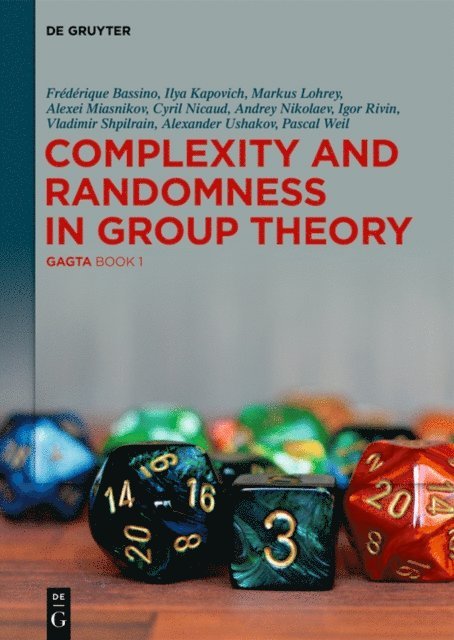
Complexity and Randomness in Group Theory
GAGTA BOOK 1
Av Frédérique Bassino, Ilya Kapovich m. fl.
Inbunden, 2020
2239 kr
Lägg i varukorg
Detailed Description
Complexity and Randomness in Group Theory
GAGTA BOOK 1
Av Pascal Weil, Alexander Ushakov m. fl.
E-bok, 2020
2195 kr
Lägg i varukorg
Detailed Description
Complexity and Randomness in Group Theory
GAGTA BOOK 1
Av Pascal Weil, Alexander Ushakov m. fl.
E-bok, 2020
2267 kr
Lägg i varukorg
Detailed Description
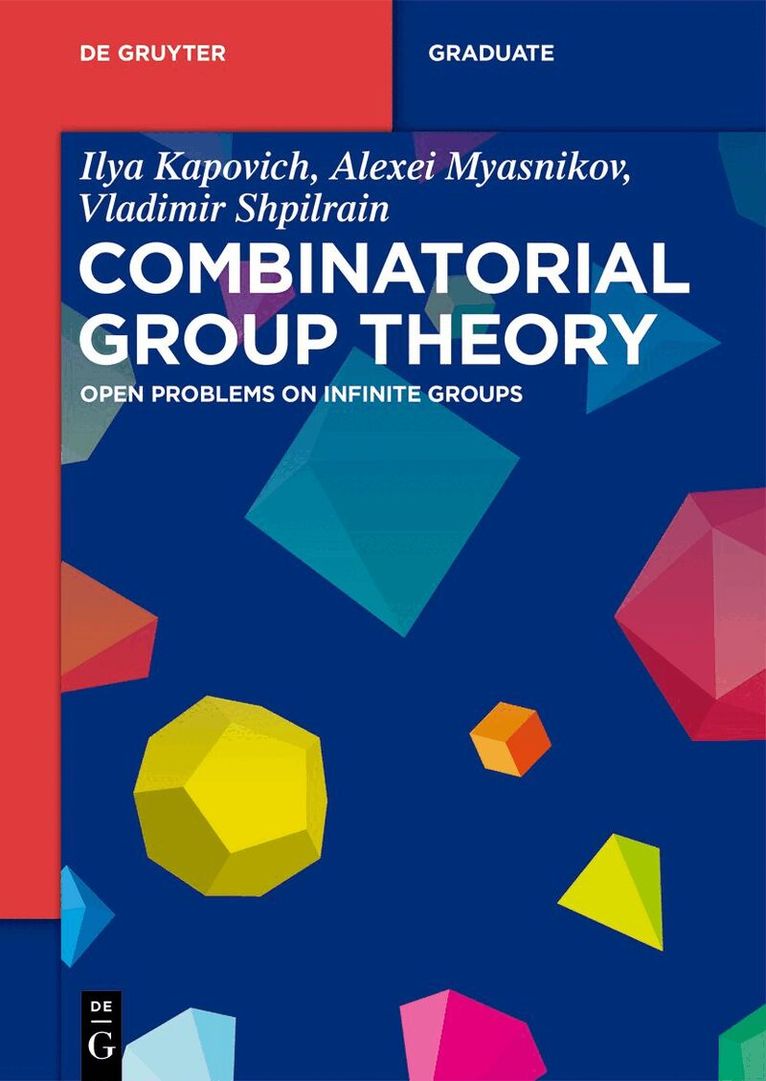
Combinatorial Group Theory
Open Problems on Infinite Groups
Av Ilya Kapovich, Alexei Myasnikov m. fl.
Häftad, 2026
890 kr
Lägg i varukorg
This is an annotated collection of over 200 open problems in combinatorial group theory. One can say that most of the problems are closer in spirit to the "purely combinatorial" group theory. However, the authors included several problems with geometric flavor where they felt this was natural. …
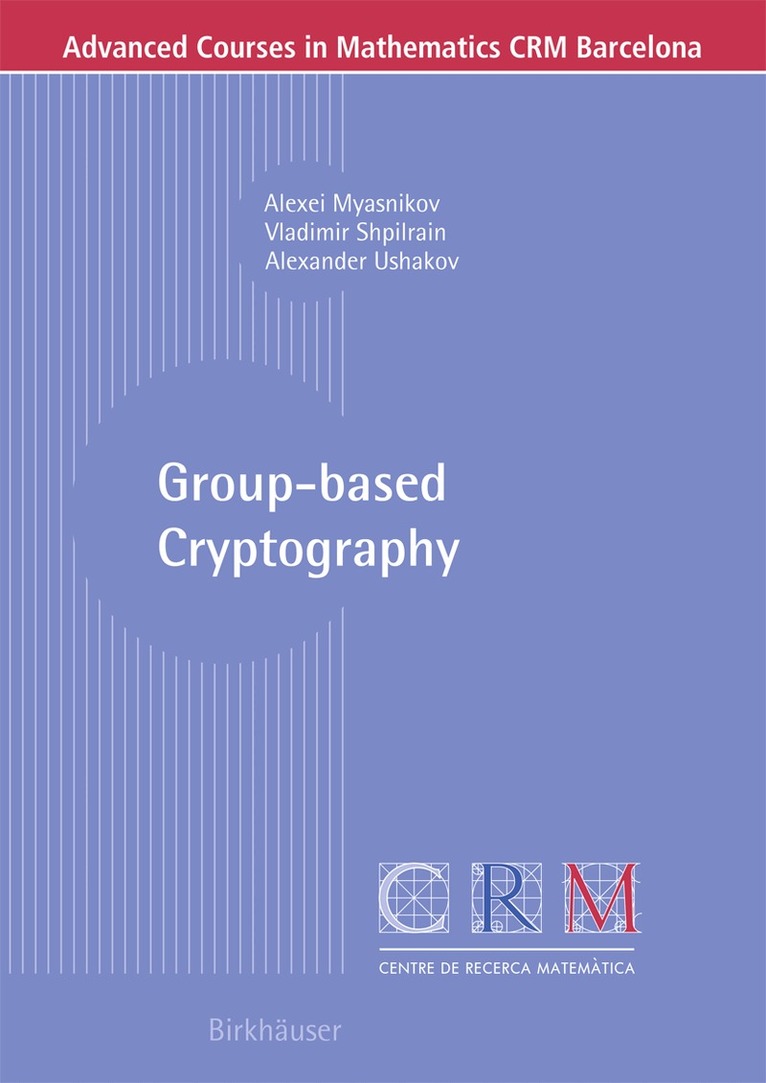
Group-based Cryptography
Av Alexei Myasnikov, Vladimir Shpilrain m. fl.
Häftad, 2008
332 kr
Lägg i varukorg
This book is about relations between three di?erent areas of mathematics and theoreticalcomputer science: combinatorialgroup theory, cryptography,and c- plexity theory. We explorehownon-commutative(in?nite) groups,which arety- callystudiedincombinatorialgrouptheory,canbeusedinpublickeycryptography. …
Group-based Cryptography
Av Alexander Ushakov, Vladimir Shpilrain m. fl.
E-bok, 2008
431 kr
Lägg i varukorg