Vladimir Turaev – författare
Visar alla böcker från författaren Vladimir Turaev. Handla med fri frakt och snabb leverans.
11 produkter
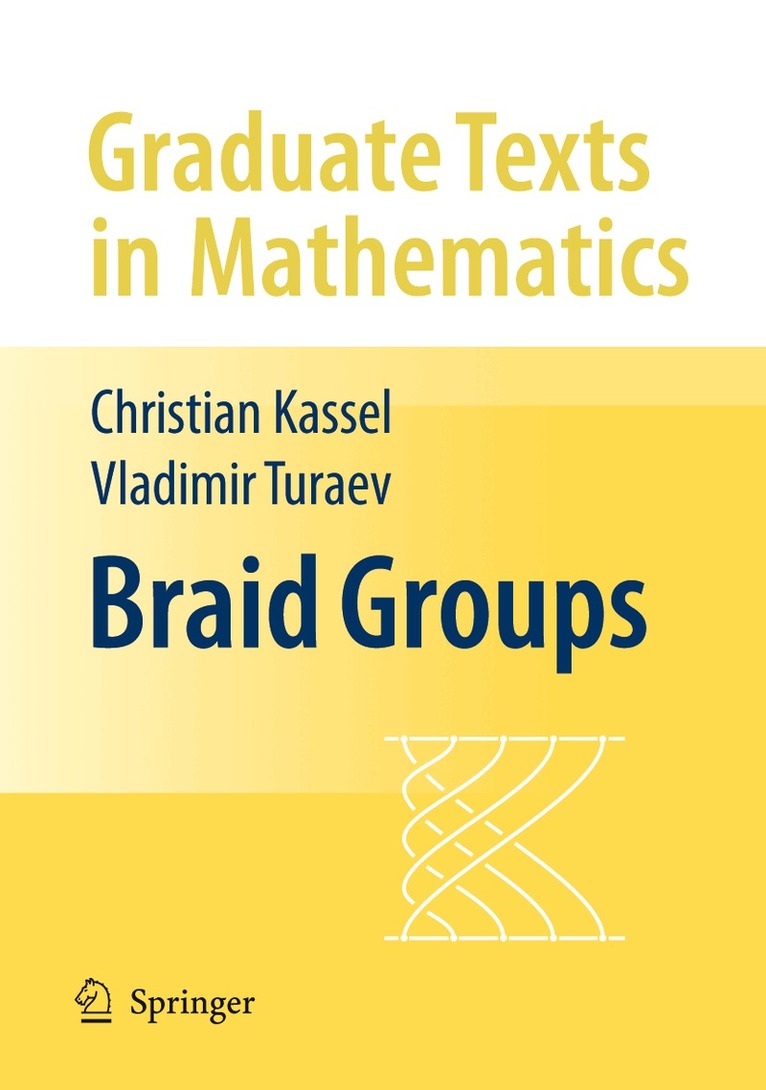
Braid Groups
Av Christian Kassel, Vladimir Turaev
Inbunden, 2008
1093 kr
Lägg i varukorg
Braids and braid groups, the focus of this text, have been at the heart of important mathematical developments over the last two decades. Their association with permutations has led to their presence in a number of mathematical fields and physics. As central objects in knot theory and 3-dimensional …
Braid Groups
Av Vladimir Turaev, Christian Kassel
E-bok, 2008
1011 kr
Lägg i varukorg
Braids and braid groups, the focus of this text, have been at the heart of important mathematical developments over the last two decades. Their association with permutations has led to their presence in a number of mathematical fields and physics. As central objects in knot theory and 3-dimensional …
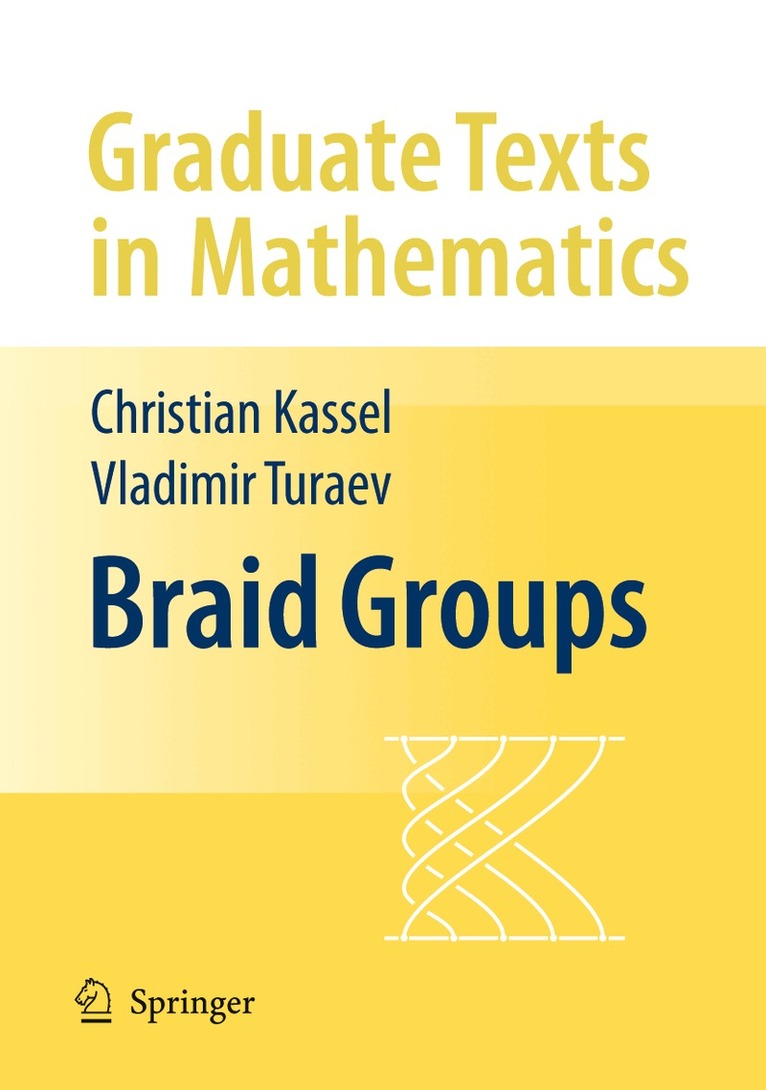
Braid Groups
Av Christian Kassel, Vladimir Turaev
Häftad, 2010
767 kr
Lägg i varukorg
Braids and braid groups, the focus of this text, have been at the heart of important mathematical developments over the last two decades. Their association with permutations has led to their presence in a number of mathematical fields and physics. As central objects in knot theory and 3-dimensional …
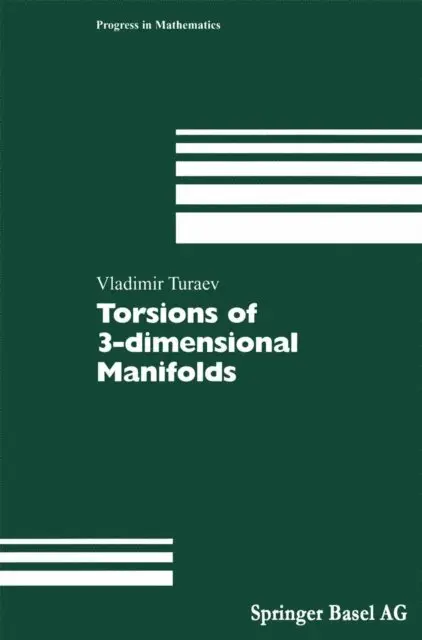
Torsions of 3-dimensional Manifolds
E-bok, 2012
718 kr
Lägg i varukorg
Three-dimensional topology includes two vast domains: the study of geometric structures on 3-manifolds and the study of topological invariants of 3-manifolds, knots, etc. This book belongs to the second domain. We shall study an invariant called the maximal abelian torsion and denoted T. It is …
Torsions of 3-dimensional Manifolds
Häftad, 2012
550 kr
Lägg i varukorg
Three-dimensional topology includes two vast domains: the study of geometric structures on 3-manifolds and the study of topological invariants of 3-manifolds, knots, etc. This book belongs to the second domain. We shall study an invariant called the maximal abelian torsion and denoted T. It is …
Monoidal Categories and Topological Field Theory
Av Vladimir Turaev, Alexis Virelizier
Inbunden, 2017
1962 kr
Lägg i varukorg
This monograph is devoted to monoidal categories and their connections with 3-dimensional topological field theories. Starting with basic definitions, it proceeds to the forefront of current research.Part 1 introduces monoidal categories and several of their classes, including rigid, pivotal, …
Monoidal Categories and Topological Field Theory
Av Alexis Virelizier, Vladimir Turaev
E-bok, 2017
2517 kr
Lägg i varukorg
This monograph is devoted to monoidal categories and their connections with 3-dimensional topological field theories. Starting with basic definitions, it proceeds to the forefront of current research. Part 1 introduces monoidal categories and several of their classes, including rigid, pivotal, …
Monoidal Categories and Topological Field Theory
Av Vladimir Turaev, Alexis Virelizier
Häftad, 2018
1962 kr
Lägg i varukorg
This monograph is devoted to monoidal categories and their connections with 3-dimensional topological field theories. Starting with basic definitions, it proceeds to the forefront of current research.Part 1 introduces monoidal categories and several of their classes, including rigid, pivotal, …
Introduction to Combinatorial Torsions
Häftad, 2001
604 kr
Lägg i varukorg
This book is an extended version of the notes of my lecture course given at ETH in spring 1999. The course was intended as an introduction to combinatorial torsions and their relations to the famous Seiberg-Witten invariants. Torsions were introduced originally in the 3-dimensional setting by K. …
Torsions of 3-dimensional Manifolds
Inbunden, 2002
550 kr
Lägg i varukorg
Three-dimensional topology includes two vast domains: the study of geometric structures on 3-manifolds and the study of topological invariants of 3-manifolds, knots, etc. This book belongs to the second domain. We shall study an invariant called the maximal abelian torsion and denoted T. It is …