W. Horosz - Böcker
Visar alla böcker från författaren W. Horosz. Handla med fri frakt och snabb leverans.
3 produkter
3 produkter
1 589 kr
Skickas inom 10-15 vardagar
The cross-disciplinary studies in this volume are of special interest because they link human purpose to the present debate between religion and the process of secularization. If that debate is to be a creative one, the notion of the 'human orderer' must be related significantly both to the sacred and secular realms. In fact, if man were not a purposive being, he would have neither religious nor secular problems. Questions about origins and destiny, divine purposiveness and the order of human development, would not arise as topics of human concern. It would appear, then, that few would deny the fact of man's purposiveness in existence, that the pursuit of these purposes constitutes the dramas of history and culture. Yet the case is otherwise. For, concerning 'purposes' itself, widely divergent, even antithetical, views have been held. The common man has mistrusted its guidance for purpose, much too often, 'changes its mind'. Its fluctuations and whimsical nature are too much even for common sense. The sciences have identified purpose with the personal life and viewed it as a function of the subject self. Consequently they had no need for it in scientific method and objective knowledge. The religions of the world have used purpose in its holistic sense, for purposes of establishing grandious systems of religious totality and for stating the ultimate goals in man's destiny.
1 589 kr
Skickas inom 10-15 vardagar
The cross-disciplinary studies in this volume are of special interest because they link human purpose to the present debate between religion and the process of secularization. If that debate is to be a creative one, the notion of the 'human orderer' must be related significantly both to the sacred and secular realms. In fact, if man were not a purposive being, he would have neither religious nor secular problems. Questions about origins and destiny, divine purposiveness and the order of human development, would not arise as topics of human concern. It would appear, then, that few would deny the fact of man's purposiveness in existence, that the pursuit of these purposes constitutes the dramas of history and culture. Yet the case is otherwise. For, concerning 'purposes' itself, widely divergent, even antithetical, views have been held. The common man has mistrusted its guidance for purpose, much too often, 'changes its mind'. Its fluctuations and whimsical nature are too much even for common sense. The sciences have identified purpose with the personal life and viewed it as a function of the subject self. Consequently they had no need for it in scientific method and objective knowledge. The religions of the world have used purpose in its holistic sense, for purposes of establishing grandious systems of religious totality and for stating the ultimate goals in man's destiny.
534 kr
Skickas inom 10-15 vardagar
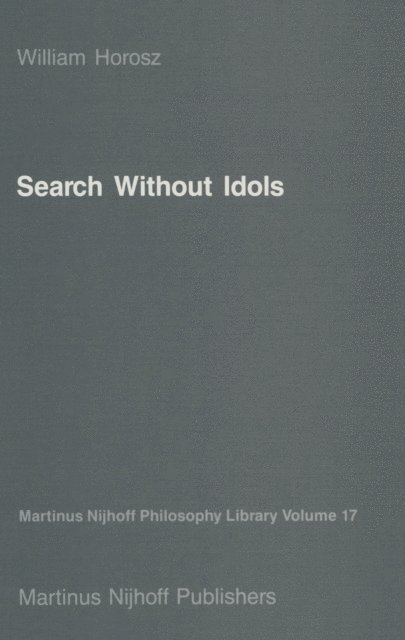
Search Without Idols is a study of human transcendence in the context of human striving, projecting, surpassing, overcoming. This power is central to man's search for wholeness. Such transcendence makes reality tolerable. It provides us with ~m impressive array of human responses which enable us to cope. But it also provides the excesses that go beyond human striving. Nothing seems to be off-limits to this ubiquitous power. Such a state of surpassing limits is what we find in the relation between the human search for wholeness and the quest for external totalities which lies beyond the human context. Such soaring flights beyond the capacity of human striving are hard to control, impossible to show responsibility-for and beyond the reach of criteria. The reach exceeds both our grasp and our control. Transcendence, then, is a greatly used and much abuse~ human power. Its activities have never ceased to amaze me, its excesses have always troubled me even from the beginning of my studies. This book is not an exercise in self-clarification. I have some thoughts on the matter which I wish to share with the reader. Perhaps we can mutually appreciate the great gift without compromising our sanity. Part I will provide a new look at the meaning of transcendence.