W. Krohn - Böcker
Visar alla böcker från författaren W. Krohn. Handla med fri frakt och snabb leverans.
6 produkter
6 produkter
1 577 kr
Skickas inom 10-15 vardagar
may be complex without being able to be replaced by something »still more simple«. This became evident with the help of computer models of deterministic-recursive systems in which simple mathematical equation systems provide an extremely complex behavior. (2) Irregularity of nature is not treated as an anomaly but becomes the focus of research and thus is declared to be normal. One looks for regularity within irregularity. Non-equilibrium processes are recognized as the source of order and the search for equilibrium is replaced by the search for the dynamics of processes. (3) The classical system-environment model, according to which the adaptation of a system to its environment is controlled externally and according to which the adaptation of the system occurs in the course of a learning process, is replaced by a model of systemic closure. This closure is operational in so far as the effects produced by the system are the causes for the maintenance of systemic organization. If there is sufficient complexity, the systems perform internal self-observation and exert self-control (»Cognition« as understood by Maturana as self-perception and self-limitation, e. g. , that of a cell vis-a. -vis its environment). 22 But any information a system provides on its environment is a system-internal construct. The »reference to the other« is merely a special case of »self-reference«. The social sciences frequently have suffered from the careless way in which scientific ideas and models have been transferred.
Del 200 - Boston Studies in the Philosophy and History of Science
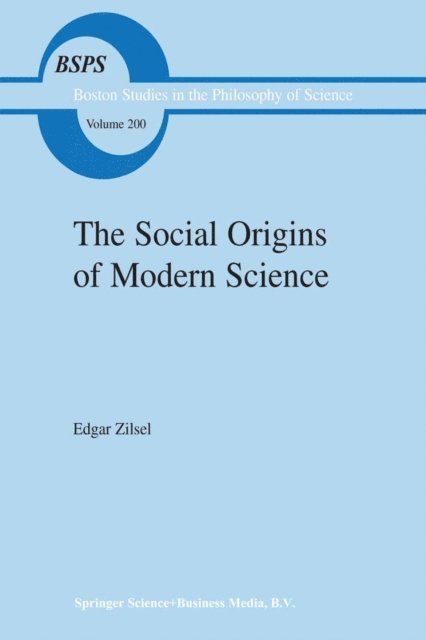
Social Origins of Modern Science
Inbunden, Engelska, 2000
2 310 kr
Skickas inom 10-15 vardagar
This single volume contains all the important historical essays Edgar Zilsel (1891-1944) published during WWII on the emergence of modern science. This edition also contains one previously unpublished essay and an extended version of an essay published earlier. In these essays, Zilsel developed the now famous thesis, named after him, that science came into being when, in the late Middle Ages, the social barriers between the intellectuals and the artisans were eroded, due to the fact that the rapidly expanding commercial classes of that period had a keen interest in improvements in technology. This class was city-based and stimulated a social environment in which men of learning came to regard the craftsmen and technicians with a new respect, in which they no longer felt any contempt for manual work and in which theory and practice were eventually combined to produce modern science. This critical edition also carries a long introduction in which much new material about Zilsel's life and work is presented. It suggests that a radical new look at Zilsel's project needs to be taken.Zilsel's essays on the history of science look like a standard case study to substantiate a particular position on the origins of modern science, but they were also an attempt to show that lawlike explanation in history and social theory is possible. It is claimed that Zilsel's historical essays were a part of another project he was working on which focused on the idea that social phenomena were open to causal explanation as much as physical phenomena. Hence the volume also contains the essays Zilsel wrote in relation to this other project.
Del 200 - Boston Studies in the Philosophy and History of Science
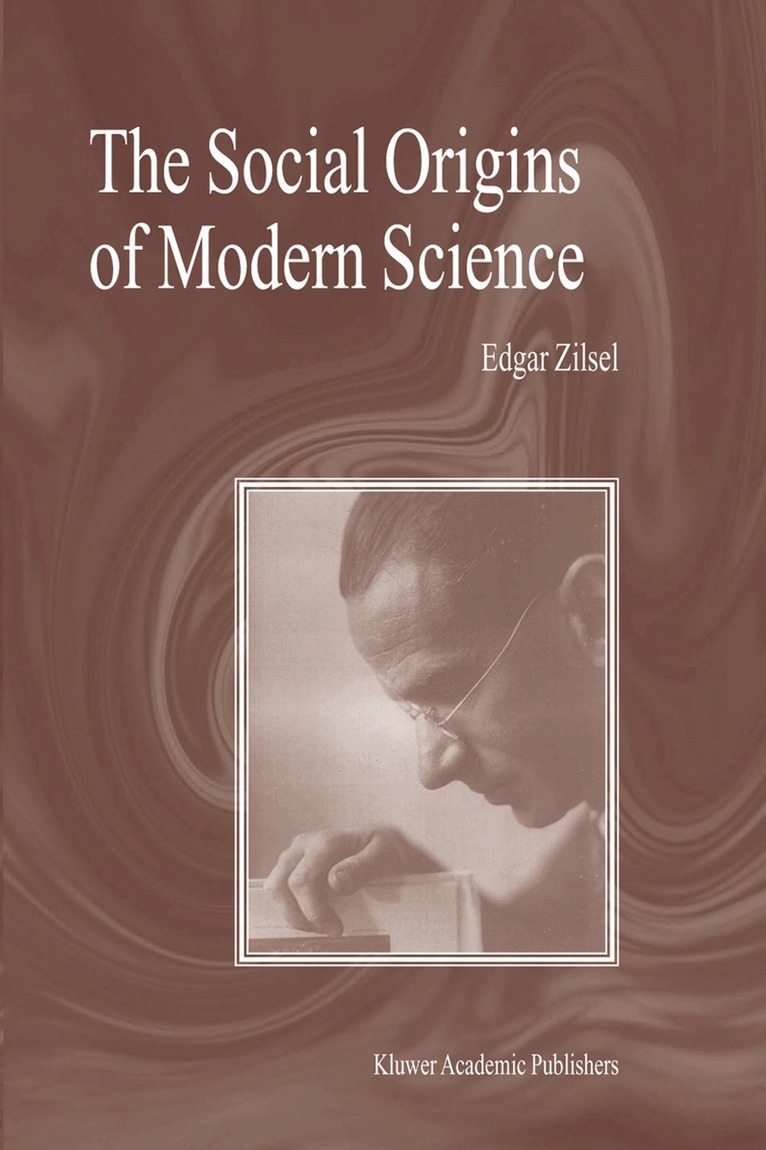
Social Origins of Modern Science
Häftad, Engelska, 2003
2 310 kr
Skickas inom 10-15 vardagar
This work makes available in a single volume all the important historical essays Edgar Zilsel (1891-1944) published during WWII on the emergence of modern science. This edition also contains one previously unpublished essay and an extended version of an essay published earlier. In these essays, Zilsel developed the now famous thesis, named after him, that science came into being when, in the late Middle Ages, the social barriers between the intellectuals and the artisans were eroded, due to the fact that the rapidly expanding commercial classes of that period had a keen interest in improvements in technology. This class was city-based and stimulated a social environment in which men of learning came to regard the craftsmen and technicians with a new respect, in which they no longer felt any contempt for manual work and in which theory and practice were eventually combined to produce modern science. This critical edition also carries a long introduction in which much new material about Zilsel's life and work is presented. It suggests that a radical new look at Zilsel's project needs to be taken.Zilsel's essays on the history of science look like a standard case study to substantiate a particular position on the origins of modern science, but they were also an attempt to show that lawlike explanation in history and social theory is possible. It is claimed that Zilsel's historical essays were a part of another project he was working on which focused on the idea that social phenomena were open to causal explanation as much as physical phenomena. Hence the volume also contains the essays Zilsel wrote in relation to this other project. Previously there have been published a German and an Italian edition of the Zilsel essays. This edition is the first in English; compared to the other two editions this one is the first that includes unpublished material and the first to undertake a serious effort to research Zilsel's life and work. What is special about this volume is the well-articulated social perspective it takes on the origins of modern science.
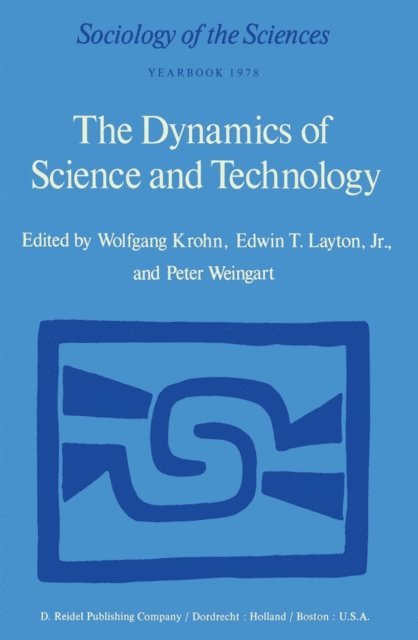
Dynamics of Science and Technology
Social Values, Technical Norms and Scientific Criteria in the Development of Knowledge
Inbunden, Engelska, 1978
1 064 kr
Skickas inom 10-15 vardagar
The interrelations of science and technology as an object of study seem to have drawn the attention of a number of disciplines: the history of both science and technology, sociology, economics and economic history, and even the philosophy of science. The question that comes to mind is whether the phenomenon itself is new or if advances in the disciplines involved account for this novel interest, or, in fact, if both are intercon nected. When the editors set out to plan this volume, their more or less explicit conviction was that the relationship of science and technology did reveal a new configuration and that the disciplines concerned with 1tS analysis failed at least in part to deal with the change because of conceptual and methodological preconceptions. To say this does not imply a verdict on the insufficiency of one and the superiority of any other one disciplinary approach. Rather, the situation is much more complex. In economics, for example, the interest in the relationship between science and technology is deeply influenced by the theoretical problem of accounting for the factors of economic growth. The primary concern is with technology and the problem is whether the market induces technological advances or whether they induce new demands that explain the subsequent diffusion of new technologies. Science is generally considered to be an exogenous factor not directly subject to market forces and, therefore, appears to be of no interest.
Dynamics of Science and Technology
Social Values, Technical Norms and Scientific Criteria in the Development of Knowledge
Häftad, Engelska, 1978
1 064 kr
Skickas inom 10-15 vardagar
The interrelations of science and technology as an object of study seem to have drawn the attention of a number of disciplines: the history of both science and technology, sociology, economics and economic history, and even the philosophy of science. The question that comes to mind is whether the phenomenon itself is new or if advances in the disciplines involved account for this novel interest, or, in fact, if both are intercon nected. When the editors set out to plan this volume, their more or less explicit conviction was that the relationship of science and technology did reveal a new configuration and that the disciplines concerned with 1tS analysis failed at least in part to deal with the change because of conceptual and methodological preconceptions. To say this does not imply a verdict on the insufficiency of one and the superiority of any other one disciplinary approach. Rather, the situation is much more complex. In economics, for example, the interest in the relationship between science and technology is deeply influenced by the theoretical problem of accounting for the factors of economic growth. The primary concern is with technology and the problem is whether the market induces technological advances or whether they induce new demands that explain the subsequent diffusion of new technologies. Science is generally considered to be an exogenous factor not directly subject to market forces and, therefore, appears to be of no interest.
1 577 kr
Skickas inom 10-15 vardagar
may be complex without being able to be replaced by something »still more simple«. This became evident with the help of computer models of deterministic-recursive systems in which simple mathematical equation systems provide an extremely complex behavior. (2) Irregularity of nature is not treated as an anomaly but becomes the focus of research and thus is declared to be normal. One looks for regularity within irregularity. Non-equilibrium processes are recognized as the source of order and the search for equilibrium is replaced by the search for the dynamics of processes. (3) The classical system-environment model, according to which the adaptation of a system to its environment is controlled externally and according to which the adaptation of the system occurs in the course of a learning process, is replaced by a model of systemic closure. This closure is operational in so far as the effects produced by the system are the causes for the maintenance of systemic organization. If there is sufficient complexity, the systems perform internal self-observation and exert self-control (»Cognition« as understood by Maturana as self-perception and self-limitation, e. g. , that of a cell vis-a. -vis its environment). 22 But any information a system provides on its environment is a system-internal construct. The »reference to the other« is merely a special case of »self-reference«. The social sciences frequently have suffered from the careless way in which scientific ideas and models have been transferred.