W. Tecumseh Fitch - Böcker
Visar alla böcker från författaren W. Tecumseh Fitch. Handla med fri frakt och snabb leverans.
5 produkter
5 produkter
18 862 kr
Skickas inom 10-15 vardagar
This new four-volume collection, part of Routledge’s Critical Concepts in Linguistics series, assembles the most important scholarly writings concerning the biological evolution of language, particularly those incorporating a Darwinian view of evolution. Including excerpts from ancient sources such as the Bible, Plato, and Aristotle, along with classical sources like Condillac, Rousseau, and Herder, Language Evolution provides an overview of the intensive debate on language evolution following the publication of Darwin’s Origin of Species.It also outlines each of the major conceptions of protolanguage and examines the evolution of our human capacity for speech, as well as focusing on the modern (mostly post-1990) literature attempting to reconcile the Chomskyean approach to linguistics with a Darwinian evolutionary viewpoint. In addition, it incorporates the new insights and approaches based on computer modelling, which have played a growing role in the recent literature.This is an important resource for those scholars interested in possessing a deeper, historically informed overview of the immense literature on this topic. The collection will also, of course, provide unified and ready access to a selection of the most important papers from the 1990s onward. It is supplemented with a full index, and includes an introduction to each volume, newly written by the editors, which places the assembled materials in their historical and intellectual context.
668 kr
Skickas inom 7-10 vardagar
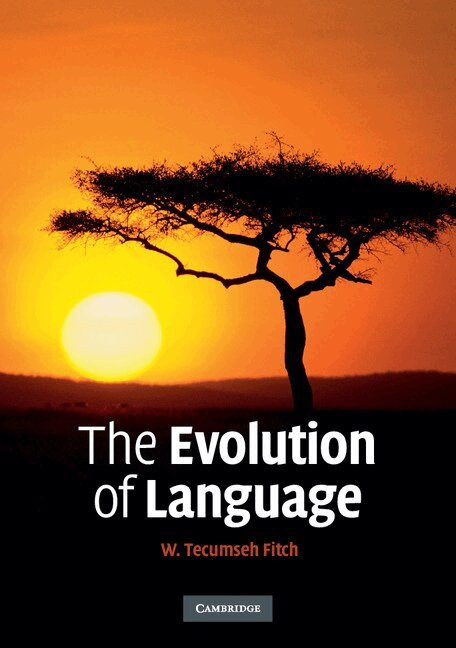
Language, more than anything else, is what makes us human. It appears that no communication system of equivalent power exists elsewhere in the animal kingdom. Any normal human child will learn a language based on rather sparse data in the surrounding world, while even the brightest chimpanzee, exposed to the same environment, will not. Why not? How, and why, did language evolve in our species and not in others? Since Darwin's theory of evolution, questions about the origin of language have generated a rapidly-growing scientific literature, stretched across a number of disciplines, much of it directed at specialist audiences. The diversity of perspectives - from linguistics, anthropology, speech science, genetics, neuroscience and evolutionary biology - can be bewildering. Tecumseh Fitch cuts through this vast literature, bringing together its most important insights to explore one of the biggest unsolved puzzles of human history.
1 472 kr
Skickas inom 7-10 vardagar
Language, more than anything else, is what makes us human. It appears that no communication system of equivalent power exists elsewhere in the animal kingdom. Any normal human child will learn a language based on rather sparse data in the surrounding world, while even the brightest chimpanzee, exposed to the same environment, will not. Why not? How, and why, did language evolve in our species and not in others? Since Darwin's theory of evolution, questions about the origin of language have generated a rapidly-growing scientific literature, stretched across a number of disciplines, much of it directed at specialist audiences. The diversity of perspectives - from linguistics, anthropology, speech science, genetics, neuroscience and evolutionary biology - can be bewildering. Tecumseh Fitch cuts through this vast literature, bringing together its most important insights to explore one of the biggest unsolved puzzles of human history.
1 744 kr
Skickas inom 10-15 vardagar
Although the fundamental principles of vocal production are well-understood, and are being increasingly applied by specialists to specific animal taxa, they stem originally from engineering research on the human voice. These origins create a double barrier to entry for biologists interested in understanding acoustic communication in their study species. The proposed volume aims to fill this gap, providing easy-to-understand overviews of the various relevant theories and techniques, and showing how these principles can be implemented in the study of all main vertebrate groups. The volume will have eleven chapters assembled from the world's leading researchers, at a level intelligible to a wide audience of biologists with no background in engineering or human voice science. Some will cover sound production in a particular vertebrate group; others will address a particular issue, such as vocal learning, across vertebrate taxa. The book will highlight what is known and how to implement useful techniques and methodologies, but will also summarize current gaps in the knowledge. It will serve both as a tutorial introduction for newcomers and a springboard for further research for all scientists interested in understanding animal acoustic signals.
1 744 kr
Skickas inom 10-15 vardagar
Although the fundamental principles of vocal production are well-understood, and are being increasingly applied by specialists to specific animal taxa, they stem originally from engineering research on the human voice.