
W. Van Rensbergen – författare
Visar alla böcker från författaren . Handla med fri frakt och snabb leverans.
4 produkter
4 produkter
Inbunden, Engelska, 1994
1 194 kr
Skickas inom 10-15 vardagar
This book presents a complete overview of what we know, and would like to know, about the evolution and structure of massive stars. The spectra of early-type stars are produced by elaborate model atmospheres enveloping the internal structure. The book should be of value to researchers into the evolution, structure and atmospheres of massive stars. The book is also appropriate for astrophysics courses at university level, where it can be used to get acquainted with the most recent observational data, modelling of the internal and atmospheric structure, and the refined development of single and binary evolution scenarios of massive stars.
Del 232 - Astrophysics and Space Science Library
Brightest Binaries
Häftad, Engelska, 2001
547 kr
Skickas inom 10-15 vardagar
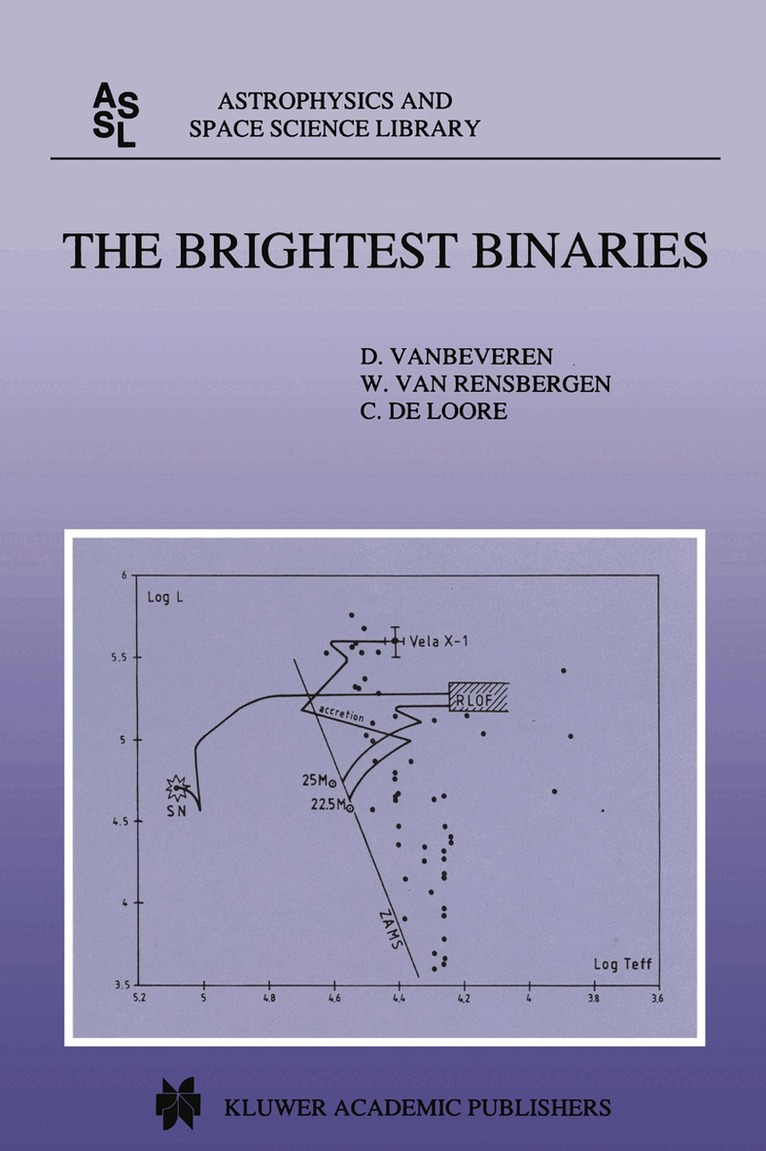
The evolution of galaxies is governed mainly by the evolution of massive stars whereas the evolution of a massive star depends primarily on its mass, chemical composition and on whether or not the star is a Single object or a binary component. To study the evolution of galaxies, it is therefore essential to know how stellar masses are distributed at birth, how many stars are formed in binaries, and what the mass ratio and orbital period distribution of binaries look like. Massive stars are intrinsically the brightest stars, so that it may be possible to discover their properties in distant groups prOvided that large telescopes can be used for basic stellar observations. However, until now the observations of massive stars have been reasonably complete only for a small region of our own Galaxy (~ 3 kpc from the Sun). One hopes that the conclusions resulting from these observations hold for the whole Galaxy, for the whole cosmos. With 'The Brightest Stars' of De Jager (1980) in mind, the present monograph is an addendum and an update in which we discuss the observations of 'The Brightest Binaries' in the framework of stellar evolution. A small or intermediate mass star close to the Sun may look brighter than a massive one far away. However, within volume limited star samples, the massive stars are on average also the brightest ones. In the present monograph (similarly as in the work of De Jager), bright means massive. The book consists of four main chapters.
Häftad, Engelska, 2012
1 087 kr
Skickas inom 10-15 vardagar
Massive stars occupy an exceptional place in general astrophysics. They trigger many if not all of the important processes in galactic evolution whereas due to their intrinsic brightness, they offer the (only until now) possibility to study the stellar content and stellar behaviour in distant galaxies. The last, say, 25 years, massive stars have been the subject of numerous meetings discussing the influence of massive stars on population synthesis, the number distribution of different types of massive stars, the LBV phenomenon, WR stars, X-ray binaries, stellar winds in massive stars, chemical pecularities in massive stars, supernova explosions of massive stars and the important SN1987A event, the influence of massive stars and chemical evolution of galaxies. It is clear that without a theory of stellar evolution, the study of these topics loses a lot of its significance. Massive star evolution therefore got a chance in these meetings, but rarely as a prime subject. The state of the art, the physical processes and the uncertainties in stellar evolution were barely touched. Even more, the influence of close binaries in all these massive star meetings slowly disappeared the last, say, 13 years without any scientific justification, although a significant fraction of stars occurs in close binaries with periods small enough so that both components will interact during their evolution. Denying the binaries or not discussing their influence on results and conclusions, makes the latter very uncertain or even completely unreliable.
E-bok
PDF, Engelska, 20121 413 kr
Läs direkt efter köp
Massive stars occupy an exceptional place in general astrophysics. They trigger many if not all of the important processes in galactic evolution whereas due to their intrinsic brightness, they offer the (only until now) possibility to study the stellar content and stellar behaviour in distant galaxies. The last, say, 25 years, massive stars have been the subject of numerous meetings discussing the influence of massive stars on population synthesis, the number distribution of different types of massive stars, the LBV phenomenon, WR stars, X-ray binaries, stellar winds in massive stars, chemical pecularities in massive stars, supernova explosions of massive stars and the important SN1987A event, the influence of massive stars and chemical evolution of galaxies. It is clear that without a theory of stellar evolution, the study of these topics loses a lot of its significance. Massive star evolution therefore got a chance in these meetings, but rarely as a prime subject. The state of the art, the physical processes and the uncertainties in stellar evolution were barely touched. Even more, the influence of close binaries in all these massive star meetings slowly disappeared the last, say, 13 years without any scientific justification, although a significant fraction of stars occurs in close binaries with periods small enough so that both components will interact during their evolution. Denying the binaries or not discussing their influence on results and conclusions, makes the latter very uncertain or even completely unreliable.