Walter E. Rex - Böcker
Visar alla böcker från författaren Walter E. Rex. Handla med fri frakt och snabb leverans.
5 produkter
5 produkter
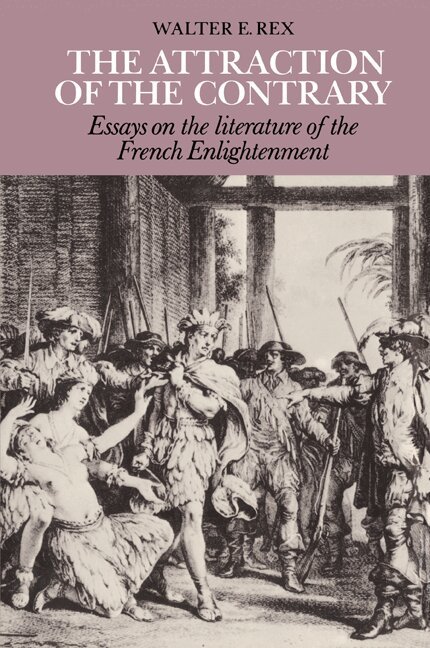
The Attraction of the Contrary
Essays on the Literature of the French Enlightenment
Häftad, Engelska, 2011
493 kr
Skickas inom 7-10 vardagar
The essays in this 1987 volume are concerned with ideas of contrarity and other kinds of polar opposition in French literature of the eighteenth century. Originally these ideas were merely part of an impulse to undermine the establishment, but as the century progressed the desire to invert social values and question accepted norms merged with the main groundswell of the age to form part of the movement of Revolution. Professor Rex considers some of the major writers of the period: Diderot, Rousseau, Voltaire, and Beaumarchais. He also explores minor genres such as opéras comiques, theatrical parodies, and erotic or pornographic pieces; these have been largely forgotten, but in their time they imbued the creative life of the era with vitality. In treating the literature in relation to the other arts, especially painting and music, these essays will be of interest to scholars of all aspects of eighteenth-century French culture.
1 986 kr
Skickas inom 7-10 vardagar
Sold as a multi-volume set – the individual volumes are not available for purchase.
Del 223 - Oxford University Studies in the Enlightenment
Inventory Of Diderot's Encyclopédie: Plates
With a Study of the Contributors by John Lough
Inbunden, Engelska, 1984
1 536 kr
Skickas inom 7-10 vardagar
Del 363 - Oxford University Studies in the Enlightenment
Diderot's Counterpoints
The Dynamics of Contrariety in His Major Works
Inbunden, Engelska, 1998
1 558 kr
Skickas inom 7-10 vardagar
The exhilarating brilliance of Diderot’s ideas combined with the intractable difficulties we encounters in his writings place him among the most challenging and controversial of the philosophes. This book puts forward a clearer understanding of Diderot’s perplexities by taking into account the dynamics of his thought processes, especially the mode, peculiar to him, of thinking via contrarieties. Uniquely among the philosophes, Diderot has the irregular habit of letting his ideas capsize and go into reverse, ‘pro’ turning into ‘contra’, ‘yea’ becoming ‘nay’ – without the author bothering to notice (much less to inform the reader) that he has completely changed his mind. The phenomenon is frequent; in a number of instances, it is impossible to ‘make sense’ of Diderot’s writings unless we are alert to this even when it occurs, that is, alert the dynamics of contrariety.This feature of Diderot’s mental processes has received little attention from scholars – for good reasons: contrarieties suggest that the movement of Diderot’s thought is often neither logical nor even rational, that frequently his concepts do not remain fixed and stable, or add up along straight lines. The existence of contrarieties implies that, as Diderot wrote, his ideas proceed in discrete stages, creating an evolution of concepts whose values are not only changing, but often contradicting their previous meanings. Finally, contrarieties play against the principle, sacred to scholars of literature, that the ideas of work of art must have cogerence in order to be comprehensible.Accepting these challenges to tradition as the basis of his argument, Professor Rex proposes radically new analyses of almost all of Diderot’s major works (the only significant omission, La Religieuse, has been extensively treated by Professor Rex elsewhere). In sum, this perception of the dynamics of Diderot’s thought promises not only to alter fundamentally our understanding of his ‘philosophy’, but also to give a new sense of his importance in the Enlightenment.
Del 12 - Medieval and Early Modern French Studies
Molière’s Strategies
Timely Reflections on his Art of Comedy
Häftad, Engelska, 2013
934 kr
Skickas inom 5-8 vardagar
Of all the playwrights from the age of Louis XIV, only Molière’s work is still regularly performed in France and beyond. This book analyses certain elements of the plays that may explain Molière’s longevity: a plausible chain of events peppered with shocks and surprises; tensions between opposites; intellectual concerns that had not previously been the province of comedy; and plots founded on situations that are anything but comic. These hallmarks added up to an intense type of comic theatre, meaningful in ways that gave the genre a new dimension. The author of this study does not treat Molière’s plays as variations on a single prototype, but brings a fresh approach to each. The book’s witty, learned and penetrating readings examine critical issues such as the ambiguous anti-feminism of Les Femmes savantes, Molière’s revisions of the myth of Don Juan, ‘conversion’ as the theological starting point of Le Tartuffe, contrariety as the basis of comedies such as George Dandin and Le Misanthrope, and coded satire in the comédie-ballets. Each play is revealed to have a seamless comic design, while at the same time speaking to the wider world. Molière’s works are shown to be entirely and immediately involved in human society, in the social dimension of the human condition.