Wayne Norman - Böcker
Visar alla böcker från författaren Wayne Norman. Handla med fri frakt och snabb leverans.
3 produkter
3 produkter
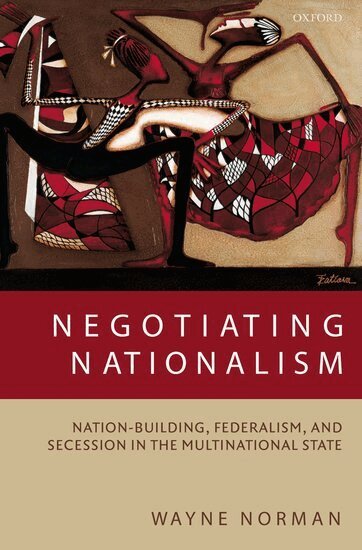
Negotiating Nationalism
Nation-Building, Federalism, and Secession in the Multinational State
Inbunden, Engelska, 2006
1 975 kr
Skickas inom 5-8 vardagar
There are at least three times as many nations as states in the world today. This book addresses some of the special challenges that arise when two or more national communities re the same (multinational) state. As a work in normative political philosophy its principal aim is to evaluate the political and institutional choices of citizens and governments in states with rival nationalist discourses and nation-building projects. The first chapter takes stock of a decade of intense philosophical and sociological debates about the nature of nations and nationalism. Norman identifies points of consensus in these debates, as well as issues that do not have to be definitively resolved in order to proceed with normative theorizing. He recommends thinking of nationalism as a form of discourse, a way of arguing and mobilizing support, and not primarily as a belief in a principle. A liberal nationalist, then, is someone who uses nationalist arguments, or appeals to nationalist sentiments, in order to rally support for liberal policies. The rest of the book is taken up with the three big political and institutional choices in multinational states. First, what can political actors and governments legitimately do to shape citizens' national identity or identities? This is the core question in the ethics of nation-building, or what Norman calls national engineering. Second, how can minority and majority national communities each be given an adequate degree of self-determination, including equal rights to carry out nation-building projects, within a democratic federal state? Finally, even in a world where most national minorities cannot have their own state, how should the constitutions of multinational federations regulate secessionist politics within the rule of law and the ideals of democracy? More than a decade after Yael Tamir's ground-breaking Liberal Nationalism, Norman finds that these three great practical and institutional questions have still rarely been addressed within a comprehensive normative theory of nationalism.
2 062 kr
Skickas inom 5-8 vardagar
Is it possible, in a modern, pluralistic society, to promote common bonds of citizenship while at the same time accommodating and showing respect for ethnocultural diversity? 'Citizenship' and 'diversity' have been two of the major topics of debate in both democratic politics and political theory over the past decade. Much has been written about the importance of citizenship, civic identities, and civic virtues for the functioning of liberal democracies, and the need to accommodate the ethnocultural, linguistic, and religious pluralism that is a fact of life in most modern states. By and large, however, these two topics have been largely discussed in mutual isolation. Much of the writing on the issues of both citizenship and diversity remains rather abstract and general and disconnected from the specific issues of public policy and institutional design. Citizenship in Diverse Societies examines the specific points of conflict and convergence between concerns for citizenship and diversity in democratic societies and reassesses and refines existing theories of 'diverse citizenship' by examining these theories in the light of actual practices and policies of pluralistic democracies.
816 kr
Skickas inom 5-8 vardagar
Is it possible, in a modern, pluralistic society, to promote common bonds of citizenship while at the same time accommodating and showing respect for ethnocultural diversity? 'Citizenship' and 'diversity' have been two of the major topics of debate in both democratic politics and political theory over the past decade. Much has been written about the importance of citizenship, civic identities, and civic virtues for the functioning of liberal democracies, and also about the need to accommodate the ethnocultural, linguistic, and religious pluralism that is a fact of life in most modern states. By and large, however, these two topics have been largely discussed in mutual isolation. Much of the writing on the issues of both citizenship and diversity remains rather abstract and general and disconnected from the concrete issues of public policy and institutional design. Citizenship in Diverse Societies examines the specific points of conflict and convergence between concerns for citizenship and diversity in democratic societies and reassesses and refines existing theories of 'diverse citizenship' by examining these theories in the light of actual practices and policies of pluralistic democracies.