W.F. Bynum - Böcker
Visar alla böcker från författaren W.F. Bynum. Handla med fri frakt och snabb leverans.
2 produkter
2 produkter
7 632 kr
Skickas inom 10-15 vardagar
Originally published in 1985 by The Tavistock Press, this three-volume set covers the history of British and continental European madness and psychiatry from the Renaissance through to Freud. The long time-span covered affords the reader views of the changing understanding of madness and the resultant policies towards it in the light of long-term developments such as secularization and industrialization.Volume 1 examines theories of madness and its treatment, both those of laymen and those of the emergent psychiatric profession, as well as looking at the experiences of mad people themselves.Volume 2 examines the emergence of the modern lunatic asylum and judges how far it lived up to the hopes of the nineteenth century reformers. Essays on such subjects as psychiatry in the courtroom and the treatment of First World War shellshock victims dissect the historical dimensions of current notions of psychiatry as a means of social control.Volume 3 brings together essays on nineteenth century psychiatry on various themes ranging from the architecture of asylums to social policy, from therapeutics to professionalization. As well as British, aspects of French, Italian, American and Danish psychiatry are also analysed.
Del 51 - Clio Medica
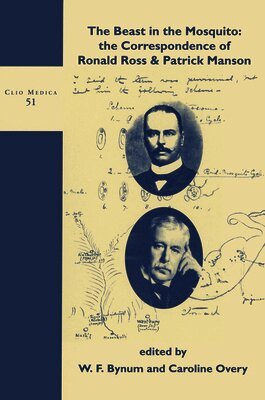
Beast in the Mosquito
The Correspondence of Ronald Ross & Patrick Manson
Inbunden, Engelska, 1998
3 217 kr
Skickas inom 5-8 vardagar
The correspondence between Sir Ronald Ross (1857-1932) and Sir Patrick Manson (1844-1922) is rich in both scientific and human terms. It records, in great detail, Ross's research in India between 1895 and 1899, which elucidated the role of mosquitoes in the transmission of malaria, work for which Ross was awarded the 1902 Nobel Prize for Medicine or Physiology. Ross described the mosquito-transmission theory as Manson's 'Grand Induction', and he had returned to India, where he was an officer in the Indian Medical Service, having been primed by Manson. Ross's regular letters to his mentor document the frustrations and false trails as well as the excitement of discovery. Manson in turn acted as a kind of agent in London, publicising his findings, offering advice and seeking to use his influence to secure for Ross the working conditions he so desired.These 173 letters, plus 85 from the two decades after Ross's return to Britain also record the rise and full of a relationship, as Ross's preoccupation with his place in the history of malariology led to a breach between the two men. Themes of priority, nationalism, and personal vanity punctuate this latter correspondence, which also reveals new insights about the golden years of tropical medicine.Ross included some of the correspondence in his Memoirs, but most of it appears here, fully annotated, for the first time.