Wieland Hoban - Böcker
Visar alla böcker från författaren Wieland Hoban. Handla med fri frakt och snabb leverans.
6 produkter
6 produkter
250 kr
Skickas inom 3-6 vardagar
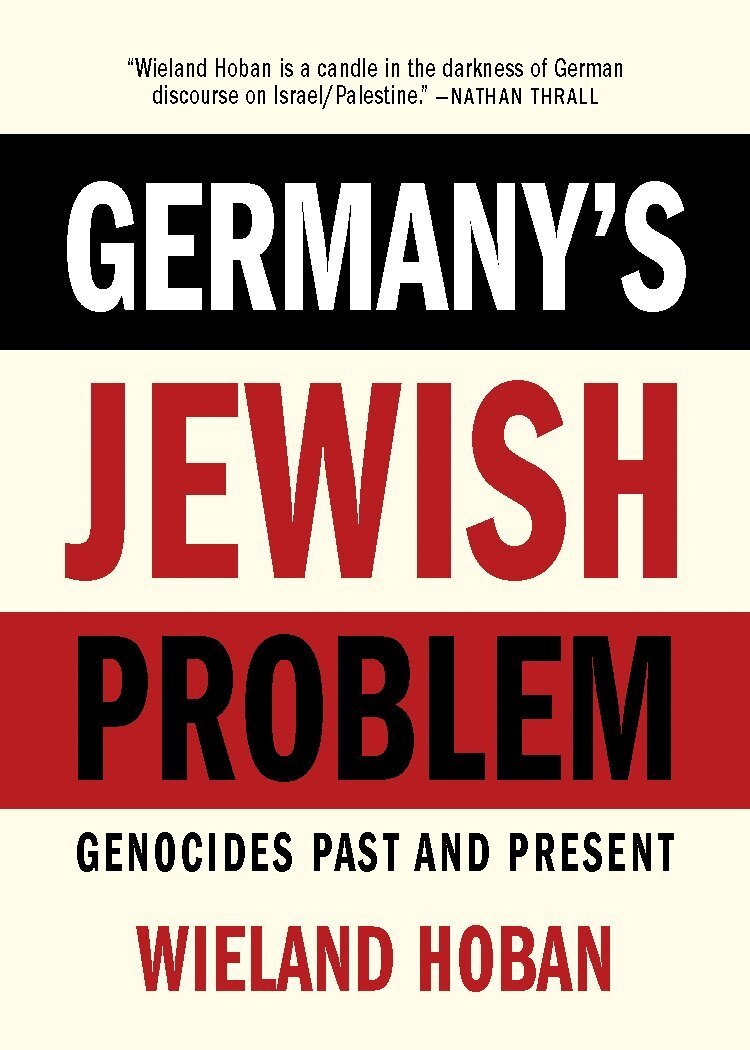
A leading German–Jewish peace activist dissects Germany’s authoritarian crackdown after Gaza.Since October 2023, the Frankfurt-based Jewish composer and activist Wieland Hoban has traveled the globe rallying opposition to the Gaza genocide. Now, in an urgent collection of writings at once blistering and revelatory, Hoban unravels the cultural neuroses and political cynicism that have made Germany an outlier in its support for Israeli crimes.From German gentiles confidently charging Israeli Jewish expats with antisemitism, to the German state’s decades-long project to stifle free speech under the guise of combating “antisemitism,” to German officials mobilising their historical responsibility for one genocide to justify participating in another—Hoban guides us through the grotesqueries of German “memory culture” and shows their lethal consequences.As the chair of a German–Jewish peace group whose bank accounts were repeatedly frozen and whose members have been arrested on Gaza solidarity protests, Hoban is uniquely placed to expose the oddities and outrages of Germany’s authoritarian turn. He also warns that what begins in Germany doesn’t stay there. From sabotaging international support for a Gaza ceasefire, to deporting foreign nationals on political grounds, to spearheading censorship laws across the EU, Hoban’s diagnosis of German pathologies demonstrates where the ideological weaponisation of “antisemitism” can lead.
230 kr
Skickas inom 7-10 vardagar
A romantic novel like no other.A writer has penned a novel about the great love of his youth. After a public reading, he is approached by a woman he doesn’t recognize—but it’s his lover. He is the author; she, the figure in his novel. The young girl from back then has turned into an interesting and attractive woman—but she’s also married. Soon the situation becomes a little strange: they sit down together, have a glass of wine, talk about French romantic novels, ask each other what one expects of love when one grows older. And all the while her husband is sitting in the next room. How is this going to end? Navid Kermani has written a romantic novel like no other—surprising, witty, profound—and one can barely put it down.
257 kr
Skickas inom 7-10 vardagar
Collects 166 of Alexander Kluge’s love stories previously concealed among his vast library of more than 2,000 texts.The latest offering from one of the greatest living German writers, The Labyrinth of Tender Force masterfully explores the greatest peaks and the most dreadful crevasses of passionate love through an inspired combination of Kluge’s vignettes with drawings, photographs, and other archival material culled from diverse sources. Organized thematically, these stories take readers on a flight over the maps—the varied topography—of love. This flight ends on a high plateau, at the heart of the most beautiful romances and a cardinal text of modernity about the economy of relationships: Madame de La Fayette’s The Princess of Cleves.
198 kr
Skickas inom 7-10 vardagar
Paints a delicate portrait of a twelve-year-old boy named Julian growing up in a mining community in 1960s Germany.First Light covers only a few summer weeks, following young Julian’s gradual social and sexual awakening amidst his parent’s financial and marital problems. Avoiding any overt drama in the description of his predicaments and observations, Rothmann instead creates a quiet sense of hope and new beginnings. His subtle, restrained prose captures the unarticulated, yet increasingly conscious feelings of the boy as he approaches the end of childhood, but still remains very remote from the adult world he sees around him. From his stressed, exhausted mother to their suspicious neighbor Herr Gorny, the adult characters remind him of his own powerlessness rather than offering encouragement; but his little sister Sophie proves his most devoted ally, gently standing up to their mother’s fits of rage. As the novel progresses, Julian becomes increasingly aware of the weaknesses and failures of the adults; despite his difficulties in understanding what goes on around him, one senses a wisdom and integrity that sets him apart from many of the other characters in his life. Rothmann’s refreshingly unpretentious style offers the perfect medium for this portrait of ambivalent youthful consciousness.
183 kr
Skickas inom 7-10 vardagar
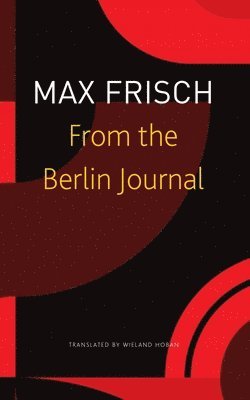
The daily journal of a giant of German literature, touching subjects ranging from everyday life to the political and social conditions in East Germany as viewed from West Berlin.Max Frisch (1911–91) was a giant of twentieth-century German literature. When Frisch moved into a new apartment in Berlin’s Sarrazinstrasse, he began keeping a journal, which he came to call the Berlin Journal. A few years later, he emphasized in an interview that this was by no means a “scribbling book,” but rather a book “fully composed.” The journal is one of the great treasures of Frisch’s literary estate, but the author imposed a retention period of twenty years from the date of his death because of the “private things” he noted in it. From the Berlin Journal now marks the first publication of excerpts from Frisch’s journal. Here, the unmistakable Frisch is back, full of doubt, with no illusions, and with a playfully sharp eye for the world. From the Berlin Journal pulls from the years 1946–49 and 1966–71. Observations about the writer’s everyday life stand alongside narrative and essayistic texts, as well as finely-drawn portraits of colleagues like Günter Grass, Uwe Johnson, Wolf Biermann, and Christa Wolf, among others. Its foremost quality, though, is the extraordinary acuity with which Frisch observed political and social conditions in East Germany while living in West Berlin.
200 kr
Skickas inom 7-10 vardagar
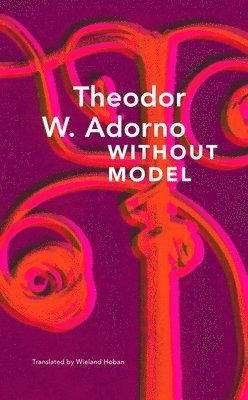
Essays by Theodor W. Adorno on art and cinema. In Without Model, Theodor W. Adorno strikingly demonstrates the intellectual range for which he is known. Taking the premise of the title as his guiding principle, that artistic and philosophical thought must eschew preconceptions and instead adapt itself to its time, circumstances, and object, Adorno presents a series of essays reflecting on culture at different levels, from the details of individual products to the social conditions of their production. He shows his more nostalgic side in the childhood reminiscences of ‘Amorbach’, but also his acute sociocultural analysis of the central topic of the culture industry. He criticizes attempts to maintain tradition in music and visual art, arguing against a restorative approach by stressing the modernity and individuality of historical works in the context of their time. In all of these essays, available for the first time in English, Adorno displays the remarkable thinking of one both steeped in tradition and dedicated to seeing beyond it.