William A. Jackson – Författare
Visar alla böcker från författaren William A. Jackson. Handla med fri frakt och snabb leverans.
5 produkter
5 produkter
2 113 kr
Skickas inom 10-15 vardagar
Arguing for a broader understanding of welfare, with culture as a unifying theme, this book demonstrates the explanatory power of an interdisciplinary approach to economic and social welfare.This approach highlights the narrowness of orthodox economics which, founded on individualistic and utilitarian modelling, has settled for a narrow, simplified picture of welfare that omits many relevant factors, such as production, work, community, identity, lifestyle, preference formation, belief systems, material consumption and the environment.The book begins by considering definitions of welfare and advocating culture as the core concept needed to capture a whole way of life. It examines economic welfare, on dimensions such as work, income, happiness and the environment, alongside social welfare, on dimensions such as capability, community, identity and freedom. These various dimensions, usually discussed separately, can be interrelated within a larger cultural vision. Prospects for promoting welfare through cultural evolution or public welfare policies are evaluated. Unlike most studies of welfare, the book adopts an interdisciplinary perspective that pulls together numerous strands of literature from heterodox economics, other social sciences and the humanities.It offers an extensive, non-technical survey of how welfare has been portrayed in the academic literature and how the diverse views can fit within a cultural approach. It will be of great interest to economists, social scientists and policy-makers.
2 113 kr
Skickas inom 10-15 vardagar
Defining markets has never been an easy task. Despite their importance for economic theory and practice, they are hard to pin down as a concept and economists have tended to adopt simplified axiomatic models or rely on piecemeal case studies. This book argues that an extended range of theory, social as well as economic, can provide a better foundation for the portrayal of markets.The book first looks at the definition of markets, their inadequate treatment in orthodox economic theory, and their historical background in the pre-capitalist and capitalist eras. It then assesses various alternatives to orthodox theory, categorised as social/cultural, structural, functional and ethical approaches. Among the alternatives considered are institutionalist accounts, Marxian views, network models, performativity arguments, field theories, Austrian views and ethical notions of fair trade. A key finding of the book is that these diverse approaches, valuable as they are, could present a more effective challenge to orthodoxy if they were less disparate. Possibilities are investigated for a more unified theoretical alternative to orthodoxy. Unlike most studies of markets, this book adopts a fully interdisciplinary viewpoint expressed in accessible, non-technical language. Ideas are brought together from heterodox economics, social theory, critical realism, as well as other social sciences such as sociology, anthropology and geography. Anybody seeking a broad critical survey of the theoretical analysis of markets will find this book useful and it will be of great interest to economists, social scientists, students and policy-makers.
578 kr
Skickas inom 10-15 vardagar
Defining markets has never been an easy task. Despite their importance for economic theory and practice, they are hard to pin down as a concept and economists have tended to adopt simplified axiomatic models or rely on piecemeal case studies. This book argues that an extended range of theory, social as well as economic, can provide a better foundation for the portrayal of markets.The book first looks at the definition of markets, their inadequate treatment in orthodox economic theory, and their historical background in the pre-capitalist and capitalist eras. It then assesses various alternatives to orthodox theory, categorised as social/cultural, structural, functional and ethical approaches. Among the alternatives considered are institutionalist accounts, Marxian views, network models, performativity arguments, field theories, Austrian views and ethical notions of fair trade. A key finding of the book is that these diverse approaches, valuable as they are, could present a more effective challenge to orthodoxy if they were less disparate. Possibilities are investigated for a more unified theoretical alternative to orthodoxy. Unlike most studies of markets, this book adopts a fully interdisciplinary viewpoint expressed in accessible, non-technical language. Ideas are brought together from heterodox economics, social theory, critical realism, as well as other social sciences such as sociology, anthropology and geography. Anybody seeking a broad critical survey of the theoretical analysis of markets will find this book useful and it will be of great interest to economists, social scientists, students and policy-makers.
1 840 kr
Skickas inom 7-10 vardagar
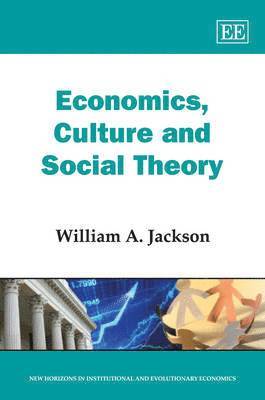
Economics, Culture and Social Theory examines how culture has been neglected in economic theorising and considers how economics could benefit by incorporating ideas from social and cultural theory. Orthodox economics has prompted a long line of cultural criticism that goes back to the origins of economic theory and extends to recent debates surrounding postmodernism. William A. Jackson discusses the cultural critique of economics, identifies the main arguments, and assesses their implications. Among the topics covered are relativism and realism, idealism and materialism, agency and structure, hermeneutics, semiotics, and cultural evolution. Drawing from varied literatures, notably social and cultural theory, the book stresses the importance of culture for economic behaviour and looks at the prospects for a renewed and culturally informed economics.The book will be invaluable to heterodox economists and to anyone interested in the links between culture and the economy. It takes an interdisciplinary approach, arguing against the isolation of economics, and will therefore hold wide appeal for social scientists working in related fields, as well as for economists specialising in cultural economics and economic methodology.
1 759 kr
Skickas inom 7-10 vardagar
Population ageing has been the subject of much discussion in recent years, often expressed in alarmist language that advocates evasive policy action to avert an imminent demographic crisis. This forward-looking book evaluates the debates surrounding population ageing and offers a more optimistic outlook on its effect on the economy.William Jackson initially considers general theoretical approaches to population ageing, particularly in relation to the rising dependency burden. He then goes on to examine traditional topics such as employment, productivity, pensions and social security, along with less traditional topics such as informal care, within the context of long-run structural changes. The author draws on an extensive range of economic literature and considers neoclassical arguments before analysing the issue from a non-neoclassical economic, social gerontological and sociological perspective. He maintains that conventional economic theory tends to overstate the effects of population ageing on the economy. Thus, he argues that while population ageing is a complex issue requiring some policy adjustments, it is a less acute problem than is suggested in popular and academic discussion.This book will be of great importance to scholars and students with an interest in population economics and the economics of social policy.