William E. Baylis - Böcker
Visar alla böcker från författaren William E. Baylis. Handla med fri frakt och snabb leverans.
5 produkter
5 produkter
818 kr
Skickas inom 10-15 vardagar
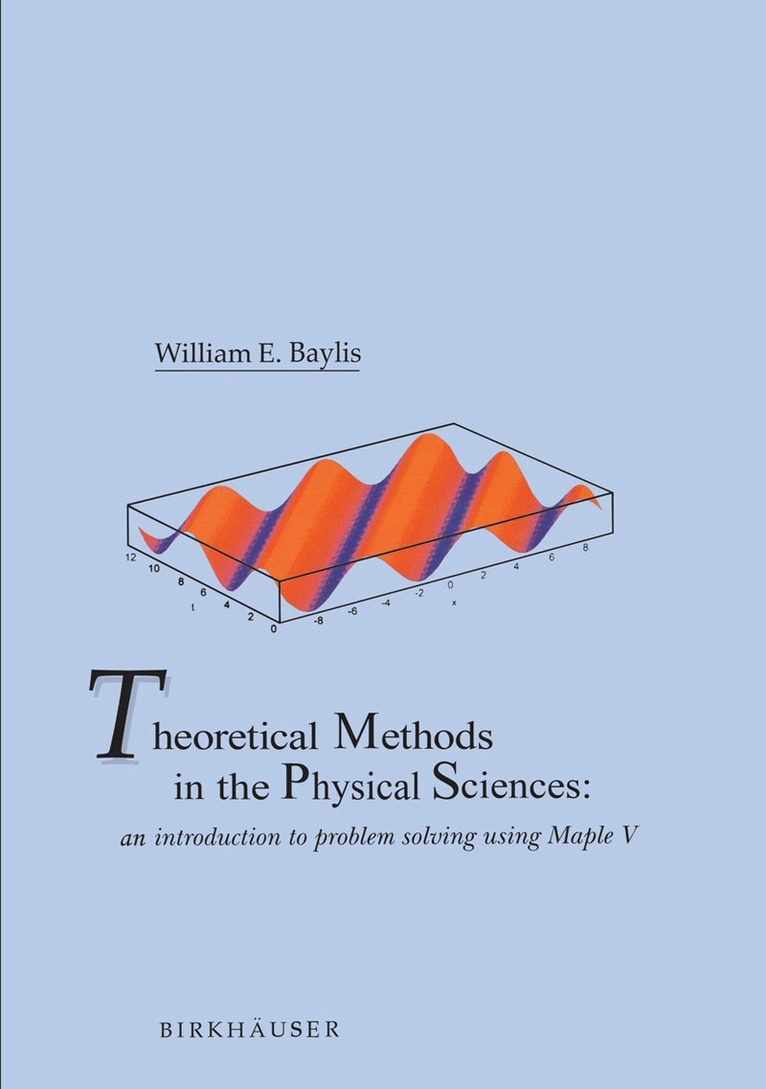
This text is designed for a one-term course. It uses the Maple package as an integral part of learning how to solve a range of problems taken from elementary physics, astronomy, chemistry and geology. At the same time it encourages the reader to think about what is being calculated, to relate results to physical experience, to make order-of-magnitude estimates of both answers and errors, and to carry out dimensional and unit checks of calculations. It is packaged with a 3.5" diskette containing Maple worksheets for each chapter and data files of physical constants, conversion factors, and chemical isotopes. The diskette is formatted on MS-Windows, but its files can also be used on Apple and Unix platforms.
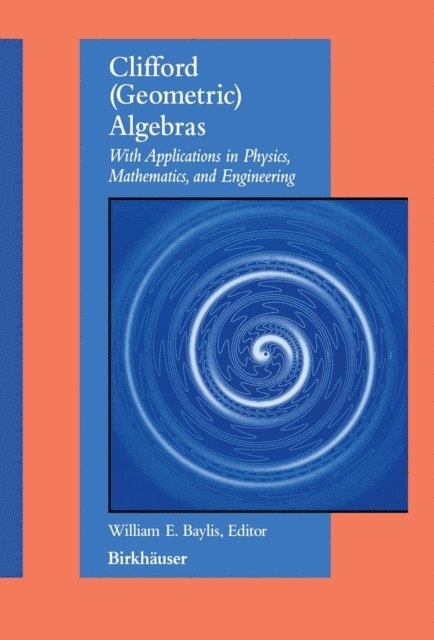
Clifford (Geometric) Algebras
with applications to physics, mathematics, and engineering
Inbunden, Engelska, 1996
1 577 kr
Skickas inom 10-15 vardagar
This text takes an emerging approach to physics, emphasizing important geometrical structures that lay the foundations of much of modern theory. The subject of Clifford algebras is presented in efficient geometric language - common concepts in physics are clarified, united and extended. The text serves as a pedgogical tool for either self-study or in undergraduate/graduate courses. Topics covered include: history of teaching algebras; linear algebra; gravity; spinors; applications in engineering; spacetime algebra and line geometry; and Clifford algebra with Maple.
852 kr
Skickas inom 10-15 vardagar
The emphasis in this text is on classical electromagnetic theory and electrodynamics, that is, dynamical solutions to the Lorentz-force and Maxwell's equations. The natural appearance of the Minkowski spacetime metric in the paravector space of Clifford's geometric algebra is used to formulate a covariant treatment in special relativity that seamlessly connects spacetime concepts to the spatial vector treatments common in undergraduate texts. Baylis' geometrical interpretation, using such powerful tools as spinors and projectors, essentially allows a component-free notation and avoids the clutter of indices required in tensorial treatments. The exposition is clear and progresses systematically - from a discussion of electromagnetic units and an explanation of how the SI system can be readily converted to the Gaussian or natural Heaviside-Lorentz systems, to an introduction of geometric algebra and the paravector model of spacetime, and finally, special relativity. Other topics include Maxwell's equation(s), the Lorentz-force law, the Fresnel equations, electromagnetic waves and polarization, wave guides, radiation from accelerating charges and time-dependent currents, the Liénard-Wiechert potentials, and radiation reaction, all of which benefit from the modern relativistic approach. Numerous worked examples and exercises dispersed throughout the text help the reader understand new concepts and facilitate self-study of the material. Each chapter concludes with a set of problems, many with answers. Complete solutions are also available. An excellent feature is the integration of Maple into the text, thereby facilitating difficult calculations. To download accompanying Maple worksheets, please visit http://www.cs.uwindsor.ca/users/b/baylis
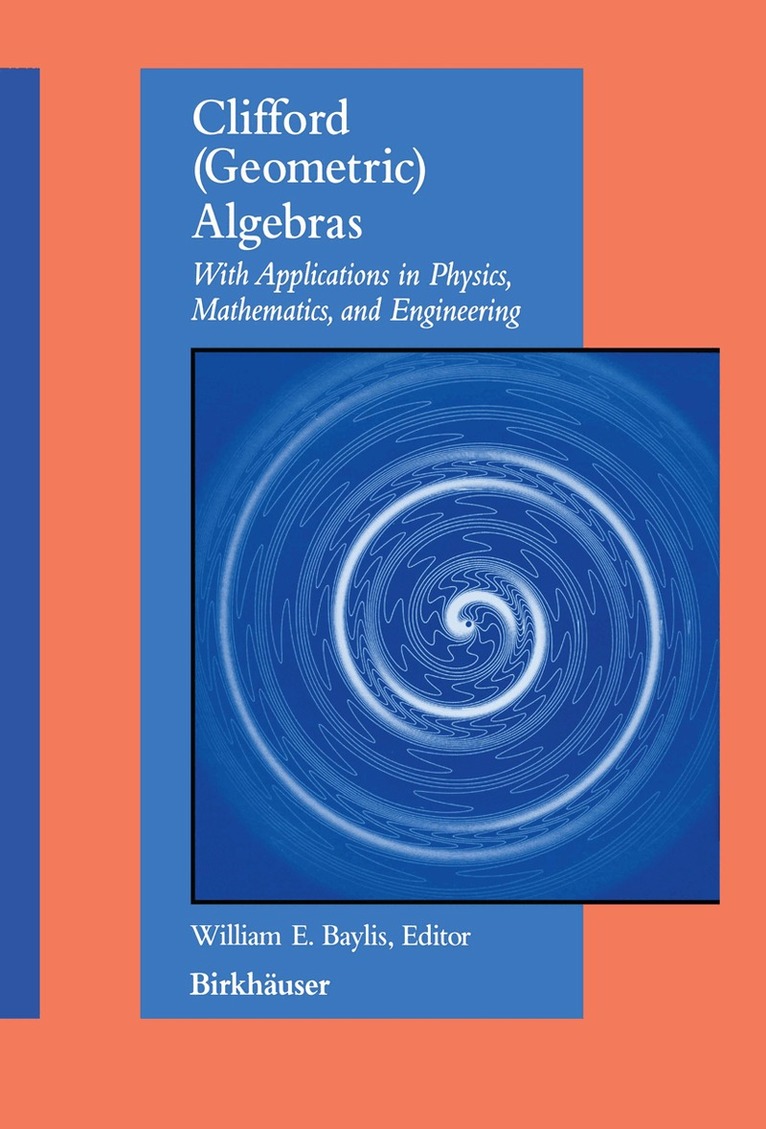
Clifford (Geometric) Algebras
with applications to physics, mathematics, and engineering
Häftad, Engelska, 2011
1 577 kr
Skickas inom 10-15 vardagar
This volume is an outgrowth of the 1995 Summer School on Theoretical Physics of the Canadian Association of Physicists (CAP), held in Banff, Alberta, in the Canadian Rockies, from July 30 to August 12,1995. The chapters, based on lectures given at the School, are designed to be tutorial in nature, and many include exercises to assist the learning process. Most lecturers gave three or four fifty-minute lectures aimed at relative novices in the field. More emphasis is therefore placed on pedagogy and establishing comprehension than on erudition and superior scholarship. Of course, new and exciting results are presented in applications of Clifford algebras, but in a coherent and user-friendly way to the nonspecialist. The subject area of the volume is Clifford algebra and its applications. Through the geometric language of the Clifford-algebra approach, many concepts in physics are clarified, united, and extended in new and sometimes surprising directions. In particular, the approach eliminates the formal gaps that traditionally separate clas sical, quantum, and relativistic physics. It thereby makes the study of physics more efficient and the research more penetrating, and it suggests resolutions to a major physics problem of the twentieth century, namely how to unite quantum theory and gravity. The term "geometric algebra" was used by Clifford himself, and David Hestenes has suggested its use in order to emphasize its wide applicability, and b& cause the developments by Clifford were themselves based heavily on previous work by Grassmann, Hamilton, Rodrigues, Gauss, and others.
Theoretical Methods in the Physical Sciences
An introduction to problem solving using Maple V
Häftad, Engelska, 2012
535 kr
Skickas inom 10-15 vardagar
The advent of relatively inexpensive but powerful computers is af fecting practically all aspects of our lives, but some of the greatest influence is being felt in the physical sciences. However, university curricula and teaching methods have responded somewhat cautiously, having only recently come to terms with the now omnipresent calcula tor. While many instructors at first feared that the widespread use of pocket calculators would lead to generations of students who could not multiply or perhaps even add, few now seriously lament the disappear ance of slide rules, logarithm tables, and the often error-bound tedium that such tools of the trade demand. Time that used to be spent on the use of logarithm tables and manual square-root extraction can be prof itably turned to earlier studies of calculus or computer programming. Now that the calculator has been accepted into the classroom, we face a computer-software revolution which promises to be considerably more profound. Modern textbooks in the physical sciences routinely assume their readers have access not only to calculators, but often to home or even mainframe computers as well, and the problems teachers discuss and assign students can be more complex and often more realistic than in the days of only pad and pencil computations. As less effort is spent on numerical computation, more can be devoted to conceptual under standing and to applications of the increasingly sophisticated mathe matical methods needed for a real appreciation of recent advances in the discipline.