William F. Trimble - Böcker
Visar alla böcker från författaren William F. Trimble. Handla med fri frakt och snabb leverans.
4 produkter
4 produkter
682 kr
Skickas inom 7-10 vardagar
This book chronicles the history of All American Aviation of western Pennsylvania, a commercial airline pioneer. The brainchild of self-styled inventor Dr. Lytle S. Adams and Richard C. du Pont, the company began as an airmail delivery carrier, taking advantage of the Experimental Air Mail Act passed by Congress in 1938. The Airway to Everywhere relates the exciting early days of airmail delivery—hair-raising tales of courageous pilots who scooped mail bags tethered to wires strung between poles on makeshift airfields. The story of this airline is placed within the context a typical twentieth-century American business pattern-where technological innovation is followed by development and commercial application, followed by government subsidies and corporate takeovers. In that vein, All American Aviation would become Allegheny Airlines, and later, U.S. Air.
238 kr
Tillfälligt slut
`A fascinating look at the father of naval avaiation’ - Library JournalThis is a detailed portrait of the man who took on the challenge offorming an aeronautical bureau within the US Navy in 1921 andthen nurtured the early development of naval aviation.Describing Admiral Moffett as one of the first high-ranking naval officers to appreciate the importance of the airplane and its potential impact on the fleet, Trimble contends that the admiral’s strong background as a surface officer gave him an unmatched credibility and trust with his superiors. Trimble is equally candid about the admiral’s shortcomings, including his heavy-handed support for airships, a technological dead end that squandered millions and led to Moffett’s death in 1933 when he went down with the airship Akron during a storm.William F. Trimble is a professor of history at Auburn University inAlabama and the author of five other books, including Wings forthe Navy.
254 kr
Skickas inom 5-8 vardagar
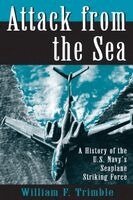
An award-winning aviation historian chronicles the Navy's efforts to develop a powerful sea-based strike force through the use of long-range attack seaplanes supported by surface ships and submarines. William Trimble traces the concept back to the early 1930s when American strategic planners sought ways to mount an assault across the Pacific with minimum air support. But it was not until 1950, when the Navy was threatened with losing its big carriers and long-range aircraft, that the idea of a Seaplane Striking Force was resurrected. Lured by breakthroughs in seaplane performance and the promise of the turbojet-powered Convair Sea Dart fighter and the Martin Sea Master attack flying boat, the Navy believed it could challenge the Air Force in the strategic role, the author explains, but found that the technology did not live up to expectations. This book investigates the difficulties of weapon system procurement within the context of strategic realities, interservice rivalry, and constrained defense budgets. It also looks at an alternative weapon system that the Navy saw as a means of extending its conventional reach and as a complement to the carrier and land-based bomber used for nuclear deterrence. That weapon, however, proved unsuccessful in the end. The author helps the reader understand that while conceptual and operational flaws kept the Seaplane Striking Force from achieving the goals set for it, the idea of a mobile weapon system capable of long-range attacks from the sea remains valid. Other books touch briefly on the subject, but this is the first to examine the concept in depth.
401 kr
Tillfälligt slut
Admiral John S. McCain and the Triumph of Naval Air Power covers the life and professional career of Adm. John S. McCain Sr. (1884-1945). McCain was among the select few officers who reached the heights of carrier task force command during World War II in the Pacific. Spanning most of the first half of the twentieth century McCain's life and career highlight the integration of aviation into the Navy emphasizing the evolution of the aircraft carrier from a tactical element of the fleet stressing sea control to a strategic force capable of long-range power projection. Although much of the book focuses on carrier aviation McCain was instrumental in the emergence of flying boats (VPs) considered essential for long-range reconnaissance in the Pacific. One of the senior officers branded as ""Johnny-Come-Latelys"" by pioneer aviators McCain nevertheless brought fresh approaches and innovation to naval aviation during the interwar and war years. His prewar and initial wartime commands encompassed tender-based and shore-based aviation which were critical to early operations in the Pacific. Yet McCain also understood the power and potential of carrier-based aviation initially as commanding officer of the Ranger before the war then as a carrier task force commander under Adm. William F. Halsey in the Pacific in 1944 and 1945. Moreover he served tours as Chief of the Bureau of Aeronautics and the first Deputy Chief of Naval Operations (Air) in 1942-1944. In these varied capacities he witnessed and played a role in the culmination of naval air power as a means of delivering crippling blows to the enemy's homeland. McCain was among only a handful of officers who achieved prominence during the war who had experience in all of these varied and challenging levels of command.