William G. Dwyer - Böcker
Visar alla böcker från författaren William G. Dwyer. Handla med fri frakt och snabb leverans.
2 produkter
2 produkter
1 453 kr
Skickas inom 7-10 vardagar
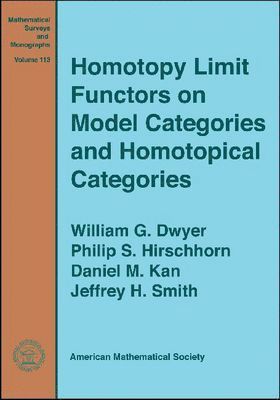
The purpose of this monograph, which is aimed at the graduate level and beyond, is to obtain a deeper understanding of Quillen's model categories. A model category is a category together with three distinguished classes of maps, called weak equivalences, cofibrations, and fibrations. Model categories have become a standard tool in algebraic topology and homological algebra and, increasingly, in other fields where homotopy theoretic ideas are becoming important, such as algebraic $K$-theory and algebraic geometry.The authors' approach is to define the notion of a homotopical category, which is more general than that of a model category, and to consider model categories as special cases of this. A homotopical category is a category with only a single distinguished class of maps, called weak equivalences, subject to an appropriate axiom. This enables one to define ""homotopical"" versions of such basic categorical notions as initial and terminal objects, colimit and limit functors, cocompleteness and completeness, adjunctions, Kan extensions, and universal properties.There are two essentially self-contained parts, and part II logically precedes part I. Part II defines and develops the notion of a homotopical category and can be considered as the beginnings of a kind of ""relative"" category theory. The results of part II are used in part I to obtain a deeper understanding of model categories. The authors show in particular that model categories are homotopically cocomplete and complete in a sense stronger than just the requirement of the existence of small homotopy colimit and limit functors. A reader of part II is assumed to have only some familiarity with the above-mentioned categorical notions. Those who read part I, and especially its introductory chapter, should also know something about model categories.
292 kr
Skickas inom 10-15 vardagar
This book looks at group cohomology with tools that come from homotopy theory. These tools give both decomposition theorems (which rely on homotopy colimits to obtain a description of the cohomology of a group in terms of the cohomology of suitable subgroups) and global structure theorems (which exploit the action of the ring of topological cohomology operations). The approach is expository and thus suitable for graduate students and others who would like an introduction to the subject that organizes and adds to the relevant literature and leads to the frontier of current research. The book should also be interesting to anyone who wishes to learn some of the machinery of homotopy theory (simplicial sets, homotopy colimits, Lannes' T-functor, the theory of unstable modules over the Steenrod algebra) by seeing how it is used in a practical setting.