William G. Wagner – Författare
Visar alla böcker från författaren William G. Wagner. Handla med fri frakt och snabb leverans.
3 produkter
3 produkter
2 572 kr
Skickas inom 5-8 vardagar
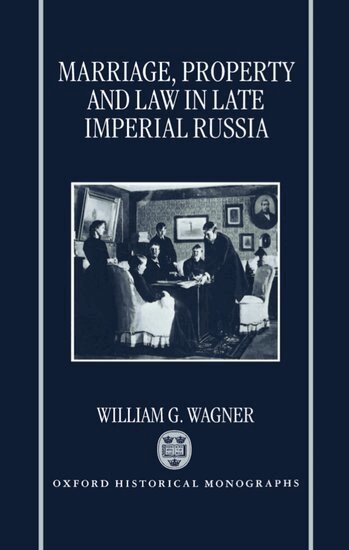
This is the first systematic study of civil law in late Imperial Russia. It shows that efforts to adjust family, property, and inheritance law to changing social and economic conditions often became intertwined with attempts to shape society in accordance with competing ideological ideals. Through a restructuring of the family's legal basis, members of the growing educated and professional strata of society in particular endeavoured to promote conflicting coneptions of authority, individuality, gender, and law. Legal reform also served for members of the emerging legal and medical professions as a way to establish their authority, often at the expense of the state administration and the Orthodox Chruch. Civil law in late Imperial Russia therefore constituted both an important medium for ideological redefinition and a field of battle for those seeking to reform, to overthrow, or to defend the ancien regime. Because this battle extended into the state bureaucracy, legislative change proved extremely difficult. Newly empowered by the 1864 judicial reform, the judiciar responded to legislative inaction by not merely adapting the law, but also by promoting an ideal of the family whose values and principles challenged those underlying the autocracy. Professor Wagner's detailed and scholarly analysis of these issues offers many important insights into cultural attitudes and political structures in late Imperial Russia.
333 kr
Skickas inom 7-10 vardagar
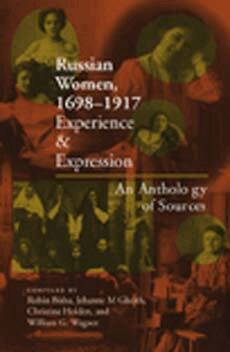
"This collection offers a treasure trove of primary sources of interest to students of women's history. Carefully introduced and annotated, these documents illustrate the diversity of Russian women's lives." —Barbara Alpern Engel"There is no other work that offers such a wide variety of documents and such a successful combination of literary and historical materials." —Ann Hibner KoblitzThis rich anthology of source materials makes available for the first time in any language a multitude of primary sources on the lives of Russian women from the reign of Peter the Great to the Bolshevik revolution. The selections are drawn from a wide variety of documents, published and unpublished, including memoirs, diaries, legal codes, correspondence, short fiction, poetry, ethnographic observations, and folklore. Primacy is given to sources produced by women and previously unavailable in English translation. Organized thematically, the documents focus on women's family life, work and schooling, public activism, creative self-expression, and sexuality and spirituality, as well as on the cultural ideals and legal framework which constrained women of all social classes.
Orthodox Sisters
Religion, Community, and the Challenge of Modernity in Imperial and Early Soviet Russia
Inbunden, Engelska, 2024
756 kr
Skickas inom 10-15 vardagar
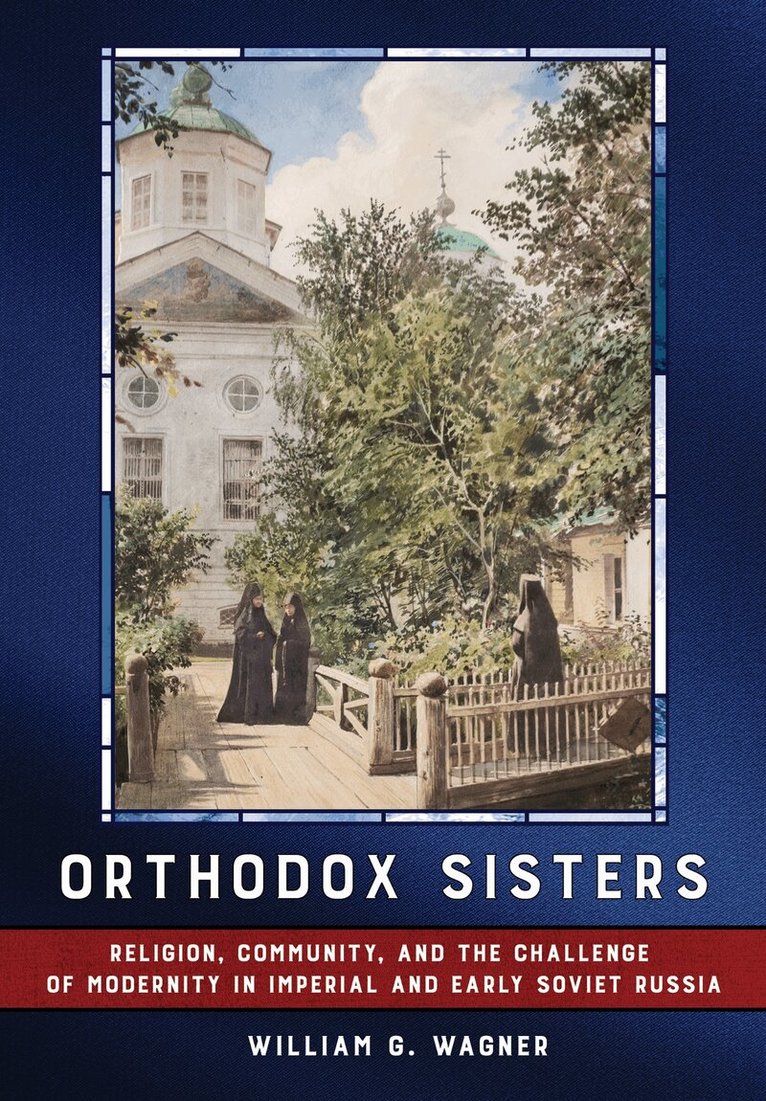
Orthodox Sisters explores the relationship between women, religion, and social, cultural, and economic change between 1700 and 1935 through the experiences of Orthodox convents in Nizhnii Novgorod diocese. Focusing primarily on the Convent of the Exaltation of the Cross, William G. Wagner places the women's experiences in the broader context of developments in female monasticism and religious life in Russia, as well as in Europe and North America over the same period. This is the first comprehensive study that follows a Russian convent through all the stages of its life—from its origins in the eighteenth century to its flourishing at the turn of the twentieth century, to its resistance to Soviet assault, and, finally, to its rebirth in the 1920s. By the late nineteenth century, the Convent of the Exaltation of the Cross and the other convents and women's religious communities in Nizhnii Novgorod diocese constituted a reimagined form of a traditional Orthodox monastic community. Wagner shows how these nuns and novices adapted to the conditions of emergent modernity in a distinctively Orthodox way. When almost everything but their communal life, work, and worship and their sacred spaces had been stripped away and they were subject to the socialist state's efforts at subversion, the sisters of the Convent of the Exaltation of the Cross and the other convents in the diocese created an authentic Christian community that gave their lives a collective meaning. In this way they were able to lead a rewarding life and survive the early years of Soviet Russia.