William H. Kimbel – författare
Visar alla böcker från författaren William H. Kimbel. Handla med fri frakt och snabb leverans.
6 produkter
Skull of Australopithecus afarensis
Av Donald C. Johanson, Yoel Rak m. fl.
E-bok, 2004
2218 kr
Lägg i varukorg
The book is the most in-depth account of the fossil skull anatomy and evolutionary significance of the 3.6-3.0 million year old early human species Australopithecus afarensis. Knowledge of this species is pivotal to understanding early human evolution, because 1) the sample of fossil remains of A. …
The Skull of Australopithecus afarensis
Av William H. Kimbel, Yoel Rak m. fl.
Inbunden, 2004
2645 kr
Lägg i varukorg
The book is the most in-depth account of the fossil skull anatomy and evolutionary significance of the 3.6-3.0 million year old early human species Australopithecus afarensis. Knowledge of this species is pivotal to understanding early human evolution, because 1) the sample of fossil remains of A. …
Skull of Australopithecus afarensis
Av Donald C. Johanson, Yoel Rak m. fl.
E-bok, 2004
2218 kr
Lägg i varukorg
The book is the most in-depth account of the fossil skull anatomy and evolutionary significance of the 3.6-3.0 million year old early human species Australopithecus afarensis. Knowledge of this species is pivotal to understanding early human evolution, because 1) the sample of fossil remains of A. …
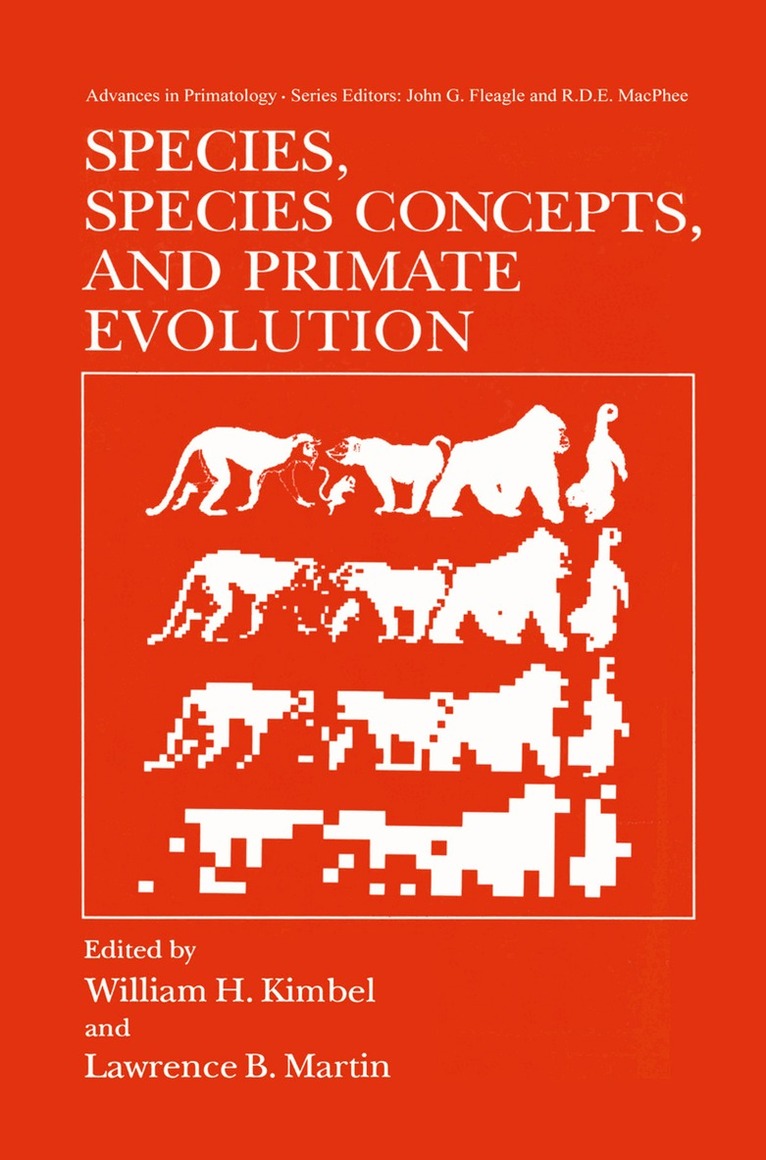
Species, Species Concepts and Primate Evolution
Av William H. Kimbel, Lawrence B. Martin
Inbunden, 1993
2188 kr
Lägg i varukorg
A world of categones devmd of spirit waits for life to return. Saul Bellow, Humboldt's Gift The stock-in-trade of communicating hypotheses about the historical path of evolution is a graphical representation called a phylogenetic tree. In most such graphics, pairs of branches diverge from other …
Species, Species Concepts and Primate Evolution
Av Lawrence B. Martin, William H. Kimbel
E-bok, 2013
2840 kr
Lägg i varukorg
A world of categones devmd of spirit waits for life to return. Saul Bellow, Humboldt''s Gift The stock-in-trade of communicating hypotheses about the historical path of evolution is a graphical representation called a phylogenetic tree. In most such graphics, pairs of branches diverge from other …
Species, Species Concepts and Primate Evolution
Av William H. Kimbel, Lawrence B. Martin
Häftad, 2013
2183 kr
Lägg i varukorg
A world of categones devmd of spirit waits for life to return. Saul Bellow, Humboldt's Gift The stock-in-trade of communicating hypotheses about the historical path of evolution is a graphical representation called a phylogenetic tree. In most such graphics, pairs of branches diverge from other …