William L. Baker - Böcker
Visar alla böcker från författaren William L. Baker. Handla med fri frakt och snabb leverans.
4 produkter
4 produkter
1 638 kr
Skickas inom 10-15 vardagar
Both fire and climatic variability have monumental impacts on the dynamics of temperate ecosystems. These impacts can sometimes be extreme or devastating as seen in recent El Nino/La Nina cycles and in uncontrolled fire occurrences. This volume brings together research conducted in western North and South America, areas of a great deal of collaborative work on the influence of people and climate change on fire regimes. In order to give perspective to patterns of change over time, it emphasizes the integration of paleoecological studies with studies of modern ecosystems. Data from a range of spatial scales, from individual plants to communities and ecosystems to landscape and regional levels, are included. Contributions come from fire ecology, paleoecology, biogeography, paleoclimatology, landscape and ecosystem ecology, ecological modeling, forest management, plant community ecology and plant morphology. The book gives a synthetic overview of methods, data and simulation models for evaluating fire regime processes in forests, shrublands and woodlands and assembles case studies of fire, climate and land use histories.The unique approach of this book gives researchers the benefits of a north-south comparison as well as the integration of paleoecological histories, current ecosystem dynamics and modeling of future changes.
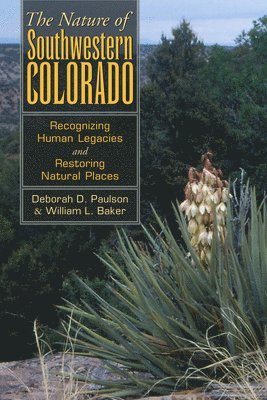
Nature of Southwestern Colorado
Recognizing Human Legacies and Restoring Natural Places
Häftad, Engelska, 2006
349 kr
Tillfälligt slut
Travellers pass through one jaw-dropping landscape after another where the snowy San Juan Mountains meet the canyon and mesa country of the Colorado Plateau in southwestern Colorado. Yet this small but remarkably varied region also plainly reveals a history of hard use, including logging scars, mine-polluted rivers, and overgrazed grasslands and forests. In The Nature of Southwestern Colorado, Deborah D. Paulson and William L. Baker guide readers through this awe-inspiring land and its human legacies, describing in detail the ecology of its six sub-regions, showing readers how to recognise human influences on the flora and fauna, and discussing current trends. Although some of the policies and attitudes in southwestern Colorado continue to harm the natural world, a number of community projects suggest a promising future. Examining these trends, the authors search for signs of a new relationship between people and nature emerging here, one that enables people to protect, restore, and coexist with the wild.
1 590 kr
Skickas inom 10-15 vardagar
Both fire and climatic variability have monumental impacts on the dynamics of temperate ecosystems. These impacts can sometimes be extreme or devastating as seen in recent El Nino/La Nina cycles and in uncontrolled fire occurrences. This volume brings together research conducted in western North and South America, areas of a great deal of collaborative work on the influence of people and climate change on fire regimes. In order to give perspective to patterns of change over time, it emphasizes the integration of paleoecological studies with studies of modern ecosystems. Data from a range of spatial scales, from individual plants to communities and ecosystems to landscape and regional levels, are included. Contributions come from fire ecology, paleoecology, biogeography, paleoclimatology, landscape and ecosystem ecology, ecological modeling, forest management, plant community ecology and plant morphology. The book gives a synthetic overview of methods, data and simulation models for evaluating fire regime processes in forests, shrublands and woodlands and assembles case studies of fire, climate and land use histories. The unique approach of this book gives researchers the benefits of a north-south comparison as well as the integration of paleoecological histories, current ecosystem dynamics and modeling of future changes.
621 kr
Skickas inom 11-20 vardagar
This title offers new understanding of fire in the Rockies from a landscape-scale, multi-century perspective. "Fire Ecology in Rocky Mountain Landscapes" brings a century of scientific research to bear on improving the relationship between people and fire. In recent years, some scientists have argued that current patterns of fire are significantly different from historical patterns, and that landscapes should be managed with an eye toward re-establishing past fire regimes. At the policy level, state and federal agencies have focused on fuel reduction and fire suppression as a means of controlling fire. Geographer William L. Baker takes a different view, making the case that the available scientific data show that infrequent episodes of large fires followed by long interludes with few fires led to naturally fluctuating landscapes, and that the best approach is not to try to change or control fire but to learn to live with it.In "Fire Ecology in Rocky Mountain Landscapes", Baker reviews functional traits and responses of plants and animals to fire at the landscape scale; explains how scientists reconstruct the history of fire in landscapes; elaborates on the particulars of fire under the historical range of variability in the Rockies; and, considers the role of Euro-Americans in creating the landscapes and fire situations of today. In the end, the author argues that the most effective action is to rapidly limit and redesign people-nature interfaces to withstand fire, which he believes can be done in ways that are immediately beneficial to both nature and communities.