William Stein – författare
Visar alla böcker från författaren William Stein. Handla med fri frakt och snabb leverans.
5 produkter
5 produkter
320 kr
Skickas inom 7-10 vardagar
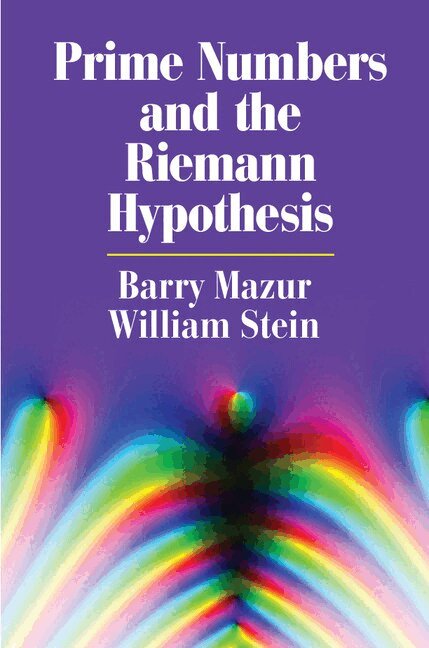
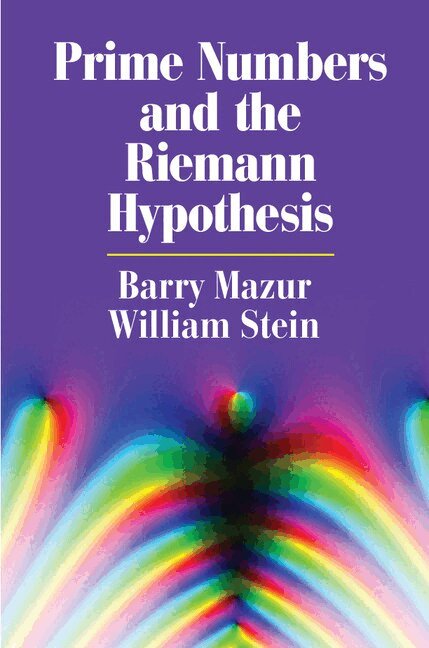
Prime numbers are beautiful, mysterious, and beguiling mathematical objects. The mathematician Bernhard Riemann made a celebrated conjecture about primes in 1859, the so-called Riemann hypothesis, which remains one of the most important unsolved problems in mathematics. Through the deep insights of the authors, this book introduces primes and explains the Riemann hypothesis. Students with a minimal mathematical background and scholars alike will enjoy this comprehensive discussion of primes. The first part of the book will inspire the curiosity of a general reader with an accessible explanation of the key ideas. The exposition of these ideas is generously illuminated by computational graphics that exhibit the key concepts and phenomena in enticing detail. Readers with more mathematical experience will then go deeper into the structure of primes and see how the Riemann hypothesis relates to Fourier analysis using the vocabulary of spectra. Readers with a strong mathematical background will be able to connect these ideas to historical formulations of the Riemann hypothesis.
Elementary Number Theory: Primes, Congruences, and Secrets
A Computational Approach
Inbunden, Engelska, 2008
647 kr
Skickas inom 10-15 vardagar
In the 1980s and 1990s, elliptic curves revolutionized number theory, providing striking new insights into the congruent number problem, primality testing, publ- key cryptography, attacks on public-key systems, and playing a central role in Andrew Wiles’ resolution of Fermat’s Last Theorem.
1 136 kr
Skickas inom 5-8 vardagar
This marvellous and highly original book fills a significant gap in the extensive literature on classical modular forms. This is not just yet another introductory text to this theory, though it could certainly be used as such in conjunction with more traditional treatments. Its novelty lies in its computational emphasis throughout: Stein not only defines what modular forms are, but shows in illuminating detail how one can compute everything about them in practice. This is illustrated throughout the book with examples from his own (entirely free) software package SAGE, which really bring the subject to life while not detracting in any way from its theoretical beauty. The author is the leading expert in computations with modular forms, and what he says on this subject is all tried and tested and based on his extensive experience. As well as being an invaluable companion to those learning the theory in a more traditional way, this book will be a great help to those who wish to use modular forms in appl --John E. Cremona, University of Nottingham William Stein is an associate professor of mathematics at the University of Washington at Seattle. He earned a PhD in mathematics from UC Berkeley and has held positions at Harvard University and UC San Diego. His current research interests lie in modular forms, elliptic curves, and computational mathematics.
740 kr
Skickas inom 7-10 vardagar
Prime numbers are beautiful, mysterious, and beguiling mathematical objects. The mathematician Bernhard Riemann made a celebrated conjecture about primes in 1859, the so-called Riemann hypothesis, which remains one of the most important unsolved problems in mathematics. Through the deep insights of the authors, this book introduces primes and explains the Riemann hypothesis. Students with a minimal mathematical background and scholars alike will enjoy this comprehensive discussion of primes. The first part of the book will inspire the curiosity of a general reader with an accessible explanation of the key ideas. The exposition of these ideas is generously illuminated by computational graphics that exhibit the key concepts and phenomena in enticing detail. Readers with more mathematical experience will then go deeper into the structure of primes and see how the Riemann hypothesis relates to Fourier analysis using the vocabulary of spectra. Readers with a strong mathematical background will be able to connect these ideas to historical formulations of the Riemann hypothesis.
Elementary Number Theory: Primes, Congruences, and Secrets
A Computational Approach
Häftad, Engelska, 2010
646 kr
Skickas inom 10-15 vardagar
This is a book about prime numbers, congruences, secret messages, and elliptic curves that you can read cover to cover. It grew out of undergr- uate courses that the author taught at Harvard, UC San Diego, and the University of Washington. The systematic study of number theory was initiated around 300B. C. when Euclid proved that there are in?nitely many prime numbers, and also cleverly deduced the fundamental theorem of arithmetic, which asserts that every positive integer factors uniquely as a product of primes. Over a thousand years later (around 972A. D. ) Arab mathematicians formulated the congruent number problem that asks for a way to decide whether or not a given positive integer n is the area of a right triangle, all three of whose sides are rational numbers. Then another thousand years later (in 1976), Di?e and Hellman introduced the ?rst ever public-key cryptosystem, which enabled two people to communicate secretely over a public communications channel with no predeterminedsecret; this invention and the ones that followed it revolutionized the world of digital communication. In the 1980s and 1990s, elliptic curves revolutionized number theory, providing striking new insights into the congruent number problem, primality testing, publ- key cryptography, attacks on public-key systems, and playing a central role in Andrew Wiles’ resolution of Fermat’s Last Theorem.