William W. E. Slights - Böcker
Visar alla böcker från författaren William W. E. Slights. Handla med fri frakt och snabb leverans.
4 produkter
4 produkter
1 440 kr
Skickas inom 7-10 vardagar
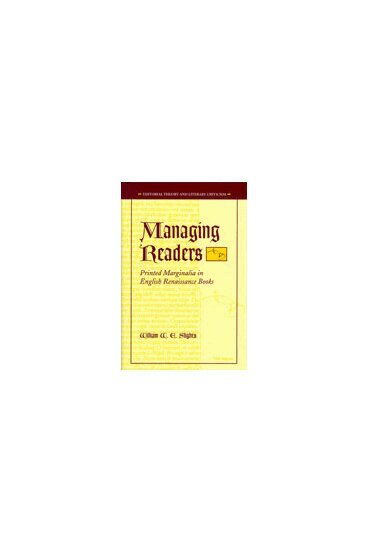
Managing Readers explores the fascinating interchange between text and margin, authorship and readership in early modern England. Printed marginalia did more than any other material feature of book production in the period between 1540 and 1700 to shape the experience of reading. William W. E. Slights considers overlooked evidence of the ways that early modern readers were instructed to process information, to contest opinions, and to make themselves into fully responsive consumers of texts. The recent revolution in the protocols of reading brought on by computer technology has forced questions about the nature of book-based knowledge in our global culture. Managing Readers traces changes in the protocols of annotation and directed reading--from medieval religious manuscripts and Renaissance handbooks for explorers, rhetoricians, and politicians to the elegant clear-text editions of the Enlightenment and the hypertexts of our own time. Developing such concepts as textual authority, generic difference, and reader-response, Slights demonstrates that printed marginalia were used to confirm the authority of the text and to undermine it, to supplement "dark" passages, and to colonize strategic hermeneutic spaces. The book contains twenty-two illustrations of pages from rare-book archives that make immediately clear how distinctive the management of the reading experience was during the first century-and-a-half of printing in England. William W. E. Slights is Professor of English, University of Saskatchewan. He is also author of Ben Jonson and the Art of Secrecy.
1 371 kr
Skickas inom 7-10 vardagar
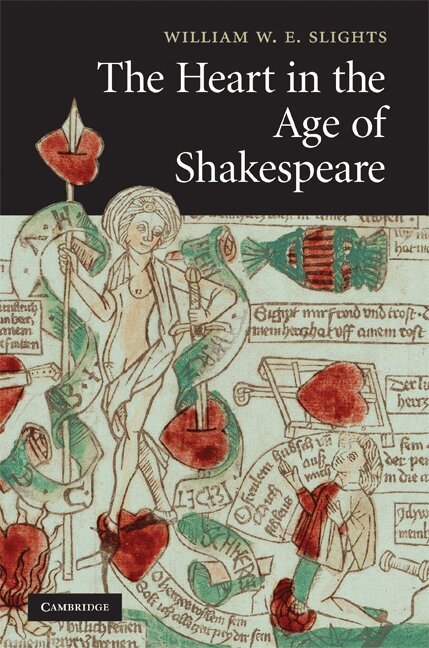
When Hamlet says he 'wears' Horatio in his 'heart of hearts', he is claiming that the strongest bonds between people are forged, stored, and understood in the heart. The Heart in the Age of Shakespeare sets out to trace the sources and subsequent impact of Hamlet's conviction. The book presents the case that by studying the interlocking anatomical, religious, and literary discourses of the heart between 1550 and 1650 we can open a new window on the culture that produced such works as The Faerie Queene, Catholic and Protestant emblem books, George Herbert's lyrics, and William Harvey's treatise on the circulation of the blood. By crossing several disciplinary boundaries and combining the material with the metaphorical, the book identifies a complex set of cardiological concerns in the dramatic works of Shakespeare and his contemporaries.
629 kr
Skickas inom 7-10 vardagar
When Hamlet says he 'wears' Horatio in his 'heart of hearts', he is claiming that the strongest bonds between people are forged, stored, and understood in the heart. The Heart in the Age of Shakespeare sets out to trace the sources and subsequent impact of Hamlet's conviction. The book presents the case that by studying the interlocking anatomical, religious, and literary discourses of the heart between 1550 and 1650 we can open a new window on the culture that produced such works as The Faerie Queene, Catholic and Protestant emblem books, George Herbert's lyrics, and William Harvey's treatise on the circulation of the blood. By crossing several disciplinary boundaries and combining the material with the metaphorical, the book identifies a complex set of cardiological concerns in the dramatic works of Shakespeare and his contemporaries.
416 kr
Skickas inom 7-10 vardagar
Secrets accomplish their cultural work by distinguishing the knowable from the (at least temporarily) unknowable, those who know from those who don't. Within these distinctions resides an enormous power that Ben Jonson (1572-1637) both deplored and exploited in his art of making plays.Conspiracies and intrigues are the driving force of Jonson's dramatic universe. Focusing on Sejanus, His Fall; Volpone, or the Fox; Epicoene, or the Silent Woman; The Alchemist; Catiline, His Conspiracy, and Bartholomew Fair, William Slights places Jonson within the context of the secrecy- ridden culture of the court of King James I and provides illuminating readings of his best-known plays.Slights draws on the sociology of secrecy, the history of censorship, and the theory of hermeneutics to investigate secrecy, intrigue, and conspiracy as aspects of Jonsonian dramatic form, contemporary court/city/church politics, and textual interpretation. He argues that the tension between concealment and revelation in the plays affords a model for the poise that sustained Jonson in the intricately linked worlds of royal court and commercial theatre and that made him a pivotal figure in the cultural history of early modern England.Equally rejecting the position that Jonson was a renegade subverter of the arcana imperii and that he was a thorough-going court apologist, Slights finds that the playwright redraws the lines between private and public discourse for his own and subsequent ages.