Winks - Böcker
Visar alla böcker från författaren Winks. Handla med fri frakt och snabb leverans.
5 produkter
5 produkter
1 709 kr
Skickas inom 3-6 vardagar
In 1648, Europe was reeling from the destabilizing effects of religious conflict, economic change, and social upheaval. The issues that divided the Church in the late Middle Ages had forced Europeans to choose sides in a bitter and bloody Catholic/Protestant conflict. A powerful capitalist movement had broken down old social ties, leading to the near disappearance of serfdom in Western Europe and to the formation of a larger merchant class in the cities. The discoveries of the Scientific Revolution had begun to corrode old certainties about the universe, just as the exploration of the New World was revealing the existence of peoples, cultures, and even continents that would have been unimaginable to previous generations. In the face of such chaos, which led many to fear that society was heading towards an utter breakdown, the European elite engaged in a desperate effort to restore order. Between 1648 and 1750, peoples and governments throughout Europe sought to contain the shift toward anarchy through the reinforcement of religious orthodoxies, the strengthening of national states, and the stiffening of social hierarchies.But by the later eighteenth century, the success of this effort led paradoxically to new institutional and intellectual demands for change. The search for order had given way to a quest for progress. A new movement known as "the Enlightenment" was transforming the old order, and revolution was about to become a Western tradition. Europe, 1648-1815 is a concise narrative of this fascinating epoch in European history. Framing the events of the period in terms of two successive movements-the search for order and the pursuit of reform-this book surveys the political, economic, social, and cultural events of the period, from the rise of absolutism to the campaigns of Napoleon, from the creation of European empires in the Americas to the controversies of the Enlightenment. With numerous selections from primary sources, a detailed and updated bibliography, a chronology of the period, and numerous illustrations, Europe, 1648-1815 is indispensable for courses on Early Modern Europe. It can be used as a stand-alone textbook or in conjunction with supplementary readings.
3 139 kr
Skickas inom 3-6 vardagar
This book is a compact, accessible history of the continent, during a time when it did not yet dominate the world in which it was situated. The text discusses the major events of the period, and also seeks to restore interconnections lost by thinkers who divided the period into "The Renaissance" and "The Reformation." With twenty-five illustrations and nine detailed maps, this short textbook is perfect for students of European history.
1 709 kr
Skickas inom 3-6 vardagar
Between roughly 1350 and 1650, Europe underwent seismic changes in economics, politics, culture, and religion. Feudal monarchies were reconceived as abstract states. The new technology of the printing press transformed how information was disseminated, bringing texts to different social groups. Painters perfected the artifice of perspective for an increasingly commercial patronage, even as they themselves cultivated the value of their own "genius" through increasingly distinctive styles and visions. Reformers called into question 1500 years of tradition, splitting the One True Church into multiple churches. In the midst of all these changes, Europeans reached farther and farther out into a world they did not yet dominate, even as they lived uneasily under the shadow of an expansionist Islamic Mediterranean. Indeed, that wider world was inseparable from those seismic changes in the political and cultural landscape of Europe. Europe in a Wider World, 1350-1650 offers a concise discussion of these events and the impact they had upon an evolving European society.It provides a clear outline of political events and a lively exploration of developments in the social and cultural landscape. Along with traditional themes, such as Protestantism, the book examines the changing roles of European women and the effects of environmental fluctuation on the history of the continent. By looking at these years as a whole, the authors attempt to restore interconnections among events that are often lost when the time period is viewed through the double categories of "The Renaissance" and "The Reformation." Illustrated with nine detailed maps and twenty-four images, and offering chapter summaries and a chronology to aid students, this text is ideal for undergraduate courses in early modern European history.
3 094 kr
Skickas inom 3-6 vardagar
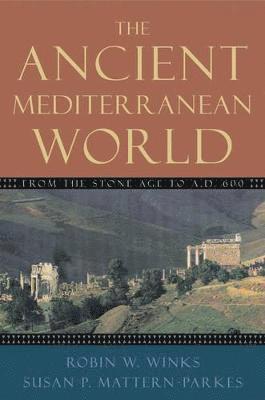
The Ancient Mediterranean World provides a concise overview of the growth of Mediterranean civilizations from Paleolithic times through the rise of Muhammad in the 7th century A.D. The book surveys ancient Mesopotamia, Egypt, Greece, and Rome, and examines life in various Roman provinces, such as Judaea and Britain. It ends with a discussion of the rise of Christianity in the late Antique world.
1 709 kr
Skickas inom 3-6 vardagar
Europe: 1945 to the Present examines the tumultuous history of Europe from the end of World War II through the present. Beginning with the post-war scene, and ending with a discussion of the European Union and its current plans for expansion, the narrative takes students through the past sixty years in a thoughtful, well-organized way. The book covers the Cold War, decolonization, and major developments in the arts and sciences, as well as Europe's reaction to the events of September 11, 2001, the wars in Afghanistan and Iraq, and such episodes of terrorism as the Madrid bombings of 2004. Written in a clear, well-paced style, Europe: 1945 to the Present features primary source text boxes, a chronology, a list of supplemental readings, and numerous illustrations and maps. It is ideal for undergraduate courses on the history of Europe since 1945.