Wonhyuk Lim - Böcker
Visar alla böcker från författaren Wonhyuk Lim. Handla med fri frakt och snabb leverans.
6 produkter
6 produkter
468 kr
Skickas inom 7-10 vardagar
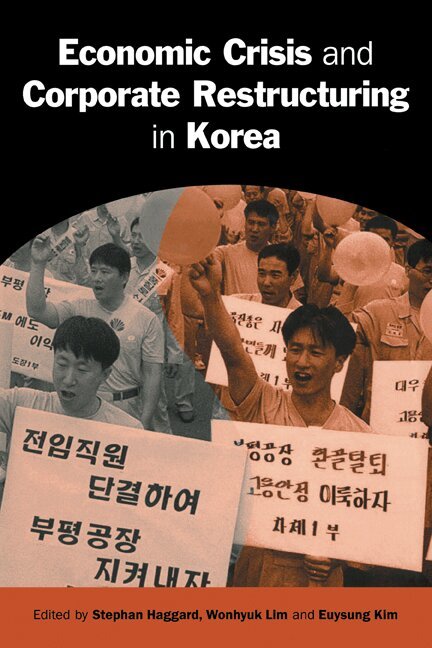
Asian business conglomerates have clearly been successful agents of growth, mobilizing capital, borrowing technology from abroad and spearheading Asia's exports. However, these firms have long had a number of organisational and financial weaknesses, including heavy reliance on debt, that make them vulnerable to shocks. Nowhere was this more true than in Korea, where the large corporate groups known as chaebol have dominated the economic landscape. This collection of essays by leading political scientists and economists provides a comprehensive look at the chaebol problem in the wake of the Asian financial crisis. The authors consider the historical evolution of the chaebol and their contribution to the onset of economic turmoil in 1997. The book analyses the government's short-run response to corporate and financial distress, and outlines an agenda for longer-term reform of the financial system, corporate governance and the politics of business-government relations.
Del 375 - Harvard East Asian Monographs
Korean Economy
From a Miraculous Past to a Sustainable Future
Inbunden, Engelska, 2015
411 kr
Skickas inom 7-10 vardagar
South Korea has been held out as an economic miracle—as a country that successfully completed the transition from underdeveloped to developed country status—and as an example of how a middle-income country can continue to move up the technology ladder into the production and export of more sophisticated goods and services. But with these successes have come challenges, among them poverty, inequality, long work hours, financial instability, and complaints about the economic and political power of the country’s large corporate conglomerates, or chaebol.The Korean Economy provides an overview of Korean economic experience since the 1950s, with a focus on the period since democratization in 1987. Successive chapters analyze the Korean experience from the perspectives of political economy, the growth record, industrial organization and corporate governance, financial development and instability, labor and employment, inequality and social policy, and Korea’s place in the world economy. A concluding chapter describes the country’s economic challenges going forward and how they can best be met. The volume also serves to summarize the findings of companion volumes in the Harvard–Korean Development Institute series on the Korean economy, also published by the Harvard University Asia Center.
434 kr
Skickas inom 10-15 vardagar
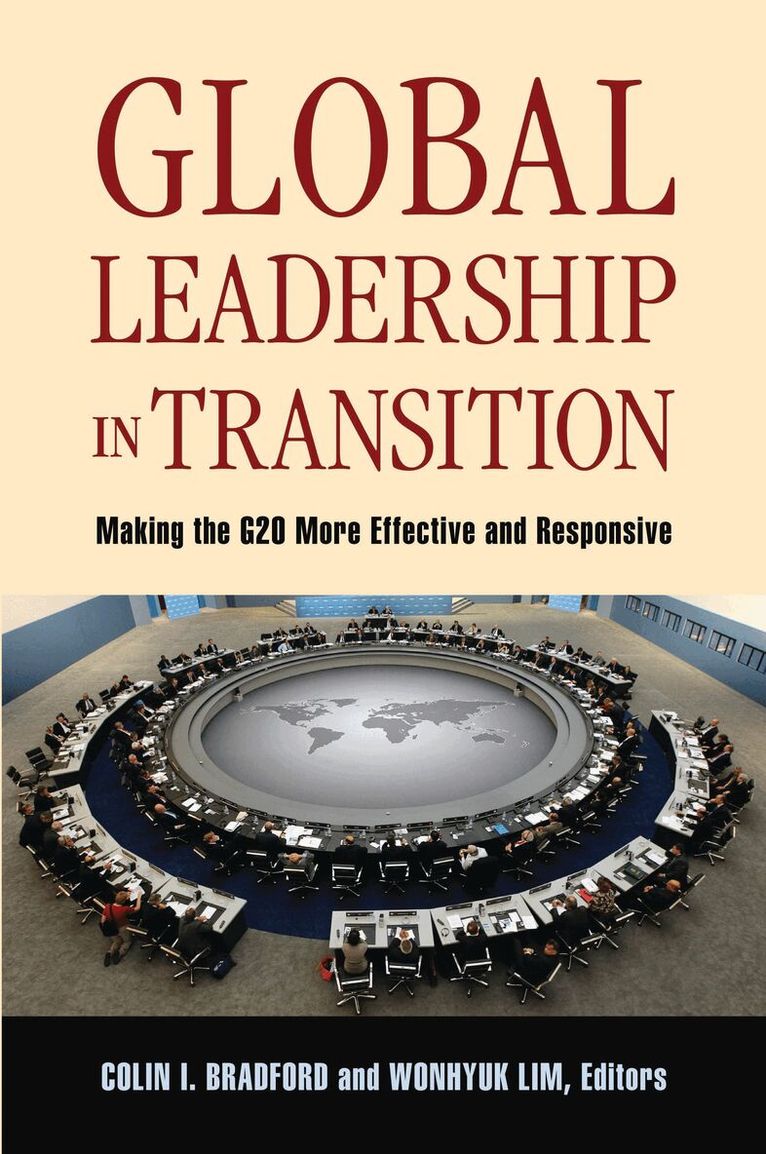
Global Leadership in Transition calls for innovations that would ""institutionalize"" or consolidate the G20, helping to make it the global economy's steering committee. The emergence of the G20 as the world's premier forum for international economic cooperation presents an opportunity to improve economic summitry and make global leadership more responsive and effective, a major improvement over the G8 era.""Key contributors to this volume were well ahead of their time in advocating summit meetings of G20 leaders. In this book, they now offer a rich smorgasbord of creative ideas for transforming the G20 from a crisis-management committee to a steering group for the international system that deserves the attention of those who wish to shape the future of global governance.""C. Randall Henning, American University and the Peterson InstituteContributors: Alan Beattie, Financial Times; Thomas Bernes, Centre for International Governance Innovation (CIGI); Sergio Bitar, former Chilean minister of public works; Paul Blustein, Brookings Institution and CIGI; Barry Carin, CIGI and University of Victoria; Andrew F. Cooper, CIGI and University of Waterloo; Kemal Dervis, Brookings; Paul Heinbecker, CIGI and Laurier University Centre for Global Relations; Oh-Seok Hyun, Korea Development Institute (KDI); Jomo Kwame Sundaram, United Nations; Homi Kharas, Brookings; Hyeon Wook Kim, KDI; Sungmin Kim, Bank of Korea; John Kirton, University of Toronto; Johannes Linn, Brookings and Emerging Markets Forum; Pedro Malan, Itau Unibanco; Thomas Mann, Brookings; Paul Martin, former prime minister of Canada; Simon Maxwell, Overseas Development Institute and Climate and Development Knowledge Network; Jacques Mistral, Institut Français des Relations Internationales; Victor Murinde, University of Birmingham (UK); Pier Carlo Padoan, OECD Paris; Yung Chul Park, Korea University; Stewart Patrick, Council on Foreign Relations; Il SaKong, Presidential Committee for the G20 Summit; Wendy R. Sherman, Albright Stonebridge Group; Gordon Smith, Centre for Global Studies and CIGI; Bruce Stokes, German Marshall Fund; Ngaire Woods, Oxford Blavatnik School of Government; Lan Xue, Tsinghua University (Beijing); Yanbing Zhang, Tsinghua University.
Unfinished Transformation
Domestic Politics and International Relations since the COVID-19 Pandemic
Häftad, Engelska, 2025
341 kr
Skickas inom 10-15 vardagar
The end of the Cold War, the acceleration of globalization, and “the rise of the rest” posed serious challenges to the existing international order based on World War II settlements and Cold War modifications. The Global Financial Crisis of 2008 provided an opportunity to address this problem, as evidenced by the emergence of the G20 at the leadership level, but this adjustment, reflecting a sea change in international economic and political realities, was by no means a smooth process. Domestically, in many advanced industrial countries, there was a populist/nativist backlash as increasing socioeconomic disparities and interaction with the outside world produced economic anxiety and status anxiety. Politicians who promised to take back control appealed to a large number of voters, using “us vs. them” rhetoric to divert attention from socioeconomic inequality. Thus, even before the outbreak of COVID-19, the combination of international power shift and populist/nativist backlash made global cooperation a precarious proposition, even though the proliferation of global value chains, climate change, and infectious diseases made global cooperation more imperative than ever before.The pandemic has accelerated the pre-existing trends of increasing inequality at home and decreasing inequality among countries, especially U.S.-China competition. It is evident that these accelerating trends cannot lead to stable outcomes, as they exacerbate the risks of crisis and conflict if they continue. This book explores how domestic and international transformation can address these problems. Domestically, instead of blaming “the global elite” and “outsiders,” investing in people should receive priority, given the challenges of automation and globalization. Unless workers and the middle class feel secure enough, governments would find it difficult to push for international initiatives. Internationally, a new order should reflect changing economic and political realities, with guardrails to prevent conflict and mechanisms to promote global cooperation.
Unfinished Transformation
Domestic Politics and International Relations since the COVID-19 Pandemic
Inbunden, Engelska, 2025
835 kr
Skickas inom 10-15 vardagar
The end of the Cold War, the acceleration of globalization, and “the rise of the rest” posed serious challenges to the existing international order based on World War II settlements and Cold War modifications. The Global Financial Crisis of 2008 provided an opportunity to address this problem, as evidenced by the emergence of the G20 at the leadership level, but this adjustment, reflecting a sea change in international economic and political realities, was by no means a smooth process. Domestically, in many advanced industrial countries, there was a populist/nativist backlash as increasing socioeconomic disparities and interaction with the outside world produced economic anxiety and status anxiety. Politicians who promised to take back control appealed to a large number of voters, using “us vs. them” rhetoric to divert attention from socioeconomic inequality. Thus, even before the outbreak of COVID-19, the combination of international power shift and populist/nativist backlash made global cooperation a precarious proposition, even though the proliferation of global value chains, climate change, and infectious diseases made global cooperation more imperative than ever before.The pandemic has accelerated the pre-existing trends of increasing inequality at home and decreasing inequality among countries, especially U.S.-China competition. It is evident that these accelerating trends cannot lead to stable outcomes, as they exacerbate the risks of crisis and conflict if they continue. This book explores how domestic and international transformation can address these problems. Domestically, instead of blaming “the global elite” and “outsiders,” investing in people should receive priority, given the challenges of automation and globalization. Unless workers and the middle class feel secure enough, governments would find it difficult to push for international initiatives. Internationally, a new order should reflect changing economic and political realities, with guardrails to prevent conflict and mechanisms to promote global cooperation.
Competition Law and Economics
Developments, Policies and Enforcement Trends in the US and Korea
Inbunden, Engelska, 2020
1 555 kr
Skickas inom 7-10 vardagar
Offering a comprehensive overview of the major issues that arise in the enforcement of competition laws, this book takes an interdisciplinary approach to the topic, reviewing the development of Korean competition laws and their enforcement with rigorous economic analysis. Chapters build on the Korean experience, providing guidance to the capacity-building efforts of developing countries that have recently introduced competition laws.In this exciting new book, an international team of experts compares market structures, in both global and Korean contexts, particularly focusing on the impact of foreign competition on market concentration and ways to improve market structure. It thoroughly investigates core competition problems, including international abuses of dominance, mergers and collusion, and vertical restraints. Contributions move beyond explaining the laws and practices of enforcement agencies, offering readers an insight into the trend of ever-increasing interdependence among national economies, complemented by analyses of recent developments in the US and Canada.The exploration of clear trends both in Korea and globally will prove valuable to scholars and students of industrial competition policy, and law and economics. It will also be useful to policy-makers, particularly those in developing countries, looking to better understand the issues surrounding competition law and designing future policies.