World Institute for Development Economic - Böcker
Visar alla böcker från författaren World Institute for Development Economic. Handla med fri frakt och snabb leverans.
4 produkter
4 produkter
2 890 kr
Skickas inom 5-8 vardagar
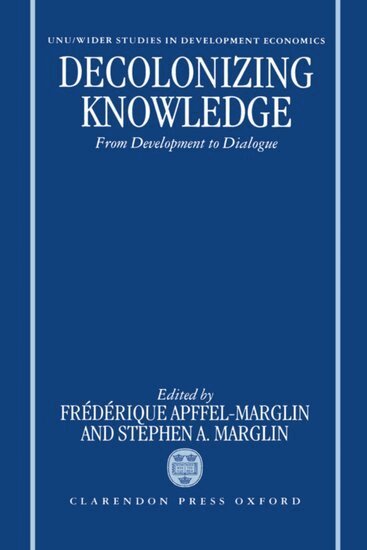
Development failures, environmental degradation and social fragmentation can no longer be regarded as side effects of `externalities'. They are the toxic consequences of pretensions that the modern Western view of knowledge is a universal neutral view, applicable to all people at all times. The very word `development' and its cognates `underdevelopment' and `developing' confidently mark the `first' world's as the future of the `third'. This book argues that the linear evolutionary paradigm of development that comes out of modern Western view of knowledge is a contemporary form of colonialism.The authors - covering topics as diverse as the theory of knowledge underlying the work of John Maynard Keynes, what the renowned British geneticist J.B.S. Haldane was looking for when he migrated to India, the knowledge of Mexican and Indian peasants - propose a pluralistic vision and decolonization of knowledge: the replacement of one-way transfers of knowledge and technology by dialogue and mutual learning.
1 313 kr
Skickas inom 3-6 vardagar
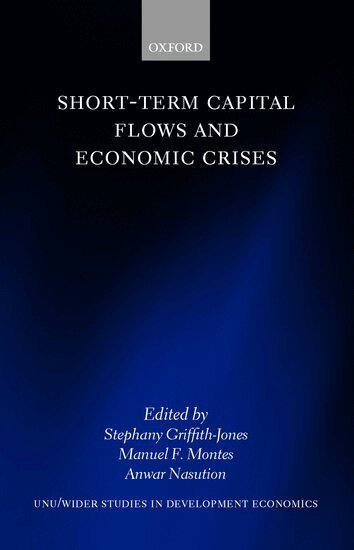
The currency crises that engulfed East Asian economies in 1997 and Mexico in 1994 - and their high development costs - raise a serious concern about the net benefits for developing countries of large flows of potentially reversible short-term international capital. Written by senior policy-makers and academics, the contributions to this volume examine in depth the macroeconomic and other policy dilemmas confronting public authorities in the emerging economies as they deal with short-term capital movements, especially in the period before the outbreak of these crises. The studies are based on comparative case studies of key emerging economies. Valuable insights are also derived from contrasts between the East Asian, Latin American, African, and European experiences, between the financial and real effects of financial flows, and between private and public responsibilities in managing financial markets. The great value of the chapters in this volume is that they analytically identify the weaknesses in both domestic and international capital market regimes. The recommendations derived from this analysis apply to the development of financial markets in developing countries, the monitoring and regulation of mutual funds in source countries, and the future development of international capital markets. They will make an important contribution both to the discussion of national policies and of a new international financial architechture.
2 752 kr
Skickas inom 5-8 vardagar
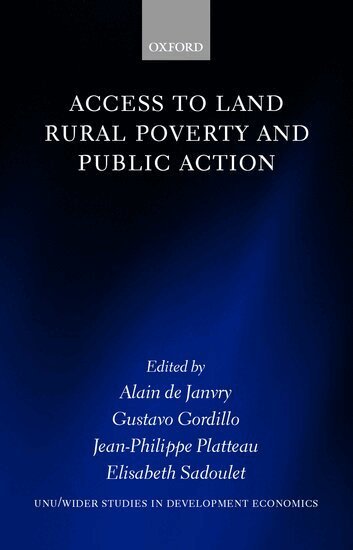
Land is a fundamental productive asset in agrarian economies. The rules that codify access to land and the way jurisdiction over land is distributed among members of a community have a powerful influence over how efficiently land is used, the incidence of poverty, and the level of inequality in the community. Yet we observe that much of the land in less developed countries is underutilized and/or misused from a sustainability standpoint, that lack of access to land or unfavorable terms of access remain a fundamental cause of poverty, and that unmet demands for land can be a source of political destabilization. At the same time, there presently exist unusual opportunities to reopen the issue of access to land. They include an increasing concern with the efficiency costs of inequality in land distribution, devolution of common property resource management to users, large scale redefinitions of property rights in the context of transition economies in Eastern and central Europe and the end of white rule in South Africa, liberalization of land markets, mounting pressure to deal with environmental issues, the proliferation of civil society organizations voicing the demands of the rural poor, and more democratic and decentralized forms of governance. There are many channels of access to land and each of these affects how land is used. While much attention has traditionally been given to state-led redistributive land reforms, this is only one among a variety of options, and currently not the easiest to manage politically. Other channels include inheritance and inter-vivos transfers, intra-household and intra-community land allocations, community titling of open access resources, the distribution of common property resources and the individualization of rights, decollectivization, land markets and land market-assisted land reforms, and land rental contracts. This book analyzes each of these channels of access to land, and recommends ways of making them more effective for poverty reduction.
2 324 kr
Skickas inom 5-8 vardagar
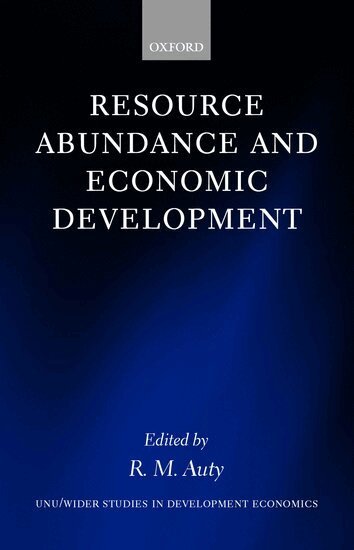
Since the 1960s the per capita incomes of the resource-poor countries have grown significantly faster than those of the resource-abundant countries. In fact, in recent years economic growth has been inversely proportional to the share of natural resource rents in GDP, so that the small mineral-driven economies have performed least well and the oil-driven economies worst of all. Yet the mineral-driven resource-rich economies have high growth potential because the mineral exports boost their capacity to invest and to import."Resource Abundance and Economic Development" explains the disappointing performance of resource-abundant countries by extending the growth accounting framework to include natural and social capital. The resulting synthesis identifies two contrasting development trajectories: the competitive industrialization of the resource-poor countries and the staple trap of many resource-abundant countries. The resource-poor countries are less prone to policy failure than the resource-abundant countries because social pressures force the political state to align its interests with the majority poor and follow relatively prudent policies. Resource-abundant countries are more likely to engender political states in which vested interests vie to capture resource surpluses (rents) at the expense of policy coherence. A longer dependence on primary product exports also delays industrialization, heightens income inequality, and retards skill accumulation. Fears of 'Dutch disease' encourage efforts to force industrialization through trade policy to protect infant industry. The resulting slow-maturing manufacturing sector demands transfers from the primary sector that outstrip the natural resource rents and sap the competitiveness of the economy. The chapters in this collection draw upon historical analysis and models to show that a growth collapse is not the inevitable outcome of resource abundance and that policy counts. Malaysia, a rare example of successful resource-abundant development, is contrasted with Ghana, Bolivia, Saudi Arabia, Mexico, and Argentina, which all experienced a growth collapse. The book also explores policies for reviving collapsed economies with reference to Costa Rica, South Africa, Russia and Central Asia. It demonstrates the importance of initial conditions to successful economic reform.