Yanjie Huang – författare
Visar alla böcker från författaren Yanjie Huang. Handla med fri frakt och snabb leverans.
4 produkter
4 produkter
Revolution Domesticated
Austerity, Ideology, and Family Life in Urban China, 1949–1984
Inbunden, Engelska, 2026
2 138 kr
Kommande
During the Mao era, Chinese urban families were subjected to decades of austerity in the name of continuous revolution. In the 1960s and 1970s, they bore the economic costs of political campaigns aimed at transforming daily life. Under Deng Xiaoping, however, a new vision took hold: a stable, moderately well-off family, strikingly reminiscent of Confucian ideals that only a few years before had been consigned to the prerevolutionary past.Drawing on Mao-era family letters, grassroots archives, and oral history, this book shows how revolutionary austerity transformed urban families and shaped China’s transition to a new economic order. Yanjie Huang pinpoints the unintended consequences of Maoist policies, arguing that urbanites turned inward to the domestic sphere of the family in order to weather the compulsory sacrifices of the Great Leap Forward and the Cultural Revolution. Sweeping visions of collective social transformation helped foster tightly knit, inward-looking nuclear families focused on rearing a single child. Tracing how Shanghai families found survival strategies for economic hardships, Huang argues that the interaction between the urban household and grassroots ideology contributed to the post-Mao turn to developmentalism. From a groundbreaking bottom-up perspective that weaves together economic, political, and social history, Revolution Domesticated provides a new understanding—rooted in everyday life—of the origins of China’s epochal post-Mao transformations.
Revolution Domesticated
Austerity, Ideology, and Family Life in Urban China, 1949–1984
Häftad, Engelska, 2026
597 kr
Kommande
During the Mao era, Chinese urban families were subjected to decades of austerity in the name of continuous revolution. In the 1960s and 1970s, they bore the economic costs of political campaigns aimed at transforming daily life. Under Deng Xiaoping, however, a new vision took hold: a stable, moderately well-off family, strikingly reminiscent of Confucian ideals that only a few years before had been consigned to the prerevolutionary past.Drawing on Mao-era family letters, grassroots archives, and oral history, this book shows how revolutionary austerity transformed urban families and shaped China’s transition to a new economic order. Yanjie Huang pinpoints the unintended consequences of Maoist policies, arguing that urbanites turned inward to the domestic sphere of the family in order to weather the compulsory sacrifices of the Great Leap Forward and the Cultural Revolution. Sweeping visions of collective social transformation helped foster tightly knit, inward-looking nuclear families focused on rearing a single child. Tracing how Shanghai families found survival strategies for economic hardships, Huang argues that the interaction between the urban household and grassroots ideology contributed to the post-Mao turn to developmentalism. From a groundbreaking bottom-up perspective that weaves together economic, political, and social history, Revolution Domesticated provides a new understanding—rooted in everyday life—of the origins of China’s epochal post-Mao transformations.
523 kr
Skickas inom 7-10 vardagar
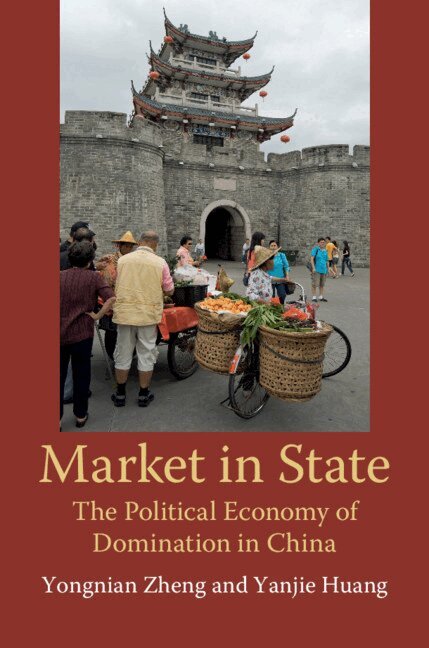
Focusing on the evolving relations between the state and market in the post-Mao reform era, Yongnian Zheng and Yanjie Huang present a theory of Chinese capitalism by identifying and analyzing three layers of the market system in the contemporary Chinese economy. These are, namely, a free market economy at the bottom, state capitalism at the top, and a middle ground in between. By examining Chinese economic practices against the dominant schools of Western political economy and classical Chinese economic thoughts, the authors set out the analytical framework of 'market in state' to conceptualize the market not as an autonomous self-regulating order but part and parcel of a state-centered order. Zheng and Huang show how state (political) principles are dominant over market (economic) principles in China's economy. As the Chinese economy continues to grow and globalize, its internal balance will likely have a large impact upon economies across the world.
1 086 kr
Tillfälligt slut
Focusing on the evolving relations between the state and market in the post-Mao reform era, Yongnian Zheng and Yanjie Huang present a theory of Chinese capitalism by identifying and analyzing three layers of the market system in the contemporary Chinese economy. These are, namely, a free market economy at the bottom, state capitalism at the top, and a middle ground in between. By examining Chinese economic practices against the dominant schools of Western political economy and classical Chinese economic thoughts, the authors set out the analytical framework of 'market in state' to conceptualize the market not as an autonomous self-regulating order but part and parcel of a state-centered order. Zheng and Huang show how state (political) principles are dominant over market (economic) principles in China's economy. As the Chinese economy continues to grow and globalize, its internal balance will likely have a large impact upon economies across the world.