Yannis Tzaninis – författare
Visar alla böcker från författaren Yannis Tzaninis. Handla med fri frakt och snabb leverans.
5 produkter
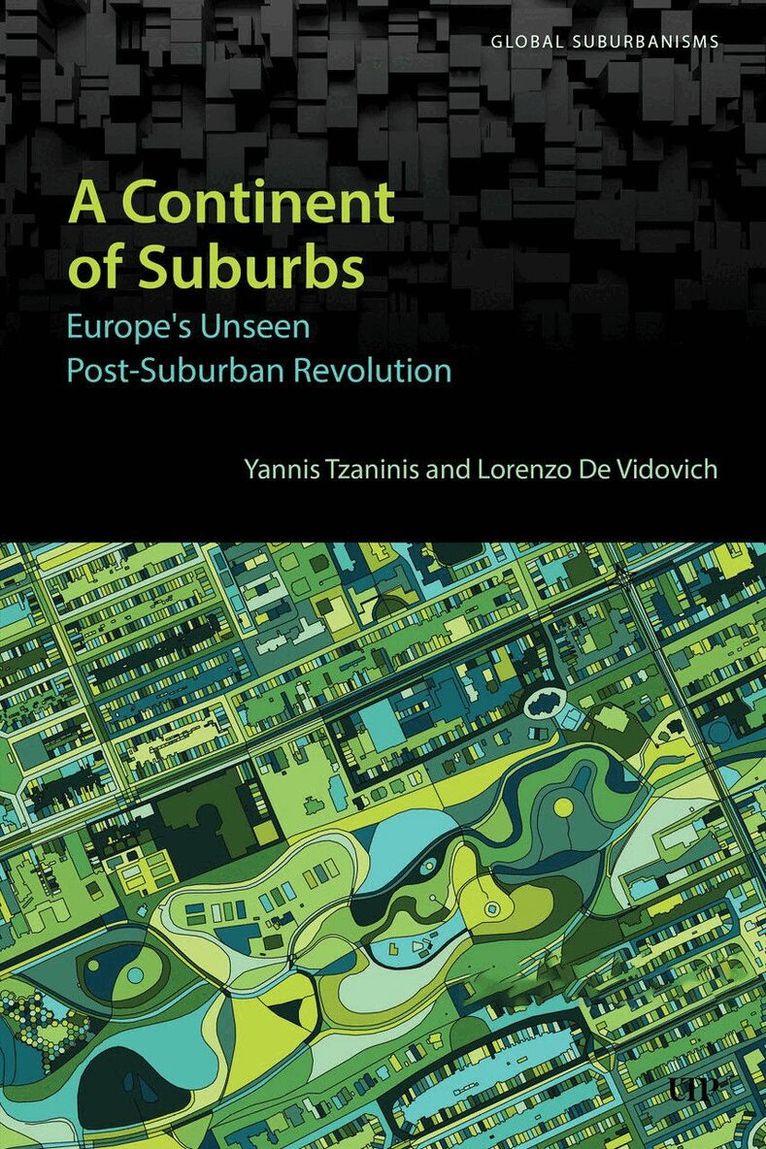
Continent of Suburbs
Europe's Unseen Post-Suburban Revolution
Av Yannis Tzaninis, Lorenzo De Vidovich
Häftad, 2026
648 kr
Lägg i varukorg
This book challenges the city-centered view of Europe by highlighting the importance of suburbs and peripheries, where millions live. It argues that Europe has long been shaped by suburbanization, which, since World War II, is closely linked to international immigration. Through historical and …
Continent of Suburbs
Europe's Unseen Post-Suburban Revolution
Av Lorenzo De Vidovich, Yannis Tzaninis
E-bok, 2026
805 kr
Lägg i varukorg
This book challenges the city-centered view of Europe by highlighting the importance of suburbs and peripheries, where millions live. It argues that Europe has long been shaped by suburbanization, which, since World War II, is closely linked to international immigration. Through historical and …
Continent of Suburbs
Europe's Unseen Post-Suburban Revolution
Av Lorenzo De Vidovich, Yannis Tzaninis
E-bok, 2026
823 kr
Lägg i varukorg
This book challenges the city-centered view of Europe by highlighting the importance of suburbs and peripheries, where millions live. It argues that Europe has long been shaped by suburbanization, which, since World War II, is closely linked to international immigration. Through historical and …
Turning Up the Heat
Urban Political Ecology for a Climate Emergency
Av Maria Kaika, Roger Keil m. fl.
Häftad, 2023
364 kr
Lägg i varukorg
Since its emergence in the 1990s, the field of Urban Political Ecology (UPE) has focused on unsettling traditional understandings of the ‘city’ as entirely distinct from nature, showing instead how cities are metabolically linked with ecological processes and the flow of resources. More recently, a …
Turning Up the Heat
Urban Political Ecology for a Climate Emergency
Av Maria Kaika, Roger Keil m. fl.
Inbunden, 2023
1261 kr
Lägg i varukorg
Since its emergence in the 1990s, the field of Urban Political Ecology (UPE) has focused on unsettling traditional understandings of the ‘city’ as entirely distinct from nature, showing instead how cities are metabolically linked with ecological processes and the flow of resources. More recently, a …