Yehouda Shenhav - Böcker
Visar alla böcker från författaren Yehouda Shenhav. Handla med fri frakt och snabb leverans.
5 produkter
5 produkter
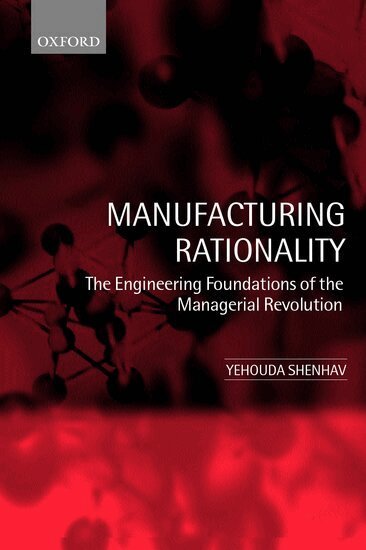
Manufacturing Rationality
The Engineering Foundations of the Managerial Revolution
Inbunden, Engelska, 1999
1 194 kr
Skickas inom 3-6 vardagar
Management is a powerful mode of thought and code of conduct in the modern world, closely associated with the American way and a natural extension of economic progress. This is a book about the history of management and the origin of managerial rationality in the United States.
Manufacturing Rationality
The Engineering Foundations of the Managerial Revolution
Häftad, Engelska, 2002
1 074 kr
Skickas inom 5-8 vardagar
Management is a powerful mode of thought and code of conduct in the modern world, closely associated with the American way and a natural extension of economic progress. This is a book about the history and development of management and managerial rationality in the United States in the nineteenth century and the early decades of the twentieth century.Through careful analysis of contemporary records in the engineering profession, the author shows how management invented itself and carved its own domain in the face of hostility and resistance from both manufacturers and workers. The book demonstrates how the new language and rhetoric of management emerged, and how it confronted and replaced the language of traditional capitalism: 'system' instead of 'individuals'; 'jobs' instead of 'natural rights'; 'planning' instead of 'free initiatives'.Manufacturing Rationality can be read simultaneously as an historical account of the genesis of modern management, a chapter in the history of American capitalism, a critical analysis of industrial engineering, and as a sociology of (managerial) knowledge.
597 kr
Skickas inom 7-10 vardagar
For over two decades, many liberals in Israel have attempted, with wide international support, to implement the two-state solution: Israel and Palestine, partitioned on the basis of the Green Line - that is, the line drawn by the 1949 Armistice Agreements that defined Israel’s borders until 1967, before Israel occupied the West Bank and Gaza following the Six-Day War. By going back to Israel’s pre-1967 borders, many people hope to restore Israel to what they imagine was its pristine, pre-occupation character and to provide a solid basis for a long-term solution to the Israeli-Palestinian conflict. In this original and controversial essay, Yehouda Shenhav argues that this vision is an illusion that ignores historical realities and offers no long-term solution. It fails to see that the real problem is that a state was created in most of Palestine in 1948 in which Jews are the privileged ethnic group, at the expense of the Palestinians - who also must live under a constant state of emergency. The issue will not be resolved by the two-state solution, which will do little for the millions of Palestinian refugees and will also require the uprooting of hundreds of thousands of Jews living across the Green Line. All these obstacles require a bolder rethinking of the issues: the Green Line should be abandoned and a new type of polity created on the complete territory of mandatory Palestine, with a new set of constitutional arrangements that address the rights of both Palestinians and Jews, including the settlers.
204 kr
Skickas inom 7-10 vardagar
For over two decades, many liberals in Israel have attempted, with wide international support, to implement the two-state solution: Israel and Palestine, partitioned on the basis of the Green Line - that is, the line drawn by the 1949 Armistice Agreements that defined Israel’s borders until 1967, before Israel occupied the West Bank and Gaza following the Six-Day War. By going back to Israel’s pre-1967 borders, many people hope to restore Israel to what they imagine was its pristine, pre-occupation character and to provide a solid basis for a long-term solution to the Israeli-Palestinian conflict. In this original and controversial essay, Yehouda Shenhav argues that this vision is an illusion that ignores historical realities and offers no long-term solution. It fails to see that the real problem is that a state was created in most of Palestine in 1948 in which Jews are the privileged ethnic group, at the expense of the Palestinians - who also must live under a constant state of emergency. The issue will not be resolved by the two-state solution, which will do little for the millions of Palestinian refugees and will also require the uprooting of hundreds of thousands of Jews living across the Green Line. All these obstacles require a bolder rethinking of the issues: the Green Line should be abandoned and a new type of polity created on the complete territory of mandatory Palestine, with a new set of constitutional arrangements that address the rights of both Palestinians and Jews, including the settlers.
820 kr
Skickas inom 7-10 vardagar
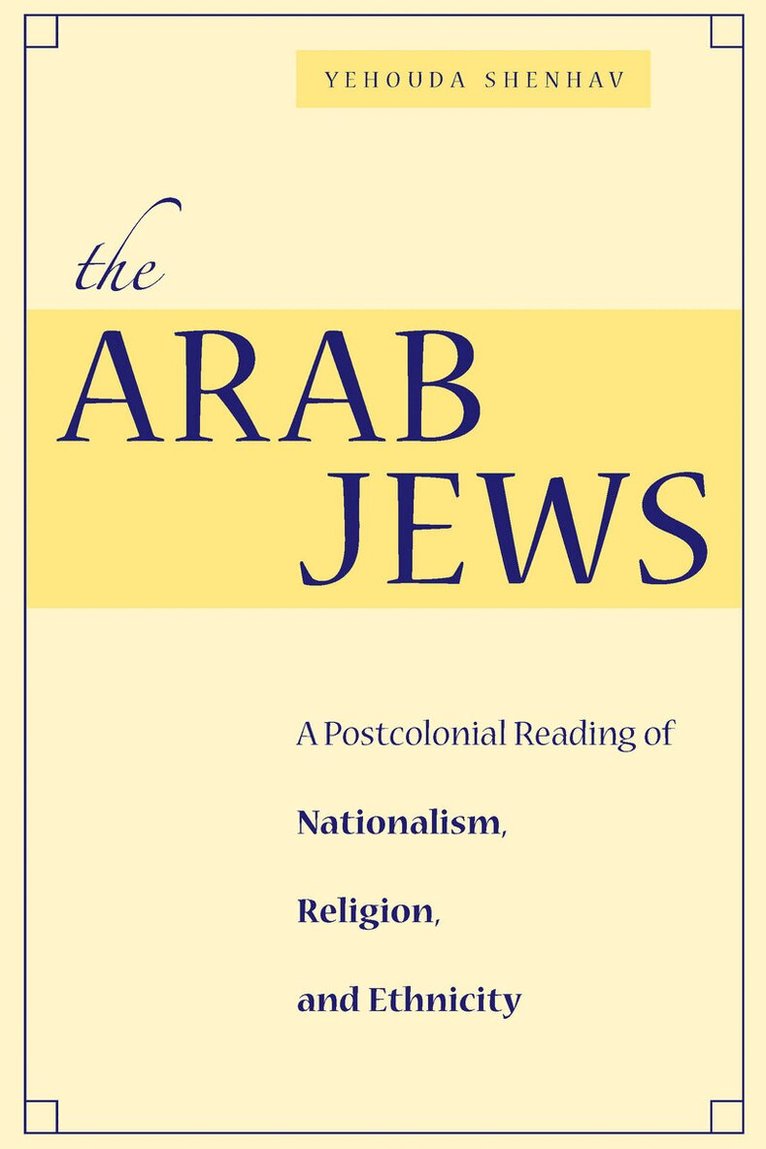
This book is about the social history of the Arab Jews—Jews living in Arab countries—against the backdrop of Zionist nationalism. By using the term "Arab Jews" (rather than "Mizrahim," which literally means "Orientals") the book challenges the binary opposition between Arabs and Jews in Zionist discourse, a dichotomy that renders the linking of Arabs and Jews in this way inconceivable. It also situates the study of the relationships between Mizrahi Jews and Ashkenazi Jews in the context of early colonial encounters between the Arab Jews and the European Zionist emissaries—prior to the establishment of the state of Israel and outside Palestine. It argues that these relationships were reproduced upon the arrival of the Arab Jews to Israel. The book also provides a new prism for understanding the intricate relationships between the Arab Jews and the Palestinian refugees of 1948, a link that is usually obscured or omitted by studies that are informed by Zionist historiography. Finally, the book uses the history of the Arab Jews to transcend the assumptions necessitated by the Zionist perspective, and to open the door for a perspective that sheds new light on the basic assumptions upon which Zionism was founded.