Yochai Benkler - Böcker
Visar alla böcker från författaren Yochai Benkler. Handla med fri frakt och snabb leverans.
6 produkter
6 produkter
Network Propaganda
Manipulation, Disinformation, and Radicalization in American Politics
Inbunden, Engelska, 2018
1 472 kr
Skickas inom 5-8 vardagar
This is an open access title available under the terms of a CC BY-NC-ND 4.0 International licence. It is free to read at Oxford Scholarship Online and offered as a free PDF download from OUP and selected open access locations.Is social media destroying democracy? Are Russian propaganda or "Fake news" entrepreneurs on Facebook undermining our sense of a shared reality? A conventional wisdom has emerged since the election of Donald Trump in 2016 that new technologies and their manipulation by foreign actors played a decisive role in his victory and are responsible for the sense of a "post-truth" moment in which disinformation and propaganda thrives.Network Propaganda challenges that received wisdom through the most comprehensive study yet published on media coverage of American presidential politics from the start of the election cycle in April 2015 to the one year anniversary of the Trump presidency. Analysing millions of news stories together with Twitter and Facebook shares, broadcast television and YouTube, the book provides a comprehensive overview of the architecture of contemporary American political communications. Through data analysis and detailed qualitative case studies of coverage of immigration, Clinton scandals, and the Trump Russia investigation, the book finds that the right-wing media ecosystem operates fundamentally differently than the rest of the media environment. The authors argue that longstanding institutional, political, and cultural patterns in American politics interacted with technological change since the 1970s to create a propaganda feedback loop in American conservative media. This dynamic has marginalized centre-right media and politicians, radicalized the right wing ecosystem, and rendered it susceptible to propaganda efforts, foreign and domestic. For readers outside the United States, the book offers a new perspective and methods for diagnosing the sources of, and potential solutions for, the perceived global crisis of democratic politics.
Network Propaganda
Manipulation, Disinformation, and Radicalization in American Politics
Häftad, Engelska, 2018
318 kr
Skickas inom 5-8 vardagar
This is an open access title available under the terms of a CC BY-NC-ND 4.0 International licence. It is free to read at Oxford Scholarship Online and offered as a free PDF download from OUP and selected open access locations. Is social media destroying democracy? Are Russian propaganda or "Fake news" entrepreneurs on Facebook undermining our sense of a shared reality? A conventional wisdom has emerged since the election of Donald Trump in 2016 that new technologies and their manipulation by foreign actors played a decisive role in his victory and are responsible for the sense of a "post-truth" moment in which disinformation and propaganda thrives.Network Propaganda challenges that received wisdom through the most comprehensive study yet published on media coverage of American presidential politics from the start of the election cycle in April 2015 to the one year anniversary of the Trump presidency. Analysing millions of news stories together with Twitter and Facebook shares, broadcast television and YouTube, the book provides a comprehensive overview of the architecture of contemporary American political communications. Through data analysis and detailed qualitative case studies of coverage of immigration, Clinton scandals, and the Trump Russia investigation, the book finds that the right-wing media ecosystem operates fundamentally differently than the rest of the media environment. The authors argue that longstanding institutional, political, and cultural patterns in American politics interacted with technological change since the 1970s to create a propaganda feedback loop in American conservative media. This dynamic has marginalized centre-right media and politicians, radicalized the right wing ecosystem, and rendered it susceptible to propaganda efforts, foreign and domestic. For readers outside the United States, the book offers a new perspective and methods for diagnosing the sources of, and potential solutions for, the perceived global crisis of democratic politics.
The Global Origins of Capitalism
Power, Productivity, and the Evolution of Modern Market Societies
Inbunden, Engelska, 2026
373 kr
Kommande
A centuries-spanning tour de force that speaks directly to the present, The Global Origins of Capitalism will reshape our understanding of economic history.Democratic market societies are in crisis. Social dislocation, anomie, and global ecological collapse live side-by-side with unimaginable wealth. Alongside real global improvements in health and longevity we find ourselves buffeted by a never-ending cycle of forces beyond our power or understanding. Gradually over a thousand years, and then quickly in the blink of an historical eye, capitalism has taken over human life, transforming our social relations and very consciousness. In The Global Origins of Capitalism, Yochai Benkler describes how this out-of-human-control dynamic evolved to the point where it overwhelmed all opposition, bringing with it both unimaginable prosperity and recurring patterns of inequality and social dislocation, and why all efforts to tame it have, to this point, failed. In doing so, Benkler provides a major reinterpretation of the entire history of modern capitalism, from the founding of Baghdad--the first major proto-capitalist node in a half-globe-spanning network through which institutions and knowledge, technologies and raw materials, people and products flowed--to the present. Innovation, production, trade, and distribution have always involved creation and leveraging of power, yet power is an issue that, over time, the mainstream economics profession came to treat as secondary or even insignificant. For that reason, only a new institutional political economy, one that puts power at the core of our analysis, can help us grasp our condition and point us toward solutions. New technologies created amazing new possibilities for production, but also triggered unemployment, migration, and conflict as new ways of doing things disrupted settled ways of life, making some poor and others rich. The invention of finance made the first capitalist states the most powerful countries in the world, but also introduced the boom-bust cycles that have destabilized modern societies ever since. After charting the entire trajectory of global capitalism through this political-economic prism, Benkler closes with an analysis of our present crisis, in which the system that has governed our lives since the 1970s is collapsing around us. A centuries-spanning tour de force that speaks directly to the present, The Global Origins of Capitalism shows how economic history and political history are really one and the same.This is an open access title available under the terms of a CC BY-NC-ND 4.0 International license. It is free to read at Oxford Academic and offered as a free PDF download from OUP and selected open access locations.
1 007 kr
Skickas inom 7-10 vardagar
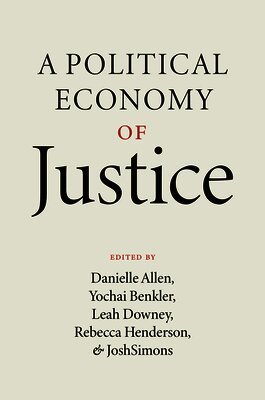
Defining a just economy in a tenuous social-political time. If we can agree that our current social-political moment is tenuous and unsustainable—and indeed, that may be the only thing we can agree on right now—then how do markets, governments, and people interact in this next era of the world? A Political Economy of Justice considers the strained state of our political economy in terms of where it can go from here. The contributors to this timely and essential volume look squarely at how normative and positive questions about political economy interact with each other—and from that beginning, how to chart a way forward to a just economy. A Political Economy of Justice collects fourteen essays from prominent scholars across the social sciences, each writing in one of three lanes: the measures of a just political economy; the role of firms; and the roles of institutions and governments. The result is a wholly original and urgent new benchmark for the next stage of our democracy.
287 kr
Skickas inom 7-10 vardagar
Defining a just economy in a tenuous social-political time. If we can agree that our current social-political moment is tenuous and unsustainable—and indeed, that may be the only thing we can agree on right now—then how do markets, governments, and people interact in this next era of the world? A Political Economy of Justice considers the strained state of our political economy in terms of where it can go from here. The contributors to this timely and essential volume look squarely at how normative and positive questions about political economy interact with each other—and from that beginning, how to chart a way forward to a just economy. A Political Economy of Justice collects fourteen essays from prominent scholars across the social sciences, each writing in one of three lanes: the measures of a just political economy; the role of firms; and the roles of institutions and governments. The result is a wholly original and urgent new benchmark for the next stage of our democracy.
260 kr
Skickas inom 7-10 vardagar
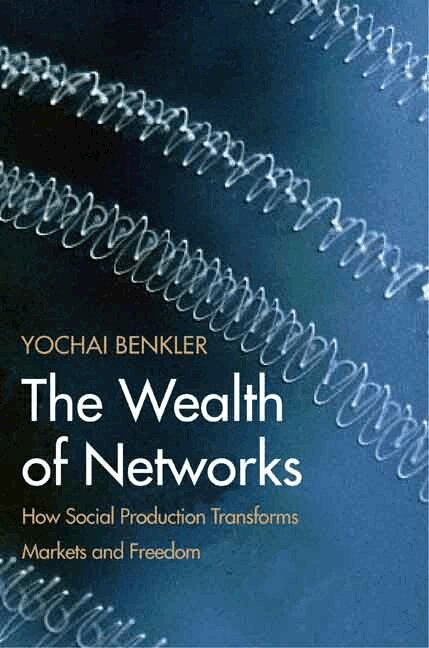
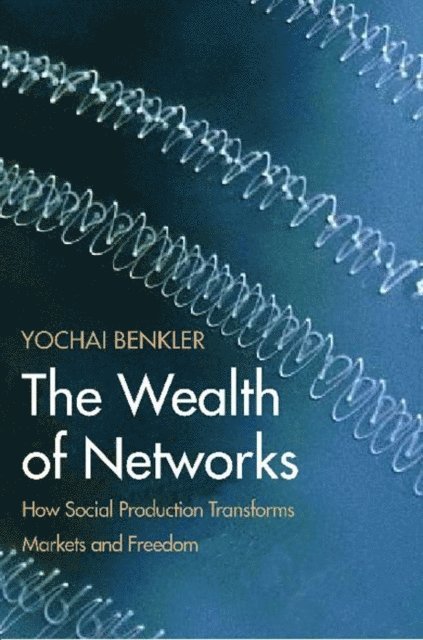
With the radical changes in information production that the Internet has introduced, we stand at an important moment of transition, says Yochai Benkler in this thought-provoking book. The phenomenon he describes as social production is reshaping markets, while at the same time offering new opportunities to enhance individual freedom, cultural diversity, political discourse, and justice. But these results are by no means inevitable: a systematic campaign to protect the entrenched industrial information economy of the last century threatens the promise of today’s emerging networked information environment.In this comprehensive social theory of the Internet and the networked information economy, Benkler describes how patterns of information, knowledge, and cultural production are changing—and shows that the way information and knowledge are made available can either limit or enlarge the ways people can create and express themselves. He describes the range of legal and policy choices that confront us and maintains that there is much to be gained—or lost—by the decisions we make today.