• Fri frakt över 249 kr
  • •
  • Snabba leveranser
  • •
  • Billiga böcker
Kundservice

Du är på sajten för privatpersoner.

Företag, bibliotek eller offentlig verksamhet?

Du handlar på classic.bokus.com, där alla dina funktioner finns intakta.
Till classic.bokus.com
Bokus logotyp. Gå till startsidan.
  • Erbjudanden
  • Nyheter
  • Student
  • Topplistor
  • Barn & ungdom
  • Bokus Play
  • E-böcker
  • Pocketböcker
  • Spel & pussel

10% rabatt på allt med kod: NYSTART10 →

Sidfot

Mina sidor

    Hjälp

    • Kundservice
    • Vanliga frågor och svar
    • Frakt och leverans
    • Retur vid ångerrätt
    • Reklamera vara
    • Betalning
    • Köpvillkor
    • Allmänna villkor
    • Information om webbplatsens tillgänglighet

    Om Bokus

    • Om oss
    • Pressrum
    • För studenter
    • För företag
    • För bibliotek och offentlig verksamhet
    • För leverantörer
    • Hållbarhet

    Populärt

    • Aktuella erbjudanden
    • Presentkort
    • Studentlitteratur
    • Nya böcker
    • Topplistor
    • Signerade böcker
    • Engelska böcker

    Inspiration

    • Boktips
    • BookTok
    • Populära bokserier
    • Barnbokskaraktärer
    • Populära författare
    Logotyp för Bokus
    Följ oss på Facebook (extern länk)Följ oss på Instagram (extern länk)Följ oss på YouTube (extern länk)Följ oss på TikTok (extern länk)
    bokus @ CookiesAnpassa cookiesIntegritetspolicyKöpvillkor
    Till Citymail hemsida (extern länk)Till Budbee hemsida (extern länk)Till Postnord hemsida (extern länk)Till Schenker hemsida (extern länk)Till Early Bird hemsida (extern länk)Till Walleys hemsida (extern länk)
    1. Samhälle och politik
    2. Politik och statsskick
    3. Statsskick och politiska processer

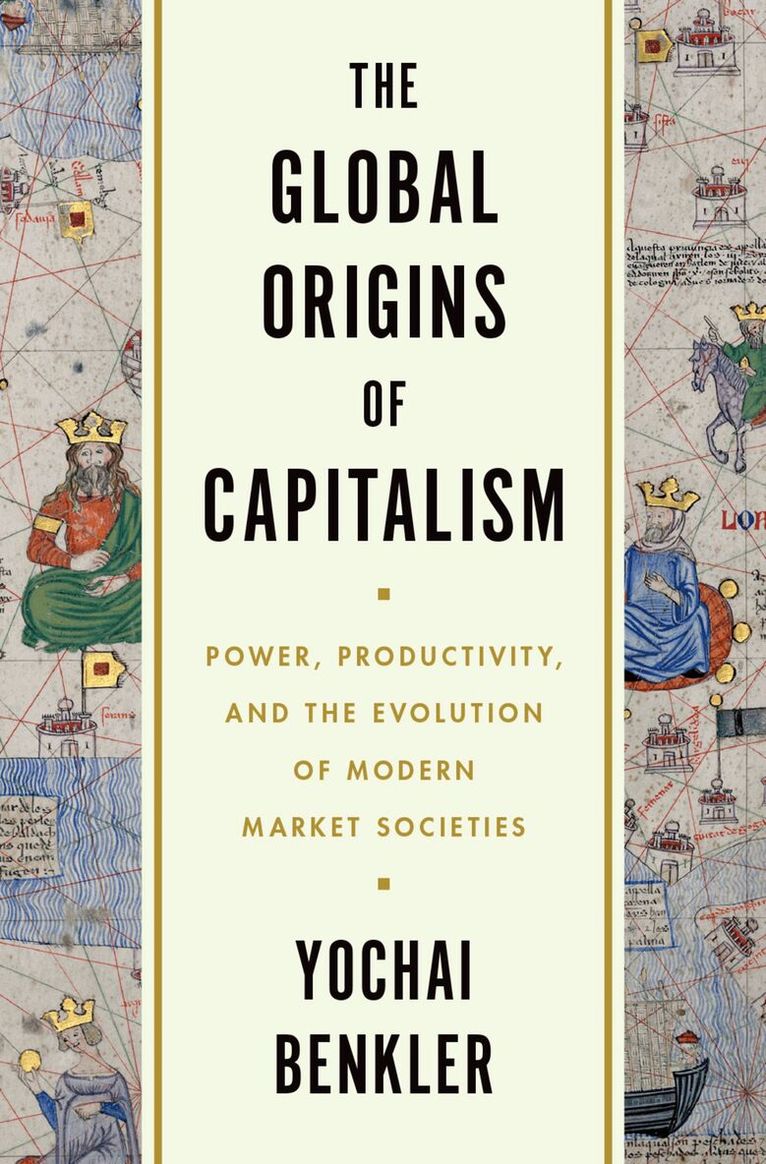
    The Global Origins of Capitalism

    Power, Productivity, and the Evolution of Modern Market Societies

    AvYochai Benkler

    Inbunden, Engelska, 2027

    380 kr

    Kommande

    Beskrivning

    A centuries-spanning tour de force that speaks directly to the present, The Global Origins of Capitalism will reshape our understanding of economic history.Democratic market societies are in crisis. Social dislocation, anomie, and global ecological collapse live side-by-side with unimaginable wealth. Alongside real global improvements in health and longevity we find ourselves buffeted by a never-ending cycle of forces beyond our power or understanding. Gradually over a thousand years, and then quickly in the blink of an historical eye, capitalism has taken over human life, transforming our social relations and very consciousness. In The Global Origins of Capitalism, Yochai Benkler describes how this out-of-human-control dynamic evolved to the point where it overwhelmed all opposition, bringing with it both unimaginable prosperity and recurring patterns of inequality and social dislocation, and why all efforts to tame it have, to this point, failed. In doing so, Benkler provides a major reinterpretation of the entire history of modern capitalism, from the founding of Baghdad--the first major proto-capitalist node in a half-globe-spanning network through which institutions and knowledge, technologies and raw materials, people and products flowed--to the present. Innovation, production, trade, and distribution have always involved creation and leveraging of power, yet power is an issue that, over time, the mainstream economics profession came to treat as secondary or even insignificant. For that reason, only a new institutional political economy, one that puts power at the core of our analysis, can help us grasp our condition and point us toward solutions. New technologies created amazing new possibilities for production, but also triggered unemployment, migration, and conflict as new ways of doing things disrupted settled ways of life, making some poor and others rich. The invention of finance made the first capitalist states the most powerful countries in the world, but also introduced the boom-bust cycles that have destabilized modern societies ever since. After charting the entire trajectory of global capitalism through this political-economic prism, Benkler closes with an analysis of our present crisis, in which the system that has governed our lives since the 1970s is collapsing around us. A centuries-spanning tour de force that speaks directly to the present, The Global Origins of Capitalism shows how economic history and political history are really one and the same.This is an open access title available under the terms of a CC BY-NC-ND 4.0 International license. It is free to read at Oxford Academic and offered as a free PDF download from OUP and selected open access locations.

    Produktinformation

    • Utgivningsdatum:2027-08-15
    • Mått:178 x 254 x undefined mm
    • Vikt:1 g
    • Format:Inbunden
    • Språk:Engelska
    • Antal sidor:1 088
    • Förlag:OUP USA
    • ISBN:9780197688182

    Utforska kategorier

    • Statsskick och politiska processer inom Samhälle och politik
    • Ekonomisk politik inom Ekonomi och Ledarskap
    • Ekonomisk historia inom Ekonomi och Ledarskap

    Mer om författaren

    Yochai Benkler is the Berkman Professor for Entrepreneurial Legal Studies at Harvard Law School, Faculty Director of the Program on Law and Political Economy at Harvard Law School, and Faculty Co-Director of the Berkman Klein Center for Internet and Society at Harvard University. He is the author, co-author, or editor of several books, including The Wealth of Networks, Network Propaganda, and The Political Economy of Justice. In the 1990s and 2000s, he played a central role in understanding information commons and decentralized collaboration to innovation, information production, and freedom in the networked economy and society. In 2012 he received a lifetime achievement award from the University of Oxford in recognition of his contribution to this field. In the 2010s, he produced leading work on networkmisinformation and propaganda. His work is socially engaged, winning him the Ford Foundation Visionaries Award in 2011, the Electronic Frontier Foundation's Pioneer Award for 2007, and the Public Knowledge IP3 Award in 2006. Benkler has advised governments and international organizations on innovation policy and telecommunications, and served on the boards of several nonprofits working towards an open society.

    Innehållsförteckning

    • Introduction: Taking Creative Destruction Seriously Chapter 1: Institutional Political Economy: Concepts and Dynamics Part I: Proto-Capitalism in the Afro-Eurasian Network: From the Founding of Baghdad to the Sack of Antwerp Chapter 2: Proto-Capitalism in the Afro-Eurasian Networks of the Islamicate Chapter 3: Italian Fulcrum: Northern Italy and Flanders Emerge on the Periphery Chapter 4: Capitalist-Imperial Symbiosis I: Pax Mongolica and the Role of Muslim and Genoese Enterprise in Mongolian Colonization of China, Persia, and Eastern Europe Chapter 5: The Afro-Eurasian Network Turns West After Mongolian Collapse and the Black Death: China, Egypt, and Italy Chapter 6: Diverging Paths of Early Modern State Formation: The Co-Evolution of State Capacity and Class Structure in Holland, England, and Germany After the Black Death Chapter 7: Capitalist-Imperial Symbiosis in the Iberian and Ottoman Expansions: Sugar, Spice, Silver, and Slaves Part II: Capitalism Reaches Escape Velocity (and Conquers the Globe) Chapter 8: Power and Productivity in the Dutch Golden Age Chapter 9: Stagnation, Colonization, and Financialization in the Declining Dutch Republic Chapter 10: Capitalism Births Liberalism and Professionalized Rule of Law: The Co-Evolution of Legitimation and Legal Structure in Capitalist Revolts Chapter 11: Capitalism, Slavery, and Racialization Chapter 12: Improved and Impoverished in the Perennial Gale Chapter 13: Law, Lobbying, and Legitimation Chapter 14: Battles, Bubbles, and Bailouts: Empire and Finance Part III: Running As Fast As We Can Just to Stay in Place: The Red Queen Dynamic Past, Present, Future Chapter 15: Variation and Adaptation: Authoritarian Corporatism, Social Democracy, and Postcolonial Development and Underdevelopment Chapter 16: Harnessing the Red Queen Dynamic: Twentieth Century Lessons on How to Create a High-Road Productivity Growth Model, and How to Lose It Chapter 17: A Way Forward: Real Freedom in Socialized Markets Notes Index