Yohan Yoo - Böcker
Visar alla böcker från författaren Yohan Yoo. Handla med fri frakt och snabb leverans.
7 produkter
7 produkter
2 098 kr
Skickas inom 10-15 vardagar
This collaboration between two scholars from different fields of religious studies draws on three comparative data sets to develop a new theory of purity and pollution in religion, arguing that a culture’s beliefs about cosmological realms shapes its pollution ideas and its purification practices.The authors of this study refine Mary Douglas’ foundational theory of pollution as "matter out of place," using a comparative approach to make the case that a culture’s cosmology designates which materials in which places constitute pollution. By bringing together a historical comparison of Ancient Near Eastern and Mediterranean religions, an ethnographic study of indigenous shamanism on Jeju Island, Korea, and the reception history of biblical rhetoric about pollution in Jewish and Christian cultures, the authors show that a cosmological account of purity works effectively across multiple disparate religious and cultural contexts. They conclude that cosmologies reinforce fears of pollution, and also that embodied experiences of purification help generate cosmological ideas.Providing an innovative insight into a key topic of ritual studies, this book will be of vital interest to scholars and graduate students in religion, biblical studies, and anthropology.
579 kr
Skickas inom 10-15 vardagar
This collaboration between two scholars from different fields of religious studies draws on three comparative data sets to develop a new theory of purity and pollution in religion, arguing that a culture’s beliefs about cosmological realms shapes its pollution ideas and its purification practices.The authors of this study refine Mary Douglas’ foundational theory of pollution as "matter out of place," using a comparative approach to make the case that a culture’s cosmology designates which materials in which places constitute pollution. By bringing together a historical comparison of Ancient Near Eastern and Mediterranean religions, an ethnographic study of indigenous shamanism on Jeju Island, Korea, and the reception history of biblical rhetoric about pollution in Jewish and Christian cultures, the authors show that a cosmological account of purity works effectively across multiple disparate religious and cultural contexts. They conclude that cosmologies reinforce fears of pollution, and also that embodied experiences of purification help generate cosmological ideas.Providing an innovative insight into a key topic of ritual studies, this book will be of vital interest to scholars and graduate students in religion, biblical studies, and anthropology.
1 024 kr
Skickas
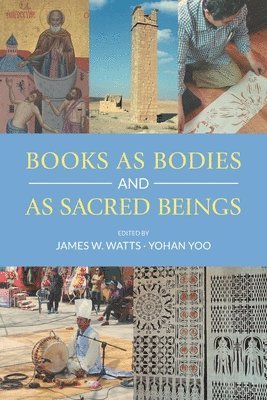
Human cultures, especially religious groups but also secular artists and performers, often ritualize bodies as sacred books and books as divine beings. An international team of scholars addresses this theme of books as sacred beings in this volume through an impressively diverse range of primary material and perspectives. These studies show the wide variety of ways in which books, bodies, and beings intermingle in material sacred texts manipulated by human bodies, and also in literary and artistic depictions of transcendent textual bodies. The boundary between material immanence and spiritual transcendence turns out to be very thin indeed when people use books. The chapters on specific book practices in different cultures are bracketed by an introduction to the collection and by a concluding essay that extrapolates on the widespread theme of books as sacred beings.
479 kr
Skickas inom 5-8 vardagar
Human cultures, especially religious groups but also secular artists and performers, often ritualize bodies as sacred books and books as divine beings. An international team of scholars addresses this theme of books as sacred beings in this volume through an impressively diverse range of primary material and perspectives. These studies show the wide variety of ways in which books, bodies, and beings intermingle in material sacred texts manipulated by human bodies, and also in literary and artistic depictions of transcendent textual bodies. The boundary between material immanence and spiritual transcendence turns out to be very thin indeed when people use books. The chapters on specific book practices in different cultures are bracketed by an introduction to the collection and by a concluding essay that extrapolates on the widespread theme of books as sacred beings.
1 177 kr
Skickas inom 5-8 vardagar
This book examines the ways in which scriptures are accepted and appropriated by religious people in Korea. It explores how sacred texts in various religions, including Protestantism, Buddhism, Confucianism, and Shamanism, attain their sacred status and power. It also delves into how the performative aspect of scriptures is often intrinsically linked to their iconic status. The book highlights the close relationship between the performative use and the iconic nature of these scriptures, showing how they are ritualized and performed in religious practices. In Korea, a distinct mix of religions coexists, each contributing to the country's religious diversity. Christianity, as the largest religion, represents a significant portion of the population, yet Buddhism, as Korea's major traditional religion, holds a comparable influence. Confucianism, with its deep historical roots and impact on Korean customs and values, continues to shape the society, particularly through ancestral rites and customs that prioritize elders. Many contemporary Koreans still resort to shamanic rituals and divinations, which have prevailed among the common people for thousands of years. Examples from these religions in Korea vividly illustrate that the iconic and performative dimensions of scriptures are generally witnessed in religions that recognize sacred texts. The interplay and complementary functions of these dimensions in the lives of the religious are also examined. The book presents compelling examples showing how the content, physical form, recitations, written characters, and imagery of scriptures are ritualized to exert sacred power
372 kr
Skickas
This book examines the ways in which scriptures are accepted and appropriated by religious people in Korea. It explores how sacred texts in various religions, including Protestantism, Buddhism, Confucianism, and Shamanism, attain their sacred status and power. It also delves into how the performative aspect of scriptures is often intrinsically linked to their iconic status. The book highlights the close relationship between the performative use and the iconic nature of these scriptures, showing how they are ritualized and performed in religious practices. In Korea, a distinct mix of religions coexists, each contributing to the country's religious diversity. Christianity, as the largest religion, represents a significant portion of the population, yet Buddhism, as Korea's major traditional religion, holds a comparable influence. Confucianism, with its deep historical roots and impact on Korean customs and values, continues to shape the society, particularly through ancestral rites and customs that prioritize elders. Many contemporary Koreans still resort to shamanic rituals and divinations, which have prevailed among the common people for thousands of years. Examples from these religions in Korea vividly illustrate that the iconic and performative dimensions of scriptures are generally witnessed in religions that recognize sacred texts. The interplay and complementary functions of these dimensions in the lives of the religious are also examined. The book presents compelling examples showing how the content, physical form, recitations, written characters, and imagery of scriptures are ritualized to exert sacred power
1 900 kr
Skickas inom 10-15 vardagar
This volume project explores how evolving values and identities in contemporary Korean society are interpreted, particularly through the lens of religion, positioning it as a window into Korea’s dynamic cultural and social landscape.