Yonatan Y. Brafman - Böcker
Visar alla böcker från författaren Yonatan Y. Brafman. Handla med fri frakt och snabb leverans.
2 produkter
2 produkter
1 064 kr
Skickas inom 5-8 vardagar
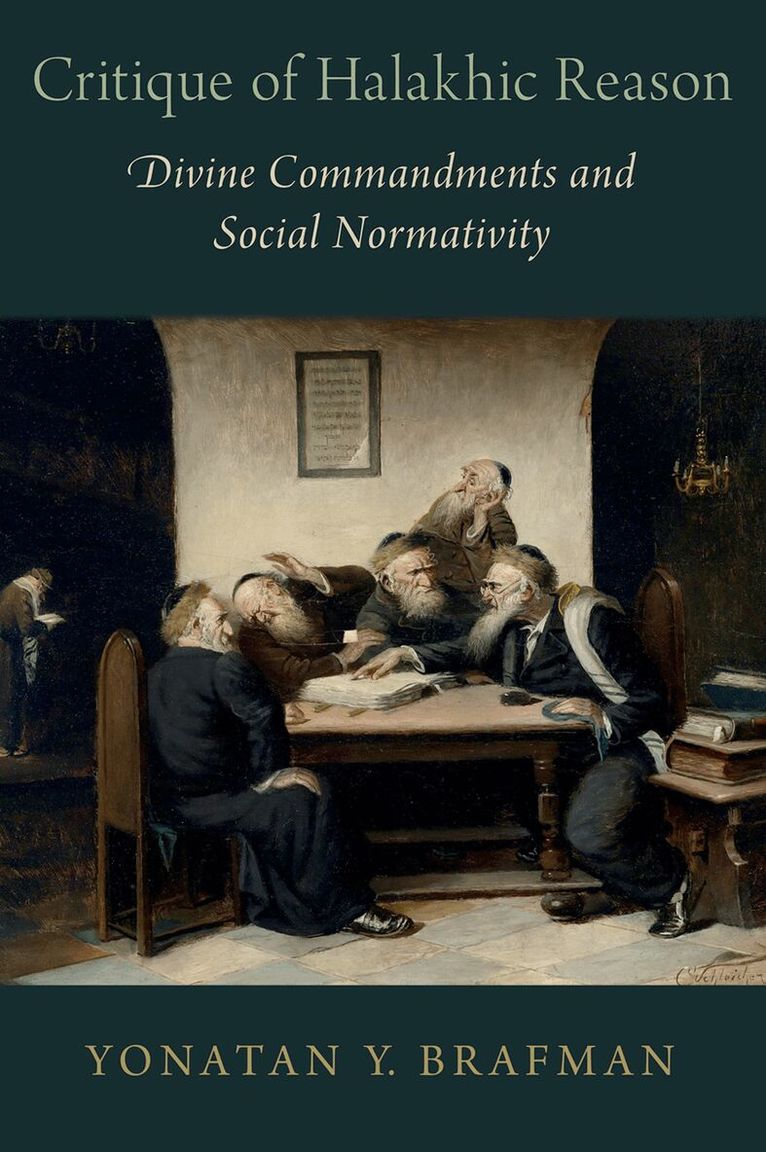
Norms and obligations are central components of many religious traditions. Yet they have often been neglected as objects of reflection in the study of religion relative to belief, experience, and even the related category of ritual. More surprisingly, despite the centrality of mitzvah (commandment) in Judaism, halakhah (Jewish law) has only recently become a central topic in modern Jewish thought. This book rectifies these deficiencies while forging new connections between reflection on religion and modern Jewish thought by offering what it calls a critique of halakhic reason. Such a critique delineates the rational constraints on the justification of the commandments and the practical consequences for their jurisprudence. It also asks whether uniquely "religious reasons" even exist and draws conclusions for several areas of study. Critique of Halakhic Reason offers fresh assessments of twentieth century Jewish thinkers, including Joseph Soloveitchik, Yeshayahu Leibowitz, and Eliezer Berkovits, as deeply engaged in reason-giving about the commandments yet simultaneously denying the normativity of practical reason. Against them, it contends that, when reasons are understood as generated by the structure of agency and the relations among subjects, they are the source of normativity. This constructivist theory of practical reason provides a basis for conceptions of authority, norms, and obligations that are applicable even to God's commands. Divine commandments too operate within a "space of reasons," and so are constrained by rationality and morality. Whether commandments are justified and how they are implemented depends on the reasons offered for and against them by humans. Reasons and practices of reason-giving are thus central to religious thought and life. Yonatan Y. Brafman examines the reasoning operative in the justification and jurisprudence of the Jewish commandments, and develops the consequences of reasoning for the study and philosophy of religion.
1 342 kr
Skickas inom 3-6 vardagar
New Perspectives on Jewish Law combines the detailed work characteristic of scholarship on Jewish law with an orientation towards its broader academic and cultural significance. It shifts the study of Jewish law from its focus on legal doctrine and history to legal theory, achieving in the process a more sophisticated understanding of law that will benefit both the legal academy and Jewish studies. By employing the framework of legal theory, it similarly corrects an over-emphasis on the metaphysical presuppositions and philosophical implications of Jewish law, which has tended to cast it as exceptional relative to other legal systems. Moreover, it answers to old-new anxieties about law, often symbolized by Judaism, raised by contemporary feminists and by philosophers who are animated by recent interpretations of Paul through actual engagement with the Jewish legal tradition. The volume consists of three parts. The first focuses on the critique of positivism, its implications, and the new directions that it opens up for the analysis of Jewish law. The second part takes stock of recent methodological developments in the study of Jewish legal texts and investigates the relation between Jewish law and the disciplines, including history, literary theory, ritual studies, the digital humanities, as well as traditional approaches to Jewish learning. It concludes with a reflection on these interdisciplinary contributions from the perspective of legal theory. The third part explores the connections among Jewish law, philosophy, and culture critique. It assesses the relation or lack thereof between Jewish law and modern Jewish thought, and examines specific issues of philosophical interest, including truth and normativity. It also investigates the image of Jewish law in the contemporary critique of law as well as how Jewish law could productively contribute to that debate. It concludes with a reflection on these studies from the perspective of philosophy of law.