
Yueduan Wang - Böcker
Visar alla böcker från författaren Yueduan Wang. Handla med fri frakt och snabb leverans.
3 produkter
3 produkter
Del 472 - Harvard East Asian Monographs
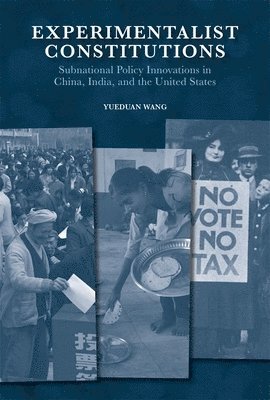
Experimentalist Constitutions
Subnational Policy Innovations in China, India, and the United States
Inbunden, Engelska, 2024
332 kr
Skickas inom 7-10 vardagar
One of the most commonly cited virtues of American federalism is its “laboratories of democracy”—the notion that decentralization and political competition encourage states to become testing grounds for novel social policies and ideas. In Experimentalist Constitutions, the first book that systematically compares subnational experimentalism in different countries, Yueduan Wang argues that the idea of federal laboratories is not exclusive to the American system; instead, similar concepts can be applied to constitutions with different center-local structures and levels of political competition. Using case studies from China, India, and the United States, the book illustrates that these vastly different polities have instituted their own mechanisms of subnational experimentalism based on the interactions between each country’s constitutional system and partisan/factional dynamics. In this study, Wang compares and contrasts these three versions of policy laboratories and comments on their pros and cons, thus contributing to the discussion of these great powers’ competing models of development.
- Nyhet

392 kr
Kommande
The New Dual State examines how regimes can institutionalize judicial autonomy without relinquishing ultimate political control. Revising the dual state theory beyond its classical and contemporary formulations, the book proposes the theory of symbiotic dualism, which argues that the consolidation of political authority can clarify and stabilize the boundary between legal order and extralegal authority, thereby permitting limited judicial independence. Using China as the central case, the book shows how political centralization enabled the regime to insulate judges from local officials, suppress unsanctioned extrajudicial interventions, and channel politically sensitive disputes away from the courts. These measures have produced a system in which courts demonstrate increasing professionalism and autonomy in routine cases, while the regime retains decisive authority over politically salient matters. Grounded in extensive fieldwork and framed by comparative legal theory, the book advances a compelling framework for understanding legality outside the context of liberal democracies.
- Nyhet

1 191 kr
Kommande
The New Dual State examines how regimes can institutionalize judicial autonomy without relinquishing ultimate political control. Revising the dual state theory beyond its classical and contemporary formulations, the book proposes the theory of symbiotic dualism, which argues that the consolidation of political authority can clarify and stabilize the boundary between legal order and extralegal authority, thereby permitting limited judicial independence. Using China as the central case, the book shows how political centralization enabled the regime to insulate judges from local officials, suppress unsanctioned extrajudicial interventions, and channel politically sensitive disputes away from the courts. These measures have produced a system in which courts demonstrate increasing professionalism and autonomy in routine cases, while the regime retains decisive authority over politically salient matters. Grounded in extensive fieldwork and framed by comparative legal theory, the book advances a compelling framework for understanding legality outside the context of liberal democracies.