Yukio Adachi - Böcker
Visar alla böcker från författaren Yukio Adachi. Handla med fri frakt och snabb leverans.
3 produkter
3 produkter
1 569 kr
Skickas inom 7-10 vardagar
While studies of policy analysis in other countries have assessed their needs and integrated them into training programmes for professional policy analysts, Japanese studies have been very limited. Policy analysis in Japan brings together for the first time a detailed examination of the theory and practice of policy analysis systems in Japan, at different levels. As part of the successful International Library of Policy Analysis series edited by Iris Geva-May and Michael Howlett, the book provides expert analysis to closely examine to what extent the Japanese government has succeeded in providing key policy actors with evidence-informed policy options, thereby improving the likelihood of better policies being adopted and implemented. The book also assesses Japan’s future policy directions, allowing policy researchers and practitioners to draw a number of lessons from the Japanese experience. The book includes empirical case studies to aid teaching and further research, and will be a valuable resource for students and academics as well as policymakers.Features of the ILPA series include:•a country-specific systematic study of policy analysis systems by government and non-governmental actors •a history of the country’s policy analysis, empirical case studies and a comparative overview of alternative approaches•a key reference collection for research and teaching in comparative policy analysis and policy studies
1 694 kr
Skickas inom 10-15 vardagar
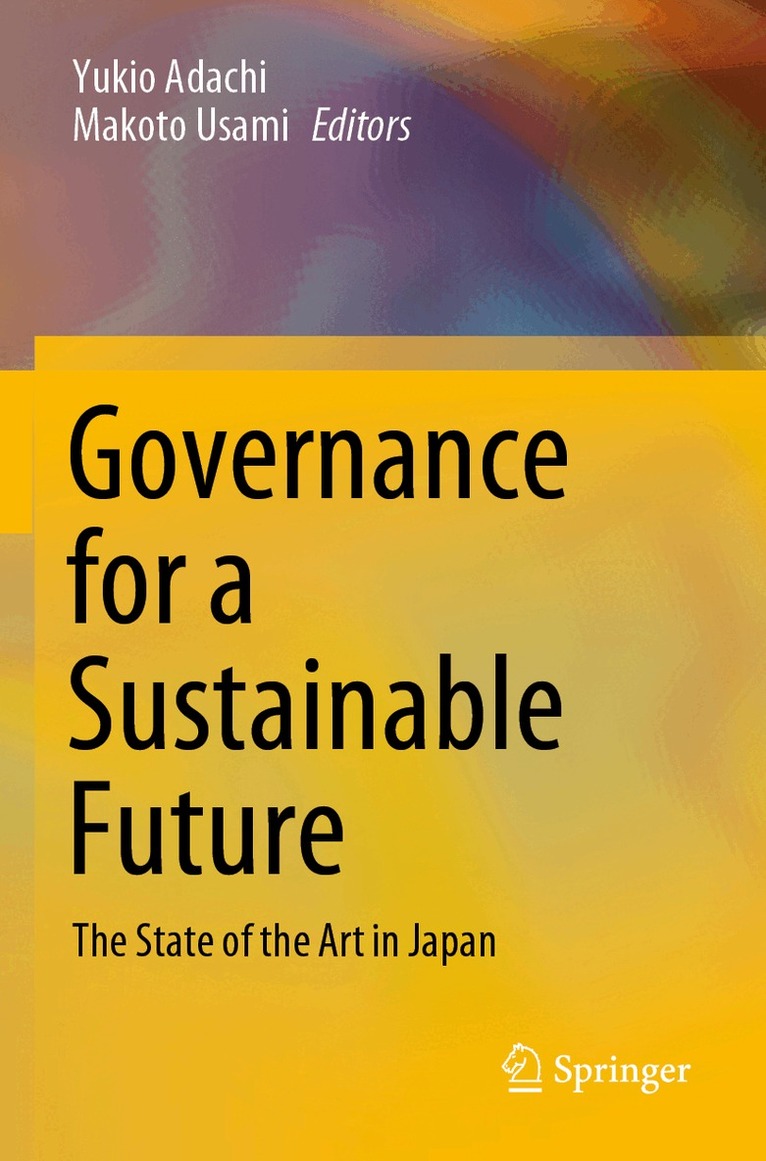
Although the expression “responsibility to future generations” is firmly established in public and political vocabulary, its operational meaning and practice are inadequately understood and yet to be systematically evaluated. Moreover, the term has not been successfully translated into viable ethical and theoretical concepts that can guide public policies and actions. How can the modes of governance and established policy priorities become compatible with the well-being of future generations? The primary objective of this book is to identify the conditions of and obstacles to governance for a sustainable future, or future-regarding governance. Governance concerns steering a society over extended periods of time, not responding to particular policy issues. The ideas and strategies proposed by contributors in this book to establish future-regarding governance are based on the theoretical and empirical analyses of the major long-term problems facing advanced democracies in general, and Japan in particular. Japan is an interesting case indeed. Relatively poor climate policy, rapidly decreasing birth rate, aging population, extensive public debt, prolonged economic recession, healthcare and pension systems that urgently require redesigning, hollowing-out of industries and subsequent loss of jobs, deteriorating infrastructures, increasing nuclear waste, and intensifying social polarization have caused a decline in people’s trust in the government and democratic processes. Currently, Japanese citizens are widely circulating their doubts about the social system’s sustainability. This book comprises two parts. In Part I, authors from various disciplinary backgrounds examine the idea of governance for a sustainable future from theoretical perspectives. This part discusses issues associated with future-regarding governance that are wicked in nature, such as the philosophical/ethical foundation on which to base the idea of governance for a sustainable future, major impediments to the development of future-regarding governance, and the modes of thinking and action required by leaders and citizens to realize such governance. Chapters in Part II largely focus on the state of long-term governance in Japan. This part uses empirical and in-depth analyses with cross-sectoral and cross-national policy perspectives to identify the state of future-regarding governance in various policy fields and major sectors or organizations mainly in Japan, while also examining strategies and measures to improve their performance. From this perspective, Western democracies and weak democratic regimes elsewhere will be provided with valuable lessons to avoid fatal policy mistakes, thereby improving future-oriented governance worldwide. By combining theoretical discussions on far-reaching issues and empirical analyses of Japanese cases, the book will shed a new light on governance for a sustainable future.
1 694 kr
Skickas inom 10-15 vardagar
Although the expression “responsibility to future generations” is firmly established in public and political vocabulary, its operational meaning and practice are inadequately understood and yet to be systematically evaluated. Moreover, the term has not been successfully translated into viable ethical and theoretical concepts that can guide public policies and actions. How can the modes of governance and established policy priorities become compatible with the well-being of future generations? The primary objective of this book is to identify the conditions of and obstacles to governance for a sustainable future, or future-regarding governance. Governance concerns steering a society over extended periods of time, not responding to particular policy issues. The ideas and strategies proposed by contributors in this book to establish future-regarding governance are based on the theoretical and empirical analyses of the major long-term problems facing advanced democracies in general, and Japan in particular. Japan is an interesting case indeed. Relatively poor climate policy, rapidly decreasing birth rate, aging population, extensive public debt, prolonged economic recession, healthcare and pension systems that urgently require redesigning, hollowing-out of industries and subsequent loss of jobs, deteriorating infrastructures, increasing nuclear waste, and intensifying social polarization have caused a decline in people’s trust in the government and democratic processes. Currently, Japanese citizens are widely circulating their doubts about the social system’s sustainability. This book comprises two parts. In Part I, authors from various disciplinary backgrounds examine the idea of governance for a sustainable future from theoretical perspectives. This part discusses issues associated with future-regarding governance that are wicked in nature, such as the philosophical/ethical foundation on which to base the idea of governance for a sustainable future, major impediments to the development of future-regarding governance, and the modes of thinking and action required by leaders and citizens to realize such governance. Chapters in Part II largely focus on the state of long-term governance in Japan. This part uses empirical and in-depth analyses with cross-sectoral and cross-national policy perspectives to identify the state of future-regarding governance in various policy fields and major sectors or organizations mainly in Japan, while also examining strategies and measures to improve their performance. From this perspective, Western democracies and weak democratic regimes elsewhere will be provided with valuable lessons to avoid fatal policy mistakes, thereby improving future-oriented governance worldwide. By combining theoretical discussions on far-reaching issues and empirical analyses of Japanese cases, the book will shed a new light on governance for a sustainable future.